QUESTION IMAGE
Question
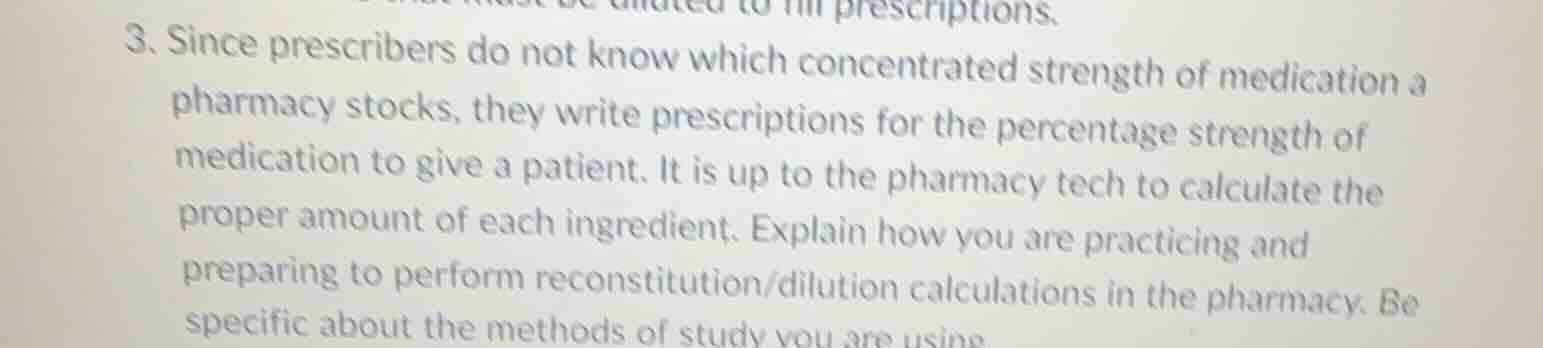
- since prescribers do not know which concentrated strength of medication a pharmacy stocks, they write prescriptions for the percentage strength of medication to give a patient. it is up to the pharmacy tech to calculate the proper amount of each ingredient. explain how you are practicing and preparing to perform reconstitution/dilution calculations in the pharmacy. be specific about the methods of study you are using.
To practice dilution/reconstitution calculations, first, recall the formula \( C_1V_1 = C_2V_2 \) (where \( C \) is concentration, \( V \) is volume). Study by solving sample problems: e.g., if a drug has a stock concentration \( C_1 \), desired concentration \( C_2 \), find \( V_1 \) or \( V_2 \). Use textbooks (like pharmacy tech calculation guides) and online practice quizzes. Review unit conversions (mg to g, mL to L) as they’re key. Create flashcards for formulas and common concentrations. Practice daily with different scenarios (oral, IV medications) to build accuracy and speed. This ensures applying the formula correctly, checking units, and verifying answers by cross - calculating.

Snap & solve any problem in the app
Get step-by-step solutions on Sovi AI
Photo-based solutions with guided steps
Explore more problems and detailed explanations
To practice reconstitution/dilution calculations: 1. Learn the formula \( C_1V_1 = C_2V_2 \) (concentration - volume relationship). 2. Use pharmacy calculation textbooks and online quizzes for sample problems (e.g., find volume of stock solution needed for a desired concentration). 3. Master unit conversions (e.g., mg to g, mL to L) as they are crucial. 4. Create flashcards for formulas and common drug concentrations. 5. Practice daily with various medication scenarios (oral, IV) to improve accuracy and speed, verifying answers via cross - calculation.