QUESTION IMAGE
Question
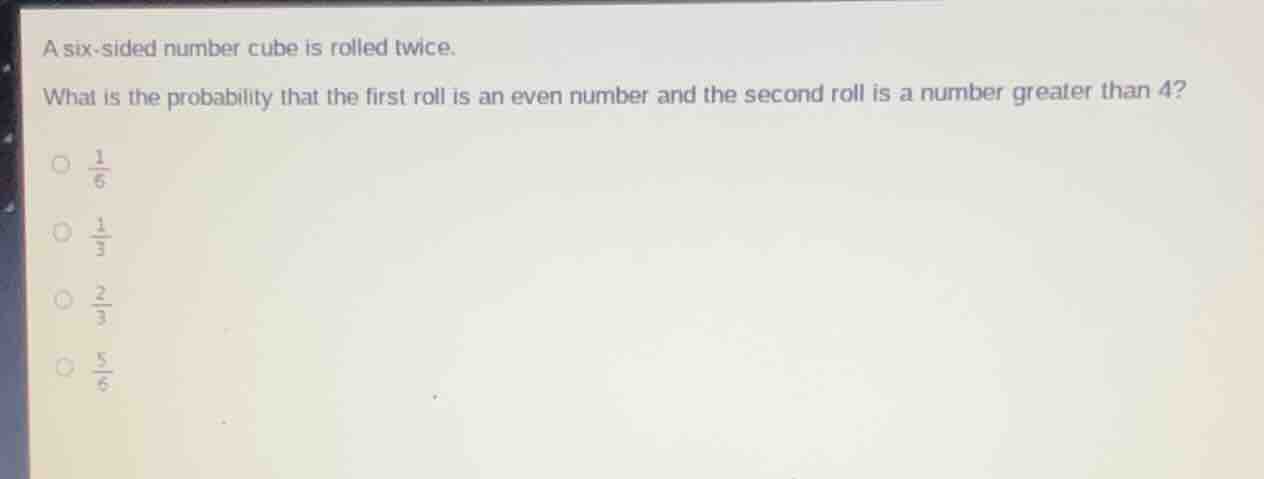
a six - sided number cube is rolled twice. what is the probability that the first roll is an even number and the second roll is a number greater than 4? \\(\frac{1}{6}\\) \\(\frac{1}{3}\\) \\(\frac{2}{3}\\) \\(\frac{5}{6}\\)
Step1: Find probability of first roll (even)
A six - sided cube has numbers 1, 2, 3, 4, 5, 6. Even numbers are 2, 4, 6 (3 numbers). Probability \( P(\text{first even})=\frac{3}{6}=\frac{1}{2} \).
Step2: Find probability of second roll ( > 4)
Numbers greater than 4 are 5, 6 (2 numbers). Probability \( P(\text{second > 4})=\frac{2}{6}=\frac{1}{3} \).
Step3: Multiply probabilities (independent events)
Since the two rolls are independent, \( P(\text{first even and second > 4}) = P(\text{first even})\times P(\text{second > 4})=\frac{1}{2}\times\frac{1}{3}=\frac{1}{6} \)? Wait, no, wait. Wait, 3 even numbers: 2,4,6 (correct), so \( \frac{3}{6}=\frac{1}{2} \). Numbers greater than 4: 5,6 (2 numbers), so \( \frac{2}{6}=\frac{1}{3} \). Then \( \frac{1}{2}\times\frac{1}{3}=\frac{1}{6} \)? But wait, let's re - check. Wait, 3 even numbers out of 6: probability \( \frac{3}{6}=\frac{1}{2} \). Numbers greater than 4: 5 and 6, so 2 numbers out of 6: \( \frac{2}{6}=\frac{1}{3} \). Multiplying them: \( \frac{1}{2}\times\frac{1}{3}=\frac{1}{6} \). But wait, the options have \( \frac{1}{6} \) as the first option. Wait, but let me check again. Wait, maybe I made a mistake. Wait, first roll: even numbers are 2,4,6 (3 numbers), so probability \( \frac{3}{6}=\frac{1}{2} \). Second roll: numbers greater than 4 are 5,6 (2 numbers), probability \( \frac{2}{6}=\frac{1}{3} \). Then the combined probability is \( \frac{1}{2}\times\frac{1}{3}=\frac{1}{6} \). So the correct answer is \( \frac{1}{6} \), which is the first option.
Wait, but wait, maybe I messed up the second probability. Wait, numbers greater than 4: 5 and 6, so 2 numbers. So \( \frac{2}{6}=\frac{1}{3} \). First probability: \( \frac{3}{6}=\frac{1}{2} \). Multiply: \( \frac{1}{2}\times\frac{1}{3}=\frac{1}{6} \). So the answer is \( \frac{1}{6} \), which is the first option.

Snap & solve any problem in the app
Get step-by-step solutions on Sovi AI
Photo-based solutions with guided steps
Explore more problems and detailed explanations
\(\frac{1}{6}\) (corresponding to the option \(\boldsymbol{\frac{1}{6}}\))