QUESTION IMAGE
Question
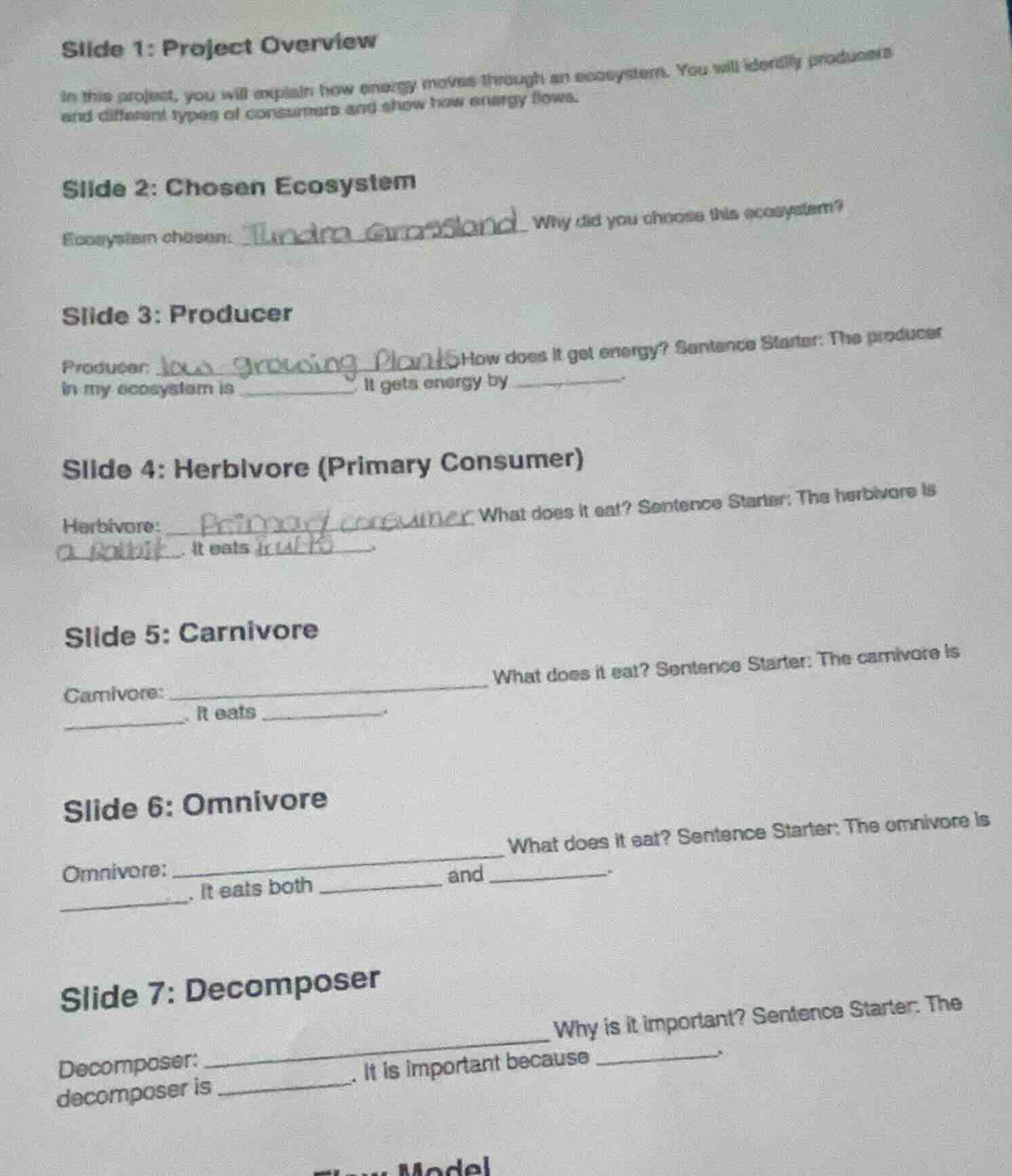
slide 1: project overview
in this project, you will explain how energy moves through an ecosystem. you will identify producers
and different types of consumers and show how energy flows.
slide 2: chosen ecosystem
ecosystem chosen: tundra grassland. why did you choose this ecosystem?
slide 3: producer
producer: low growing plants. how does it get energy? sentence starter: the producer
in my ecosystem is ____. it gets energy by ____.
slide 4: herbivore (primary consumer)
herbivore: primary consumer (a rabbit). what does it eat? sentence starter: the herbivore is
a rabbit... it eats grass.
slide 5: carnivore
carnivore: ______ what does it eat? sentence starter: the carnivore is
____. it eats ____.
slide 6: omnivore
omnivore: ______ what does it eat? sentence starter: the omnivore is
____. it eats both __ and ____.
slide 7: decomposer
decomposer: ______ why is it important? sentence starter: the
decomposer is ____. it is important because ____.
To complete this project on energy flow in a tundra grassland ecosystem, we'll fill in each slide with appropriate examples and explanations:
Slide 2: Chosen Ecosystem
- Ecosystem chosen: Tundra Grassland
- Why: I chose the tundra grassland because it has a unique, cold - climate - adapted community of organisms, and studying energy flow here can show how life persists in harsh conditions.
Slide 3: Producer
- Producer: Arctic Moss (or other tundra plants like lichens)
- Sentence: The producer in my ecosystem is Arctic Moss. It gets energy by performing photosynthesis, using sunlight, carbon dioxide, and water to make glucose (chemical energy).
Slide 4: Herbivore (Primary Consumer)
- Herbivore: Arctic Hare
- Sentence: The herbivore is an Arctic Hare. It eats Arctic Moss (or other tundra grasses/lichen).
Slide 5: Carnivore
- Carnivore: Arctic Fox
- Sentence: The carnivore is an Arctic Fox. It eats Arctic Hares (and other small tundra animals like lemmings).
Slide 6: Omnivore
- Omnivore: Grizzly Bear (some grizzlies range into tundra areas)
- Sentence: The omnivore is a Grizzly Bear. It eats both plants (like berries or roots in tundra - adjacent areas) and animals (like fish or small mammals).
Slide 7: Decomposer
- Decomposer: Fungi (like tundra - adapted fungi)
- Sentence: The decomposer is a type of tundra - adapted Fungi. It is important because it breaks down dead organisms (like dead plants and animals) and recycles nutrients back into the soil, which helps producers grow.
These answers are based on the typical organisms found in a tundra grassland ecosystem and the roles they play in energy flow (producers make energy via photosynthesis, consumers eat other organisms, decomposers recycle nutrients).

Snap & solve any problem in the app
Get step-by-step solutions on Sovi AI
Photo-based solutions with guided steps
Explore more problems and detailed explanations
To complete this project on energy flow in a tundra grassland ecosystem, we'll fill in each slide with appropriate examples and explanations:
Slide 2: Chosen Ecosystem
- Ecosystem chosen: Tundra Grassland
- Why: I chose the tundra grassland because it has a unique, cold - climate - adapted community of organisms, and studying energy flow here can show how life persists in harsh conditions.
Slide 3: Producer
- Producer: Arctic Moss (or other tundra plants like lichens)
- Sentence: The producer in my ecosystem is Arctic Moss. It gets energy by performing photosynthesis, using sunlight, carbon dioxide, and water to make glucose (chemical energy).
Slide 4: Herbivore (Primary Consumer)
- Herbivore: Arctic Hare
- Sentence: The herbivore is an Arctic Hare. It eats Arctic Moss (or other tundra grasses/lichen).
Slide 5: Carnivore
- Carnivore: Arctic Fox
- Sentence: The carnivore is an Arctic Fox. It eats Arctic Hares (and other small tundra animals like lemmings).
Slide 6: Omnivore
- Omnivore: Grizzly Bear (some grizzlies range into tundra areas)
- Sentence: The omnivore is a Grizzly Bear. It eats both plants (like berries or roots in tundra - adjacent areas) and animals (like fish or small mammals).
Slide 7: Decomposer
- Decomposer: Fungi (like tundra - adapted fungi)
- Sentence: The decomposer is a type of tundra - adapted Fungi. It is important because it breaks down dead organisms (like dead plants and animals) and recycles nutrients back into the soil, which helps producers grow.
These answers are based on the typical organisms found in a tundra grassland ecosystem and the roles they play in energy flow (producers make energy via photosynthesis, consumers eat other organisms, decomposers recycle nutrients).