QUESTION IMAGE
Question
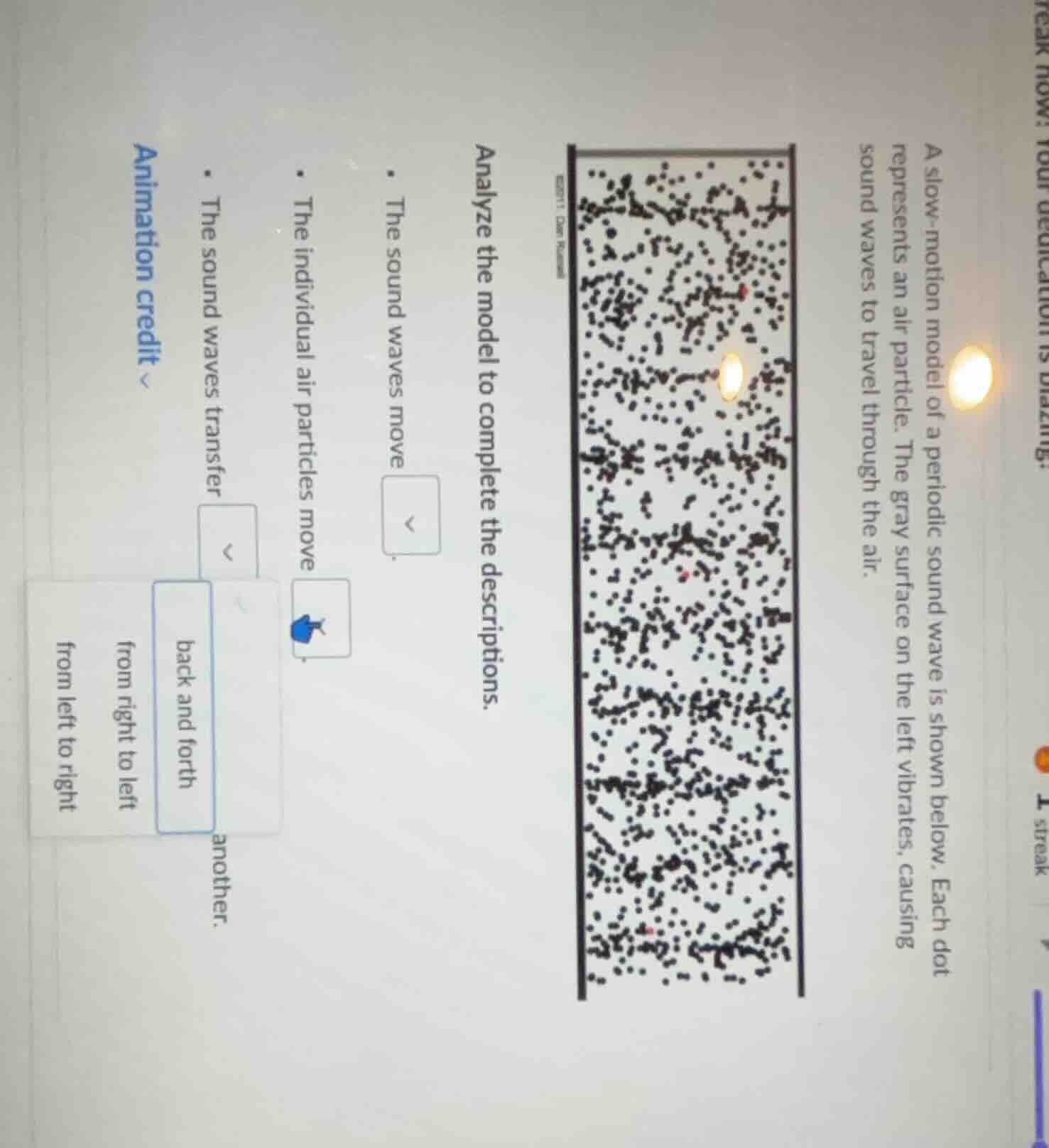
a slow - motion model of a periodic sound wave is shown below. each dot represents an air particle. the gray surface on the left vibrates, causing sound waves to travel through the air. analyze the model to complete the descriptions. - the sound waves move
- the individual air particles move
- the sound waves transfer
animation credit
options for sound waves move: (dropdown), for individual air particles move: (with a blue icon), for sound waves transfer: (dropdown with options back and forth, from right to left, from left to right) and another.
For "The sound waves move":
Sound waves are longitudinal waves. In a longitudinal wave, the wave (energy transfer) moves in the direction of particle oscillation. The vibrating source (left - side gray surface) creates a disturbance that propagates. Since the air particles oscillate back - and - forth (as we'll see for the particle motion), the sound wave (the disturbance) moves from the source (left) to the right (through the air). So the sound waves move from left to right.
For "The individual air particles move":
In a longitudinal sound wave, air particles oscillate back and forth parallel to the direction of wave propagation. They don't move along with the wave (like a transverse wave's particle motion is perpendicular, but here it's longitudinal). So individual air particles move back and forth.
For "The sound waves transfer":
Sound waves transfer energy. The vibrating source (the gray surface) imparts energy to the air particles. These particles then transfer this energy to neighboring particles as they oscillate back - and - forth, and this energy transfer is what the sound wave is. So the sound waves transfer energy (though in the given options, the relevant motion - related transfer direction for the wave's effect is that the wave moves from left to right, and the energy transfer is along with the wave's propagation direction, but in terms of the particle - related transfer of the wave's disturbance, the wave moves from left to right and the particles oscillate back - and - forth to transfer the wave's energy).

Snap & solve any problem in the app
Get step-by-step solutions on Sovi AI
Photo-based solutions with guided steps
Explore more problems and detailed explanations
s:
- The sound waves move: from left to right
- The individual air particles move: back and forth
- The sound waves transfer: (the energy transfer is associated with the wave moving from left to right, and the particles transferring energy as they oscillate, but in the context of the given options for motion - related transfer, the wave moves from left to right and the particles move back and forth to transfer the wave's disturbance/energy)
If we are to fill in the dropdowns as per the options:
For "The sound waves move": from left to right
For "The individual air particles move": back and forth
For "The sound waves transfer": (assuming the transfer is of energy, but in the given options' context, the wave moves from left to right, and the particles' back - and - forth motion transfers the wave's effect. If we consider the direction of the wave's propagation (which is the direction of energy transfer in longitudinal waves), the sound waves transfer (the disturbance/energy) from left to right, and the particles move back - and - forth to facilitate this transfer.
Final Answers (filling the dropdowns):
- The sound waves move: \(\boldsymbol{\text{from left to right}}\)
- The individual air particles move: \(\boldsymbol{\text{back and forth}}\)
- The sound waves transfer: (the wave's motion is from left to right, and the energy transfer is associated with this, with particles moving back - and - forth to transfer the wave's energy. If we follow the options' motion - related choices, the wave moves from left to right, particles move back - and - forth)