QUESTION IMAGE
Question
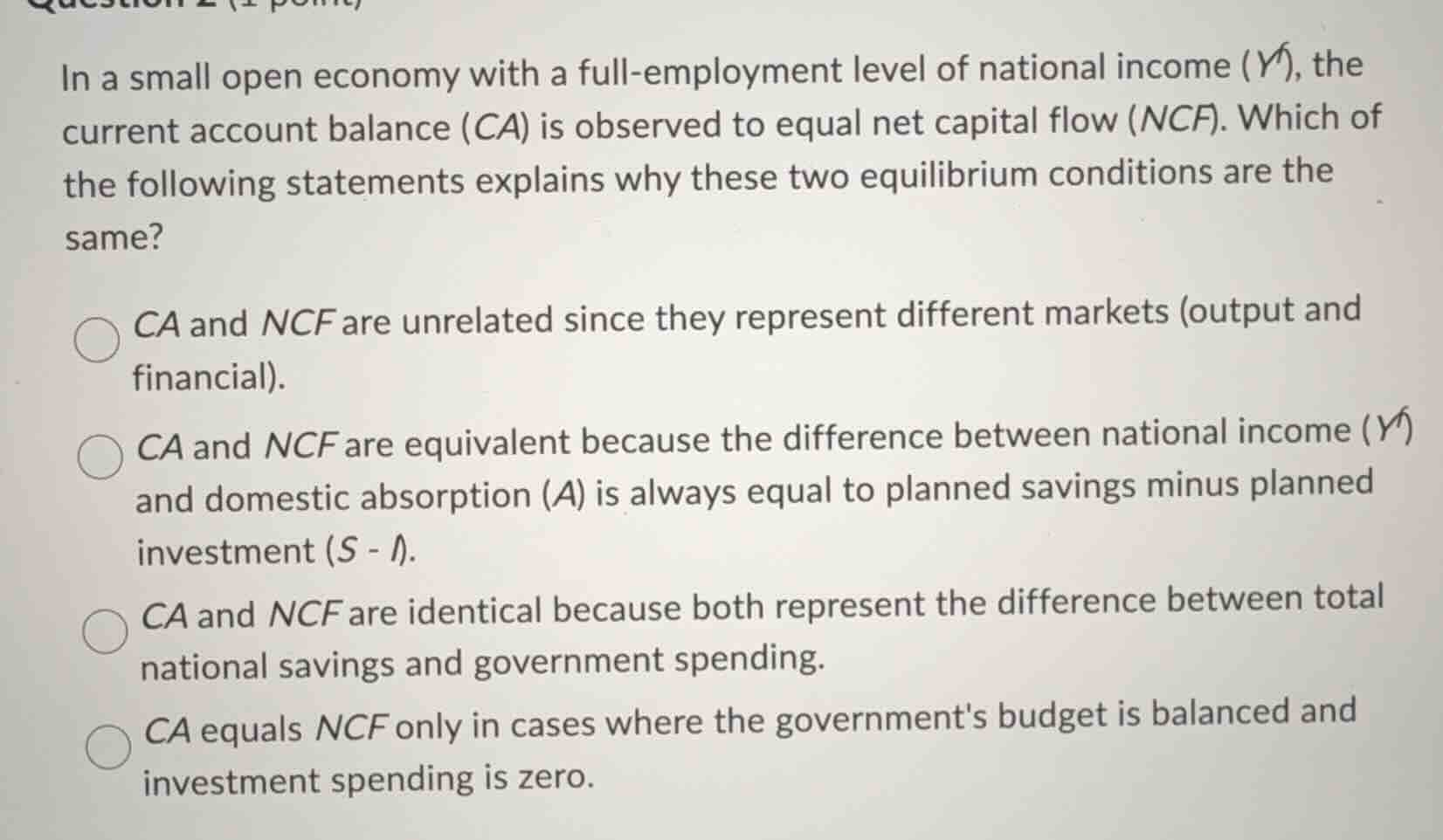
in a small open economy with a full - employment level of national income ($y^f$), the current account balance ($ca$) is observed to equal net capital flow ($ncf$). which of the following statements explains why these two equilibrium conditions are the same?
$circ$ $ca$ and $ncf$ are unrelated since they represent different markets (output and financial).
$circ$ $ca$ and $ncf$ are equivalent because the difference between national income ($y^f$) and domestic absorption ($a$) is always equal to planned savings minus planned investment ($s - i$).
$circ$ $ca$ and $ncf$ are identical because both represent the difference between total national savings and government spending.
$circ$ $ca$ equals $ncf$ only in cases where the governments budget is balanced and investment spending is zero.
- Analyze Option 1: CA (current account) and NCF (net capital flow) are related through the national income - domestic absorption and savings - investment relationships, so they are not unrelated. Eliminate this.
- Analyze Option 2: In an open economy, the current account balance \( CA=Y - A\) (where \( Y\) is national income and \( A\) is domestic absorption). Also, \( S - I=CA\) (savings - investment equals current account). Net capital flow (NCF) is related to the financial account, and in equilibrium, \( CA = NCF\) because of the relationship between national income, domestic absorption, savings, and investment. This option correctly explains the equivalence.
- Analyze Option 3: CA and NCF do not represent the difference between total national savings and government spending. The relationship is more about \( S - I\) and \( Y - A\), so this is incorrect.
- Analyze Option 4: CA equals NCF in general equilibrium for an open economy, not just when government budget is balanced and investment is zero. This is a wrong condition.

Snap & solve any problem in the app
Get step-by-step solutions on Sovi AI
Photo-based solutions with guided steps
Explore more problems and detailed explanations
B. CA and NCF are equivalent because the difference between national income (\(Y^f\)) and domestic absorption (A) is always equal to planned savings minus planned investment (\(S - I\)).