QUESTION IMAGE
Question
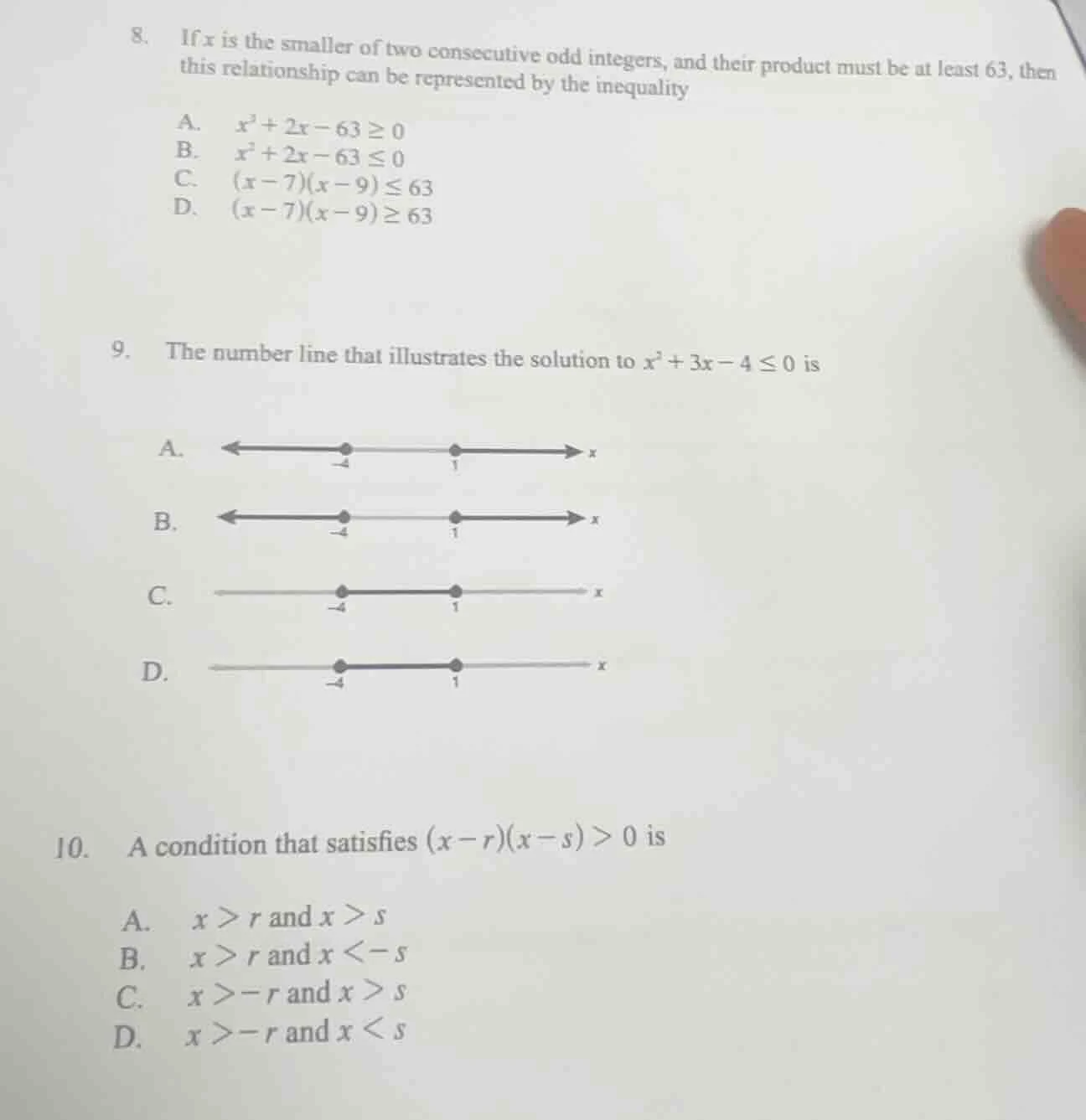
- if x is the smaller of two consecutive odd integers, and their product must be at least 63, then this relationship can be represented by the inequality
a. $x^2 + 2x - 63 \geq 0$
b. $x^2 + 2x - 63 \leq 0$
c. $(x - 7)(x - 9) \leq 63$
d. $(x - 7)(x - 9) \geq 63$
- the number line that illustrates the solution to $x^2 + 3x - 4 \leq 0$ is
a. number line with -4 and 1 marked, arrows both ways, line outside the segment
b. number line with -4 and 1 marked, arrows both ways, line outside the segment (maybe different style?)
c. number line with -4 and 1 marked, line between them, arrows right
d. number line with -4 and 1 marked, line between them, arrows right (maybe different style?)
- a condition that satisfies $(x - r)(x - s) > 0$ is
a. $x > r$ and $x > s$
b. $x > r$ and $x < -s$
c. $x > -r$ and $x > s$
d. $x > -r$ and $x < s$
Question 8
Step1: Define the two integers
Let the smaller odd integer be $x$, the larger consecutive odd integer is $x+2$.
Step2: Set up product inequality
Their product is at least 63, so $x(x+2) \geq 63$.
Step3: Simplify the inequality
Expand and rearrange: $x^2 + 2x - 63 \geq 0$.
Step1: Factor the quadratic
Factor $x^2 + 3x - 4$: $(x+4)(x-1) \leq 0$.
Step2: Find critical points
Critical points are $x=-4$ and $x=1$.
Step3: Test solution interval
The quadratic opens upward, so the inequality holds between the roots, including the endpoints (solid dots).
Step1: Analyze the inequality rule
For $(x-r)(x-s) > 0$, the product is positive when both factors are positive or both are negative.
Step2: Match valid condition
If we assume $r < s$, both positive means $x > r$ and $x > s$ (equivalent to $x > s$), which matches option A.

Snap & solve any problem in the app
Get step-by-step solutions on Sovi AI
Photo-based solutions with guided steps
Explore more problems and detailed explanations
A. $x^2 + 2x - 63 \geq 0$
---