QUESTION IMAGE
Question
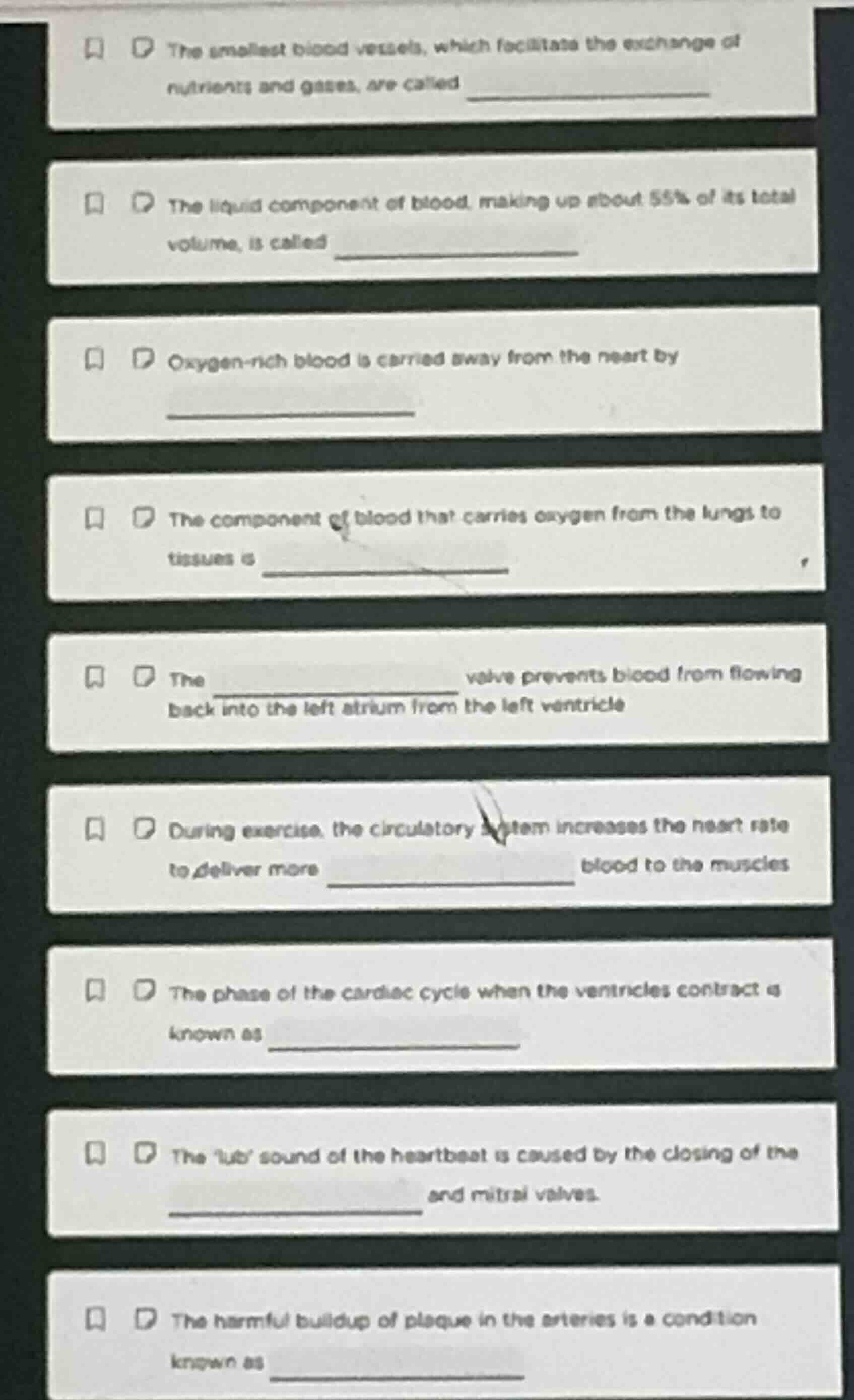
the smallest blood vessels, which facilitate the exchange of nutrients and gases, are called
the liquid component of blood, making up about 55% of its total volume, is called
oxygen - rich blood is carried away from the heart by
the component of blood that carries oxygen from the lungs to tissues is
the valve prevents blood from flowing back into the left atrium from the left ventricle
during exercise, the circulatory system increases the heart rate to deliver more blood to the muscles
the phase of the cardiac cycle when the ventricles contract is known as
the lub sound of the heartbeat is caused by the closing of the and mitral valves.
the harmful buildup of plaque in the arteries is a condition known as
Each answer corresponds to key terminology in the circulatory system, based on standard human anatomy and physiology knowledge:
- Capillaries are the smallest blood vessels, the site of nutrient/gas exchange.
- Plasma is the liquid matrix of blood, making up ~55% of blood volume.
- Arteries carry oxygen-rich blood away from the heart (except the pulmonary artery).
- Red blood cells (hemoglobin within them) bind and transport oxygen from lungs to tissues.
- The mitral (bicuspid) valve prevents backflow from left ventricle to left atrium.
- During exercise, the body needs more oxygen, so oxygen-rich blood is delivered to muscles at a higher rate.
- Ventricular contraction is the systolic phase of the cardiac cycle.
- The first heart sound ("lub") comes from closing of the atrioventricular valves: mitral (bicuspid) and tricuspid.
- Atherosclerosis is the condition where plaque builds up inside artery walls.

Snap & solve any problem in the app
Get step-by-step solutions on Sovi AI
Photo-based solutions with guided steps
Explore more problems and detailed explanations
- capillaries
- plasma
- arteries
- red blood cells (or hemoglobin)
- mitral (or bicuspid)
- oxygen-rich
- systole
- tricuspid
- atherosclerosis