QUESTION IMAGE
Question
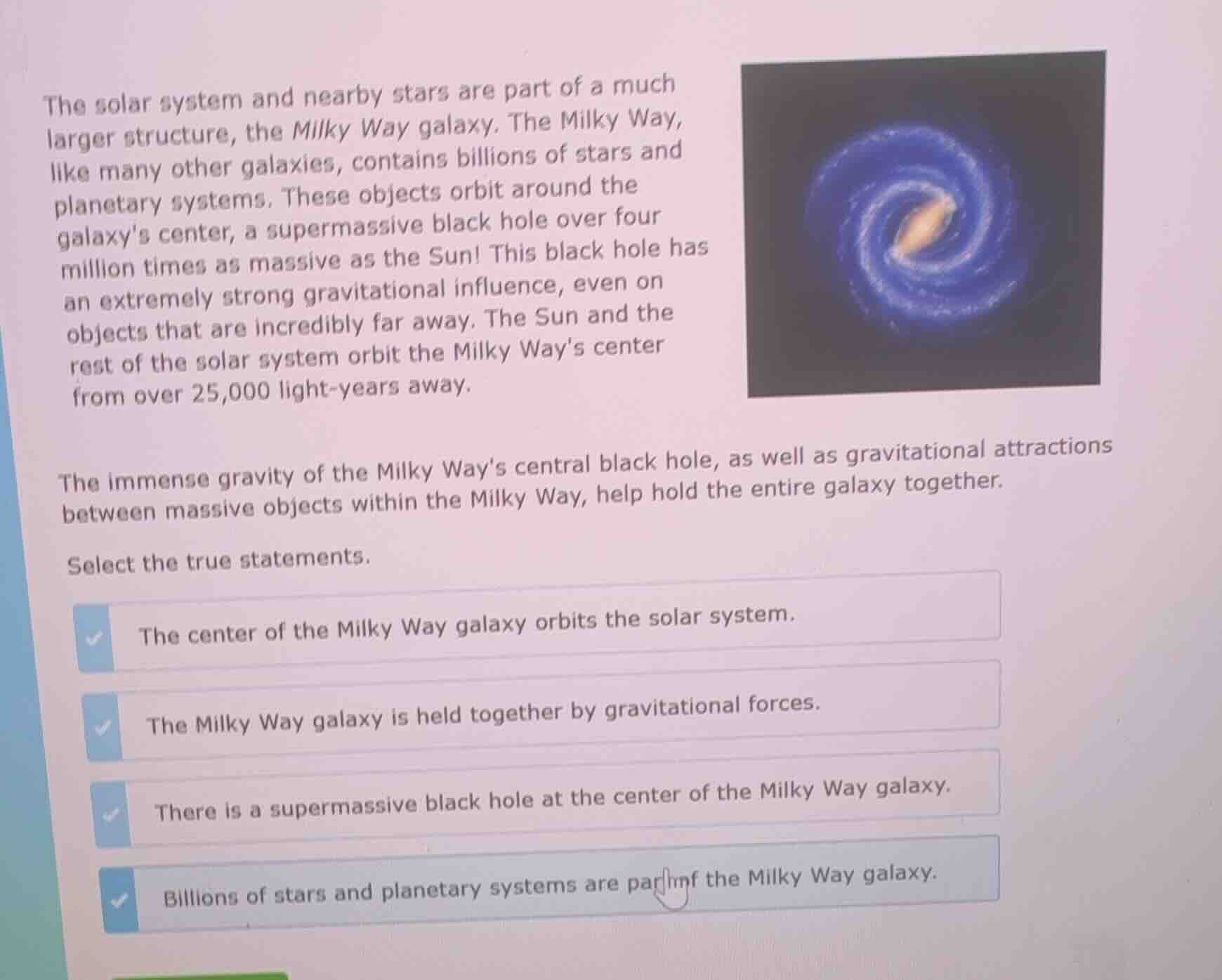
the solar system and nearby stars are part of a much larger structure, the milky way galaxy. the milky way, like many other galaxies, contains billions of stars and planetary systems. these objects orbit around the galaxys center, a supermassive black hole over four million times as massive as the sun! this black hole has an extremely strong gravitational influence, even on objects that are incredibly far away. the sun and the rest of the solar system orbit the milky ways center from over 25,000 light - years away. the immense gravity of the milky ways central black hole, as well as gravitational attractions between massive objects within the milky way, help hold the entire galaxy together. select the true statements. the center of the milky way galaxy orbits the solar system. the milky way galaxy is held together by gravitational forces. there is a supermassive black hole at the center of the milky way galaxy. billions of stars and planetary systems are part of the milky way galaxy.
- The text states the solar system orbits the Milky Way's center, not the reverse, so the first statement is false.
- The text confirms gravitational forces (from the central black hole and massive objects) hold the galaxy together, so the second statement is true.
- The text explicitly says the Milky Way's center has a supermassive black hole, so the third statement is true.
- The text notes the Milky Way contains billions of stars and planetary systems, so the fourth statement is true.

Snap & solve any problem in the app
Get step-by-step solutions on Sovi AI
Photo-based solutions with guided steps
Explore more problems and detailed explanations
- B. The Milky Way galaxy is held together by gravitational forces.
- C. There is a supermassive black hole at the center of the Milky Way galaxy.
- D. Billions of stars and planetary systems are part of the Milky Way galaxy.