QUESTION IMAGE
Question
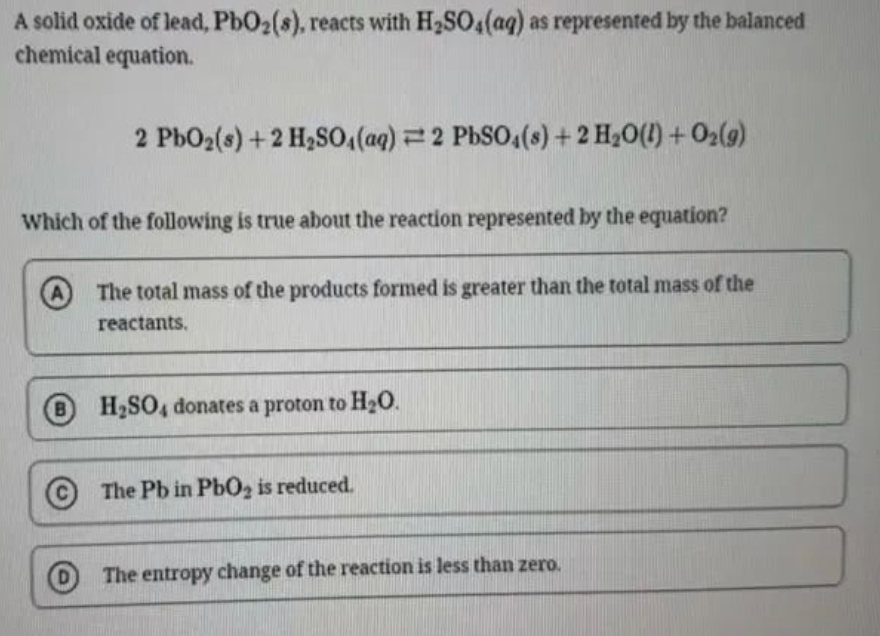
a solid oxide of lead, $\text{pbo}_2(s)$, reacts with $\text{h}_2\text{so}_4(aq)$ as represented by the balanced chemical equation.
$2 \text{pbo}_2(s) + 2 \text{h}_2\text{so}_4(aq)
ightleftarrows 2 \text{pbso}_4(s) + 2 \text{h}_2\text{o}(l) + \text{o}_2(g)$
which of the following is true about the reaction represented by the equation?
a the total mass of the products formed is greater than the total mass of the reactants.
b $\text{h}_2\text{so}_4$ donates a proton to $\text{h}_2\text{o}$.
c the pb in $\text{pbo}_2$ is reduced.
d the entropy change of the reaction is less than zero.
- Option A: Violates the law of conservation of mass, which states the total mass of reactants equals that of products.
- Option B: In this reaction, $\text{H}_2\text{SO}_4$ acts as an acid that provides sulfate ions to form $\text{PbSO}_4$, not donating protons to $\text{H}_2\text{O}$.
- Option C: In $\text{PbO}_2$, lead has an oxidation state of +4. In $\text{PbSO}_4$, lead has an oxidation state of +2. A decrease in oxidation state means the lead is reduced.
- Option D: The reaction produces gaseous $\text{O}_2$ from solid and aqueous reactants, increasing disorder, so entropy change ($\Delta S$) is greater than zero.

Snap & solve any problem in the app
Get step-by-step solutions on Sovi AI
Photo-based solutions with guided steps
Explore more problems and detailed explanations
C. The Pb in $\text{PbO}_2$ is reduced.