QUESTION IMAGE
Question
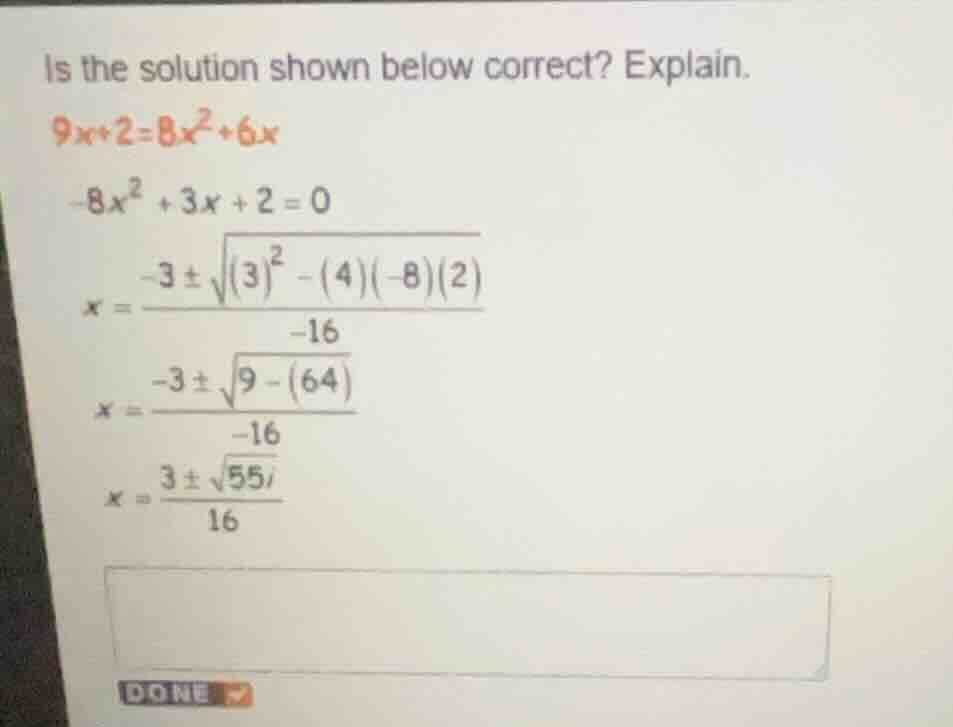
is the solution shown below correct? explain.
9x + 2 = 8x² + 6x
-8x² + 3x + 2 = 0
x = \\(\frac{-3 \pm \sqrt{(3)^2 - (4)(-8)(2)}}{-16}\\)
x = \\(\frac{-3 \pm \sqrt{9 - (64)}}{-16}\\)
x = \\(\frac{3 \pm \sqrt{55}i}{16}\\)
Step1: Check the quadratic formula application
The quadratic formula is \( x = \frac{-b \pm \sqrt{b^2 - 4ac}}{2a} \) for \( ax^2 + bx + c = 0 \). Here, the equation is \( -8x^2 + 3x + 2 = 0 \), so \( a = -8 \), \( b = 3 \), \( c = 2 \). The denominator should be \( 2a = 2\times(-8)= -16 \), which is correct. But when calculating the discriminant \( b^2 - 4ac \), we have \( (3)^2 - 4\times(-8)\times(2)=9 + 64 = 73 \), not \( 9 - 64 \). The mistake was in the sign when multiplying \( -4\times(-8)\times(2) \); it should be positive, not negative.
Step2: Analyze the discriminant calculation error
In the step \( x=\frac{-3\pm\sqrt{9 - (64)}}{-16} \), the discriminant was miscalculated. The correct discriminant is \( 9+64 = 73 \) (since \( -4\times(-8)=32 \), and \( 32\times2 = 64 \), so \( 9+64 \)). Also, when simplifying \( \frac{-3\pm\sqrt{73}}{-16} \), we can factor out a negative sign from numerator and denominator: \( \frac{3\mp\sqrt{73}}{16} \), not involving an imaginary number as the discriminant is positive (real roots), not negative (imaginary roots).

Snap & solve any problem in the app
Get step-by-step solutions on Sovi AI
Photo-based solutions with guided steps
Explore more problems and detailed explanations
The solution is incorrect. Errors include: (1) Miscalculating the discriminant (\( b^2 - 4ac \)): \( (3)^2-4(-8)(2)=9 + 64 = 73 \), not \( 9 - 64 \). (2) Incorrectly introducing an imaginary unit (the discriminant is positive, so roots are real, not complex). The correct discriminant is 73, and the roots are real: \( x=\frac{3\mp\sqrt{73}}{16} \) (or \( x=\frac{-3\pm\sqrt{73}}{-16} \) simplified).