QUESTION IMAGE
Question
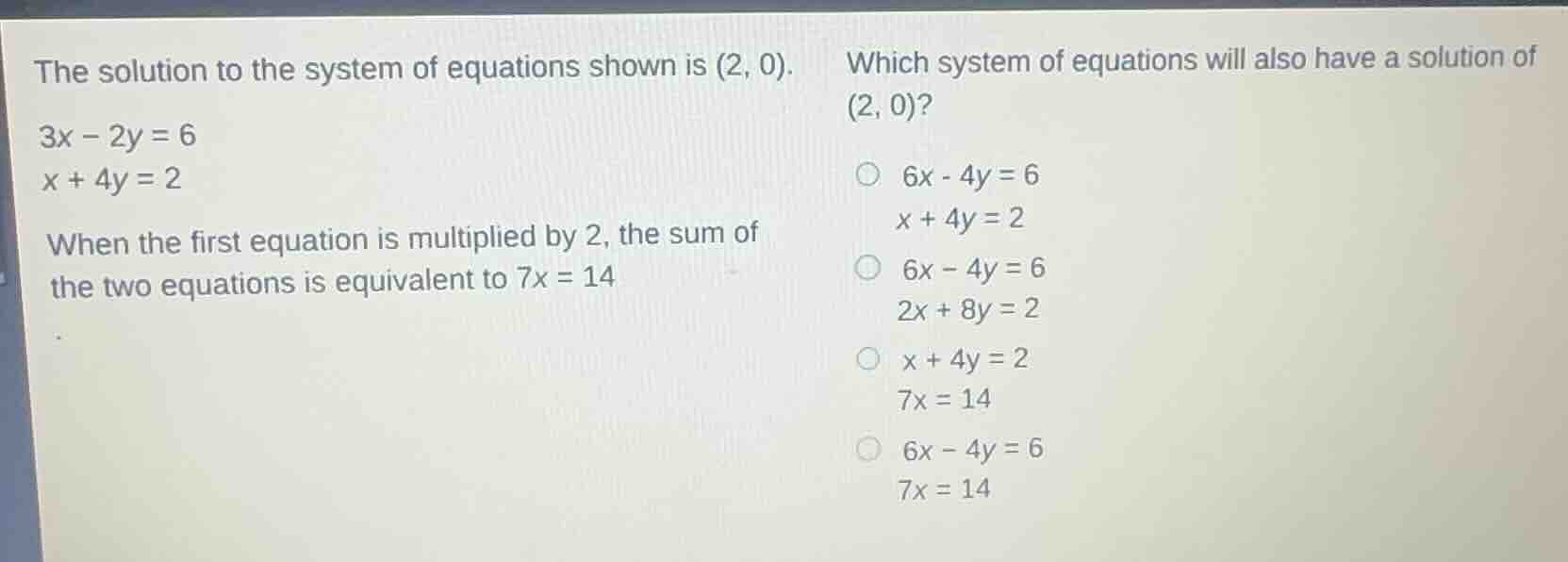
the solution to the system of equations shown is (2, 0).
3x - 2y = 6
x + 4y = 2
when the first equation is multiplied by 2, the sum of
the two equations is equivalent to 7x = 14
which system of equations will also have a solution of
(2, 0)?
○ 6x - 4y = 6
x + 4y = 2
○ 6x - 4y = 6
2x + 8y = 2
○ x + 4y = 2
7x = 14
○ 6x - 4y = 6
7x = 14
Step1: Recall solution properties
A system of equations with the same solution \((2,0)\) must be equivalent (derived from the original system via valid operations like scaling or adding equations). The original system has equations \(3x - 2y = 6\) and \(x + 4y = 2\). When we multiply the first equation by 2, we get \(6x - 4y = 12\)? Wait, no—wait, the problem says when the first equation is multiplied by 2, the sum of the two equations is \(7x = 14\). Let's check: Original first equation \(3x - 2y = 6\), multiply by 2: \(6x - 4y = 12\). Then add to second equation \(x + 4y = 2\): \((6x - 4y)+(x + 4y)=12 + 2\), which simplifies to \(7x = 14\). Wait, but the problem statement says "the sum of the two equations is equivalent to \(7x = 14\)"—maybe there was a typo, but regardless, we need to check which system has \((2,0)\) as a solution. Let's test each option by plugging \(x = 2\), \(y = 0\) into each system.
Step2: Test Option 1: \(6x - 4y = 6\) and \(x + 4y = 2\)
Plug \(x = 2\), \(y = 0\):
First equation: \(6(2)-4(0)=12 - 0 = 12
eq6\). So this system does not have \((2,0)\) as a solution.
Step3: Test Option 2: \(6x - 4y = 6\) and \(2x + 8y = 2\)
Plug \(x = 2\), \(y = 0\):
First equation: \(6(2)-4(0)=12
eq6\). Not a solution.
Step4: Test Option 3: \(x + 4y = 2\) and \(7x = 14\)
First equation: \(2 + 4(0)=2\), which matches. Second equation: \(7(2)=14\), which matches. So \((2,0)\) satisfies both equations.
Step5: Test Option 4: \(6x - 4y = 6\) and \(7x = 14\)
First equation: \(6(2)-4(0)=12
eq6\). Not a solution.

Snap & solve any problem in the app
Get step-by-step solutions on Sovi AI
Photo-based solutions with guided steps
Explore more problems and detailed explanations
C. \(x + 4y = 2\)
\(7x = 14\) (Note: Assuming the options are labeled as A, B, C, D with C being the third option as per the formatting. If the original options had labels, use the correct label. From the given options, the third one is \(x + 4y = 2\) and \(7x = 14\), which works.)