QUESTION IMAGE
Question
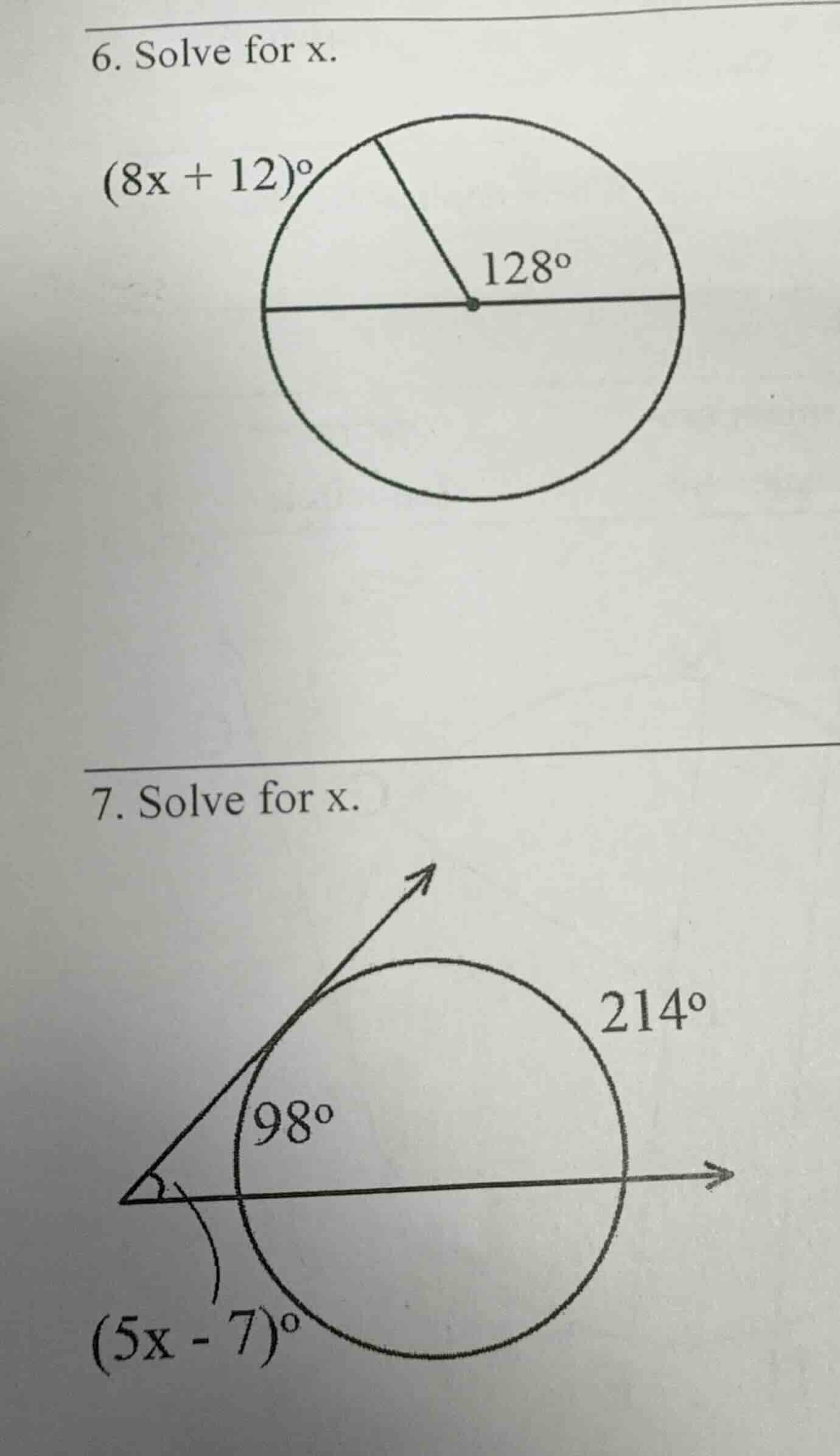
- solve for x.$(8x + 12)^circ$$128^circ$7. solve for x.$214^circ$$98^circ$$(5x - 7)^circ$
Step1: Set up circle angle equation
The sum of the arc measures around a circle is $360^\circ$. The straight line is a semicircle? No, the total circle: $(8x+12) + 128 + (360 - (8x+12)-128) = 360$, but actually, the $(8x+12)$ and $128^\circ$ are adjacent arcs on a straight diameter? No, the diameter splits the circle into two $180^\circ$ arcs? No, the $(8x+12)^\circ$ arc and $128^\circ$ arc add up to $180^\circ$ (since they are on one side of the diameter? Wait no, the diameter is a straight line through center, so the two arcs on either side of the diameter are $180^\circ$. Wait, no: $(8x+12) + 128 = 180$
$8x + 12 + 128 = 180$
Step2: Simplify and solve for x
$8x + 140 = 180$
$8x = 180 - 140$
$8x = 40$
$x = \frac{40}{8} = 5$
---
Step3: Use external angle theorem
The measure of an external angle formed by two secants is half the difference of the intercepted arcs. The external angle is $(5x-7)^\circ$, the intercepted arcs are $214^\circ$ and $98^\circ$.
$(5x - 7) = \frac{1}{2}(214 - 98)$
Step4: Calculate and solve for x
$(5x - 7) = \frac{1}{2}(116)$
$5x - 7 = 58$
$5x = 58 + 7$
$5x = 65$
$x = \frac{65}{5} = 13$

Snap & solve any problem in the app
Get step-by-step solutions on Sovi AI
Photo-based solutions with guided steps
Explore more problems and detailed explanations
For problem 6: $x=5$
For problem 7: $x=13$