QUESTION IMAGE
Question
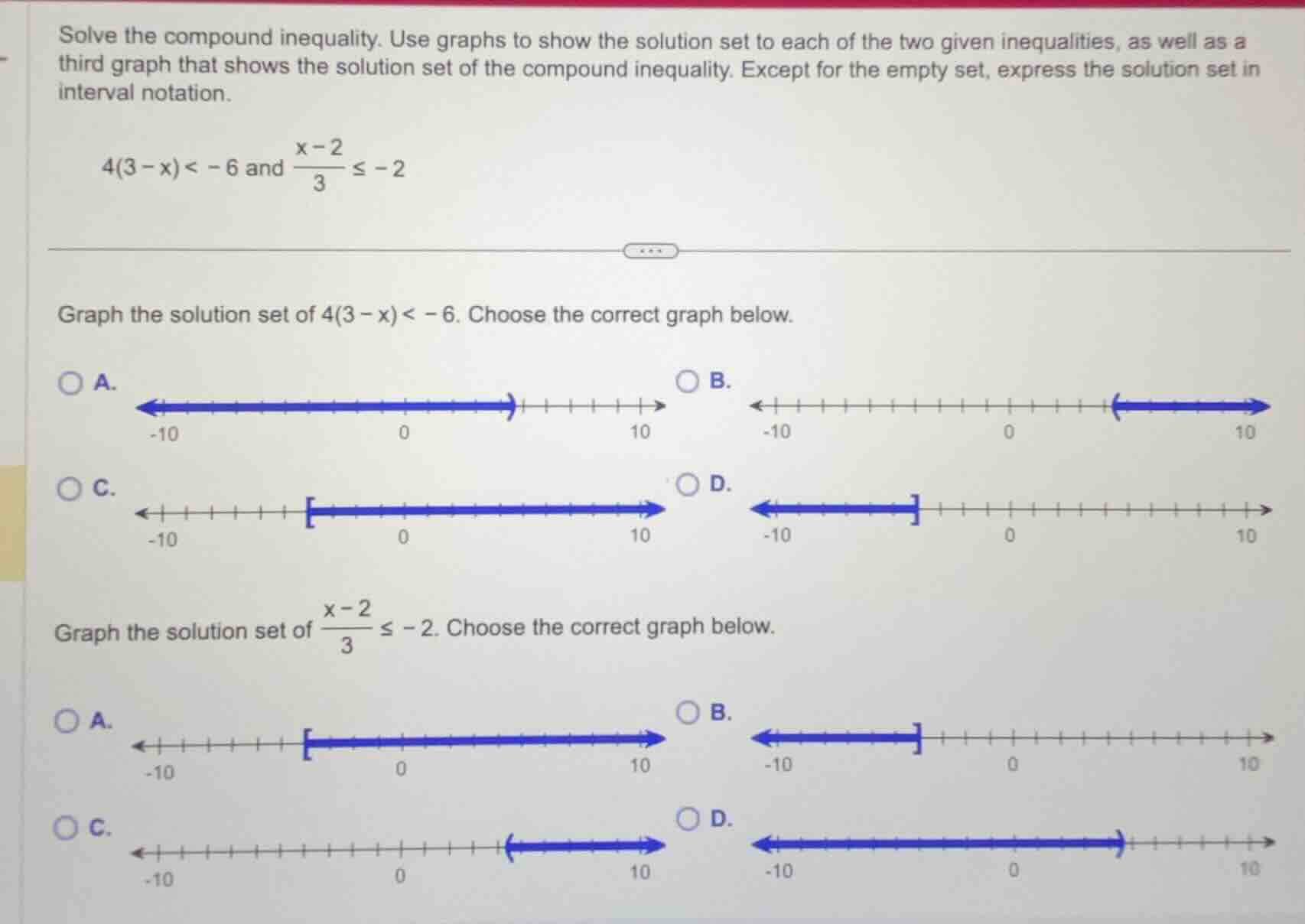
solve the compound inequality. use graphs to show the solution set to each of the two given inequalities, as well as a third graph that shows the solution set of the compound inequality. except for the empty set, express the solution set in interval notation.\\(4(3 - x) < -6\\) and \\(\frac{x - 2}{3} \leq -2\\)\\(\dots\\)\\(\text{graph the solution set of } 4(3 - x) < -6. \text{choose the correct graph below.}\\)\\(\text{\\(\boldsymbol{\circ}) a.}) graph with -10, 0, 10 and arrow \\(\text{\\(\boldsymbol{\circ}) b.}) graph with -10, 0, 10 and arrow \\(\text{\\(\boldsymbol{\circ}) c.}) graph with -10, 0, 10 and bracket \\(\text{\\(\boldsymbol{\circ}) d.}) graph with -10, 0, 10 and bracket\\(\text{graph the solution set of } \frac{x - 2}{3} \leq -2. \text{choose the correct graph below.}\\)\\(\text{\\(\boldsymbol{\circ}) a.}) graph with -10, 0, 10 and bracket \\(\text{\\(\boldsymbol{\circ}) b.}) graph with -10, 0, 10 and bracket \\(\text{\\(\boldsymbol{\circ}) c.}) graph with -10, 0, 10 and arrow \\(\text{\\(\boldsymbol{\circ}) d.}) graph with -10, 0, 10 and arrow
Step1: Solve $4(3-x) < -6$
Expand and isolate $x$:
$12 - 4x < -6$
$-4x < -6 - 12$
$-4x < -18$
Divide by $-4$ (reverse inequality):
$x > \frac{18}{4} = 4.5$
Step2: Match graph for $x > 4.5$
The graph has an open circle at $4.5$ and points right. This matches option B.
Step3: Solve $\frac{x-2}{3} \leq -2$
Multiply by 3, isolate $x$:
$x - 2 \leq -6$
$x \leq -6 + 2$
$x \leq -4$
Step4: Match graph for $x \leq -4$
The graph has a closed circle at $-4$ and points left. This matches option B.
Step5: Find compound solution
"AND" means overlap of $x > 4.5$ and $x \leq -4$. There is no overlap.

Snap & solve any problem in the app
Get step-by-step solutions on Sovi AI
Photo-based solutions with guided steps
Explore more problems and detailed explanations
- Graph for $4(3-x) < -6$: B. <graph with open circle at 4.5, arrow right>
- Graph for $\frac{x-2}{3} \leq -2$: B. <graph with closed circle at -4, arrow left>
- Compound inequality solution set: $\emptyset$ (empty set)