QUESTION IMAGE
Question
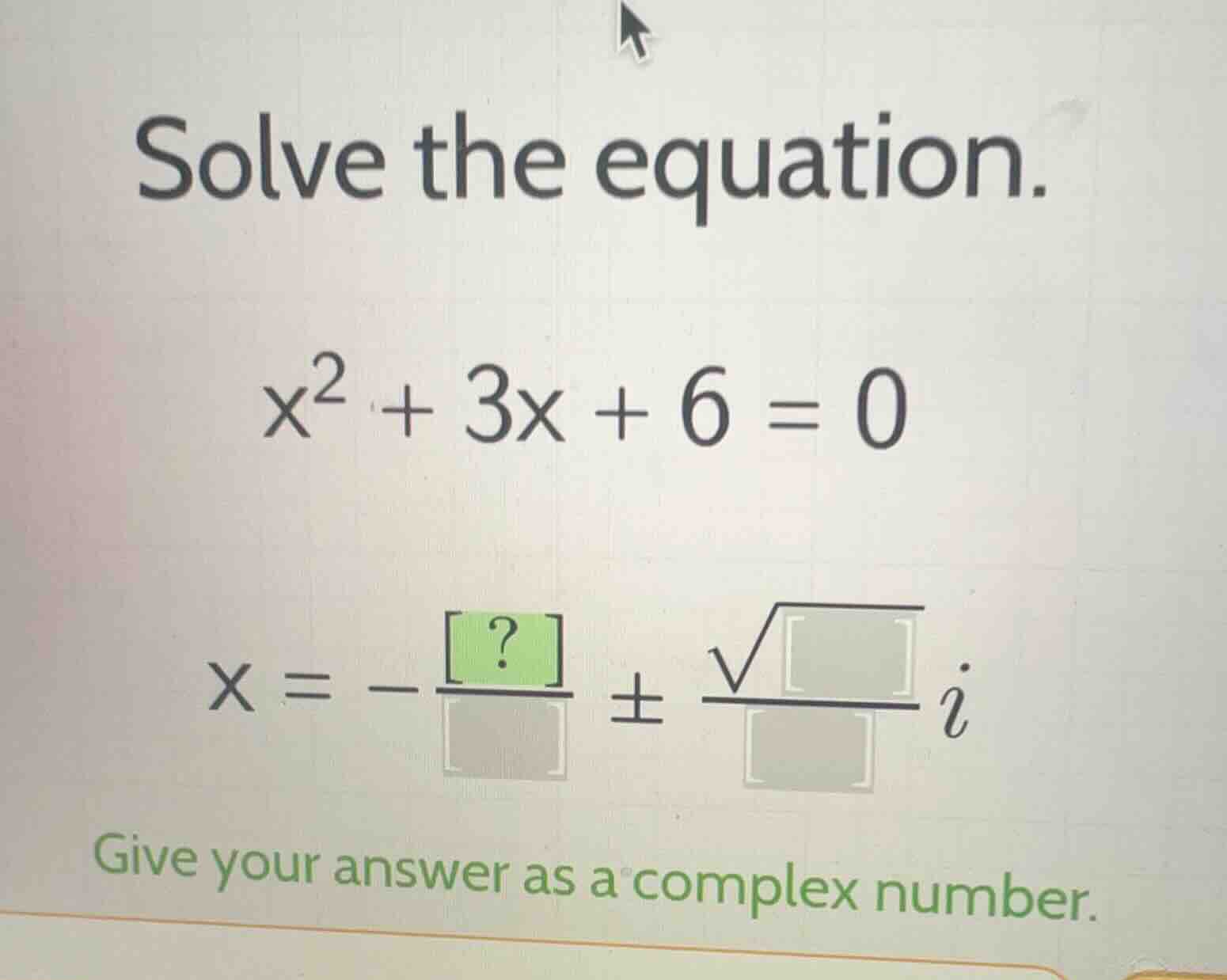
solve the equation.\\( x^2 + 3x + 6 = 0 \\)\\( x = -\frac{?}{} pm \frac{sqrt{}}{i} \\)give your answer as a complex number.
Step1: Recall Quadratic Formula
For a quadratic equation \(ax^2 + bx + c = 0\), the solutions are given by \(x=\frac{-b\pm\sqrt{b^2 - 4ac}}{2a}\). For complex solutions, when \(b^2-4ac<0\), we can write \(\sqrt{b^2 - 4ac}=\sqrt{-(4ac - b^2)}=i\sqrt{4ac - b^2}\).
Given the equation \(x^2+3x + 6 = 0\), we have \(a = 1\), \(b = 3\), and \(c = 6\).
Step2: Calculate the discriminant part
First, calculate \(b^2-4ac\):
\(b^2-4ac=(3)^2-4\times1\times6=9 - 24=- 15\)
Since the discriminant is negative, we rewrite the square - root part as \(i\sqrt{15}\) (because \(\sqrt{-15}=i\sqrt{15}\)).
Now, apply the quadratic formula:
\(x=\frac{-b\pm\sqrt{b^2 - 4ac}}{2a}=\frac{-3\pm\sqrt{-15}}{2}=\frac{-3\pm i\sqrt{15}}{2}=-\frac{3}{2}\pm\frac{\sqrt{15}}{2}i\)

Snap & solve any problem in the app
Get step-by-step solutions on Sovi AI
Photo-based solutions with guided steps
Explore more problems and detailed explanations
For the first (green) box, the numerator is \(3\), the denominator of the first fraction is \(2\), the number under the square - root in the second fraction is \(15\), and the denominator of the second fraction is \(2\). So the filled - in form is \(x =-\frac{3}{2}\pm\frac{\sqrt{15}}{2}i\)