QUESTION IMAGE
Question
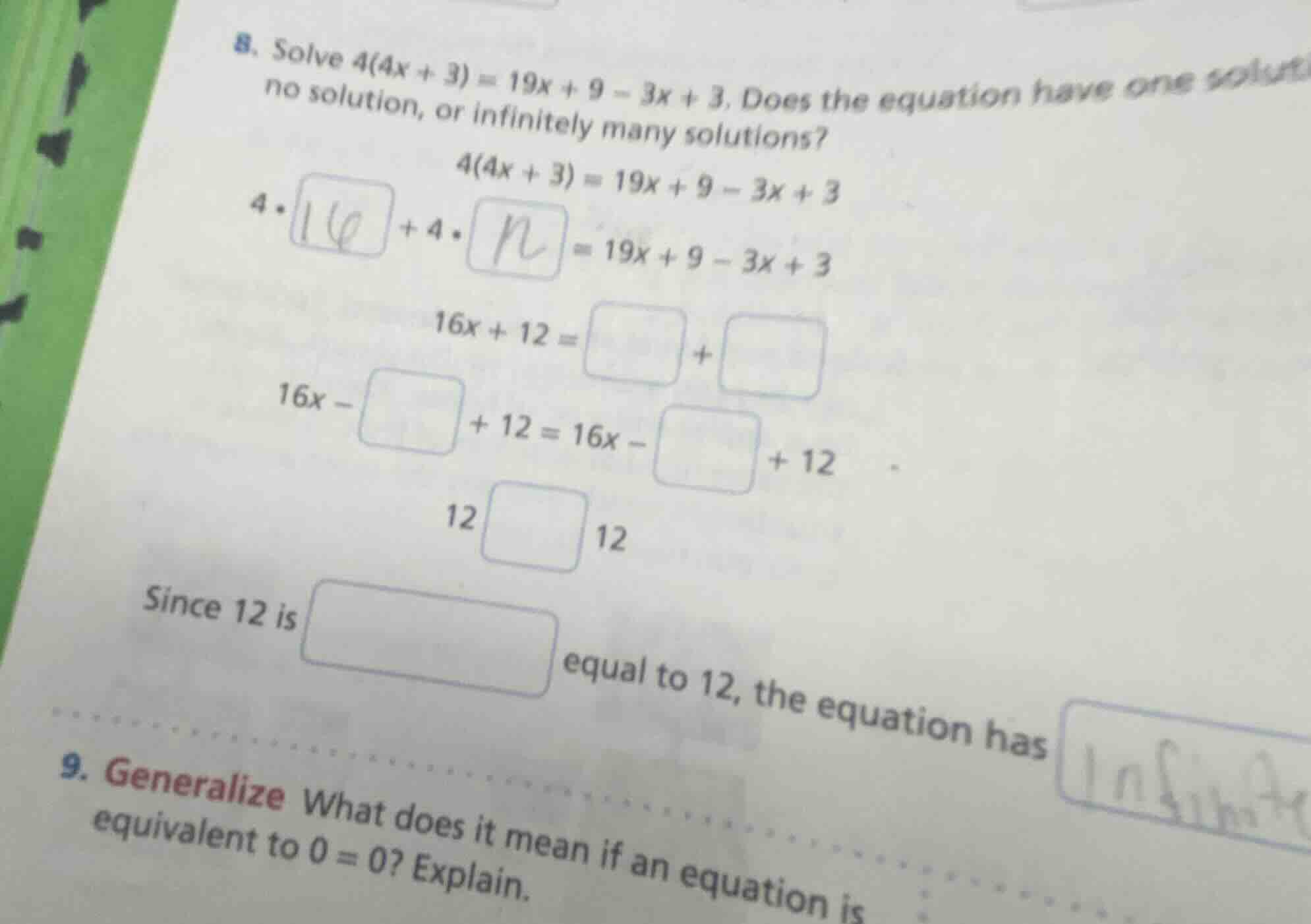
- solve $4(4x + 3)=19x + 9 - 3x + 3$. does the equation have one solution, no solution, or infinitely many solutions?
$4(4x + 3)=19x + 9 - 3x + 3$
$4\cdot\square + 4\cdot\square = 19x + 9 - 3x + 3$
$16x + 12 = \square + \square$
$16x - \square + 12 = 16x - \square + 12$
$12\square12$
since 12 is $\square$ equal to 12, the equation has $\square$
- generalize what does it mean if an equation is equivalent to $0 = 0$? explain.
Step1: Expand left-hand side
$4(4x+3) = 4\cdot4x + 4\cdot3$
Step2: Simplify both sides
Left: $16x + 12$; Right: $19x-3x + 9+3 = 16x + 12$
Step3: Subtract $16x$ from both sides
$16x - 16x + 12 = 16x - 16x + 12$
Step4: Simplify the result
$12 = 12$
Step5: Interpret the final equality
Since $12=12$ is always true, the equation has infinitely many solutions.
When an equation simplifies to $0=0$, it means the original equation is true for all possible values of the variable. This occurs when both sides of the equation are identical algebraic expressions, so every real number (or valid value for the variable) satisfies the equation.

Snap & solve any problem in the app
Get step-by-step solutions on Sovi AI
Photo-based solutions with guided steps
Explore more problems and detailed explanations
The filled blanks (in order) are: $4x$, $3$, $16x$, $12$, $16x$, $16x$, $=$, always;
The equation has infinitely many solutions.
---
For question 9: