QUESTION IMAGE
Question
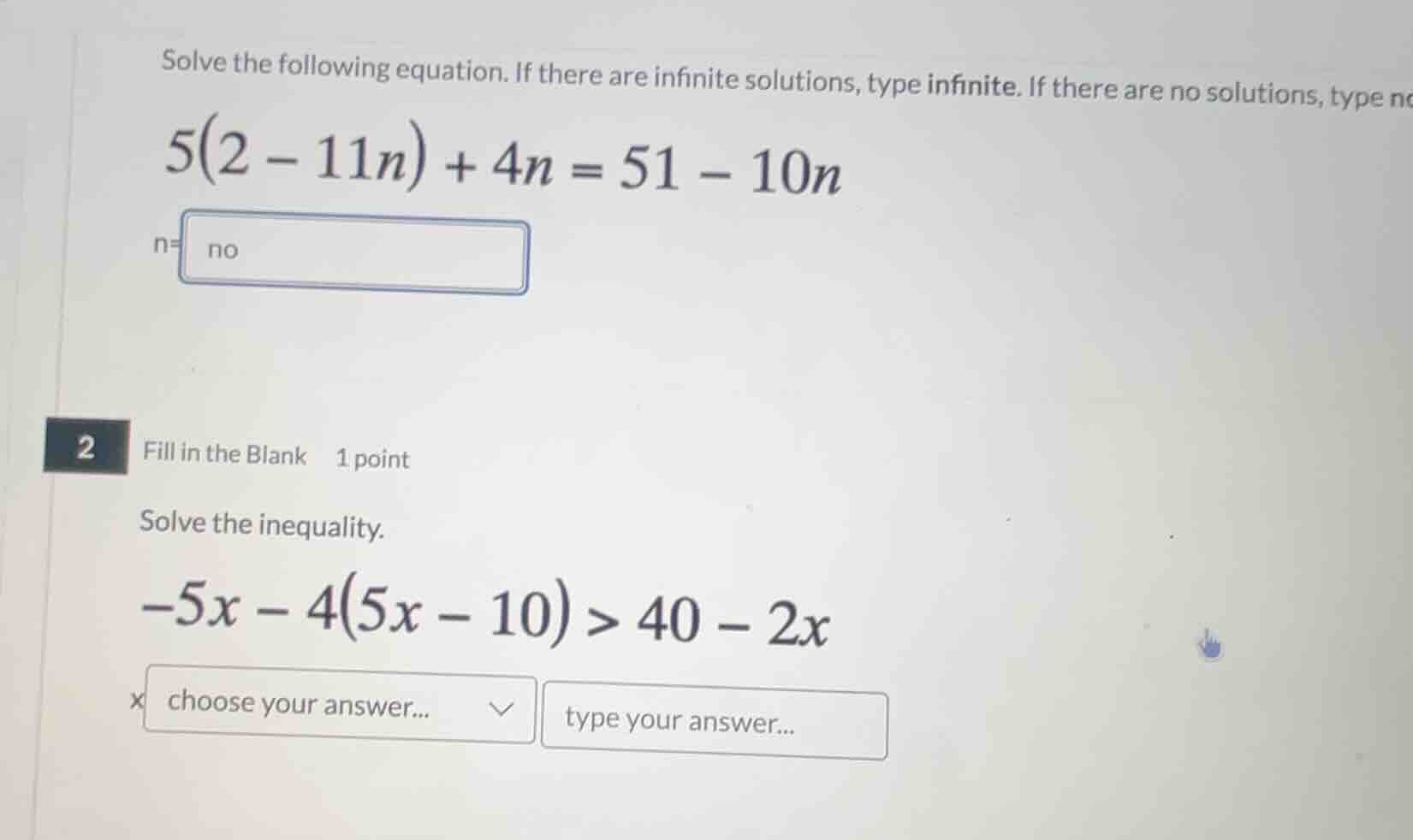
solve the following equation. if there are infinite solutions, type infinite. if there are no solutions, type no
$5(2 - 11n) + 4n = 51 - 10n$
n= no
2 fill in the blank 1 point
solve the inequality.
$-5x - 4(5x - 10) > 40 - 2x$
x choose your answer... type your answer...
First Sub - Question (Solving the Equation \(5(2 - 11n)+4n = 51-10n\))
Step 1: Expand the left - hand side
We use the distributive property \(a(b + c)=ab+ac\). For \(5(2 - 11n)\), we get \(5\times2-5\times11n = 10-55n\). Then the left - hand side of the equation becomes \(10-55n + 4n\). Combining like terms \(-55n+4n=-51n\), so the left - hand side is \(10 - 51n\).
The equation is now \(10-51n=51 - 10n\).
Step 2: Move all \(n\) terms to one side and constants to the other
Add \(51n\) to both sides: \(10-51n + 51n=51-10n + 51n\), which simplifies to \(10 = 51+41n\).
Then subtract 51 from both sides: \(10 - 51=51+41n-51\), so \(-41 = 41n\).
Step 3: Solve for \(n\)
Divide both sides by 41: \(\frac{-41}{41}=\frac{41n}{41}\), which gives \(n=-1\). Wait, let's check again. Wait, in step 2, when we add \(51n\) to both sides:
Starting from \(10-51n=51 - 10n\)
\(10-51n + 51n=51-10n + 51n\)
\(10=51 + 41n\)
Subtract 51: \(10-51=41n\)
\(-41 = 41n\)
Divide by 41: \(n=-1\)
Wait, but let's verify by plugging \(n = - 1\) back into the original equation.
Left - hand side: \(5(2-11\times(-1))+4\times(-1)=5(2 + 11)-4=5\times13-4=65 - 4 = 61\)
Right - hand side: \(51-10\times(-1)=51 + 10=61\). So \(n=-1\) is the solution. Wait, the original box had "no", maybe a mistake. Let's re - do the steps carefully.
Wait, original equation: \(5(2-11n)+4n=51 - 10n\)
Expand: \(10-55n + 4n=51-10n\)
Combine like terms: \(10-51n=51-10n\)
Add \(51n\) to both sides: \(10=51 + 41n\)
Subtract 51: \(10 - 51=41n\)
\(-41 = 41n\)
\(n=-1\)
Second Sub - Question (Solving the Inequality \(-5x-4(5x - 10)>40-2x\))
Step 1: Expand the left - hand side
Using the distributive property \(-4(5x - 10)=-4\times5x-4\times(-10)=-20x + 40\). The left - hand side of the inequality becomes \(-5x-20x + 40\). Combining like terms \(-5x-20x=-25x\), so the left - hand side is \(-25x + 40\).
The inequality is now \(-25x + 40>40-2x\).
Step 2: Move all \(x\) terms to one side
Add \(25x\) to both sides: \(-25x + 40+25x>40-2x + 25x\), which simplifies to \(40>40 + 23x\).
Step 3: Solve for \(x\)
Subtract 40 from both sides: \(40-40>40 + 23x-40\), which gives \(0>23x\).
Divide both sides by 23 (since 23>0, the inequality sign remains the same): \(\frac{0}{23}>\frac{23x}{23}\), so \(x < 0\).

Snap & solve any problem in the app
Get step-by-step solutions on Sovi AI
Photo-based solutions with guided steps
Explore more problems and detailed explanations
(First Sub - Question):
\(n=-1\)