QUESTION IMAGE
Question
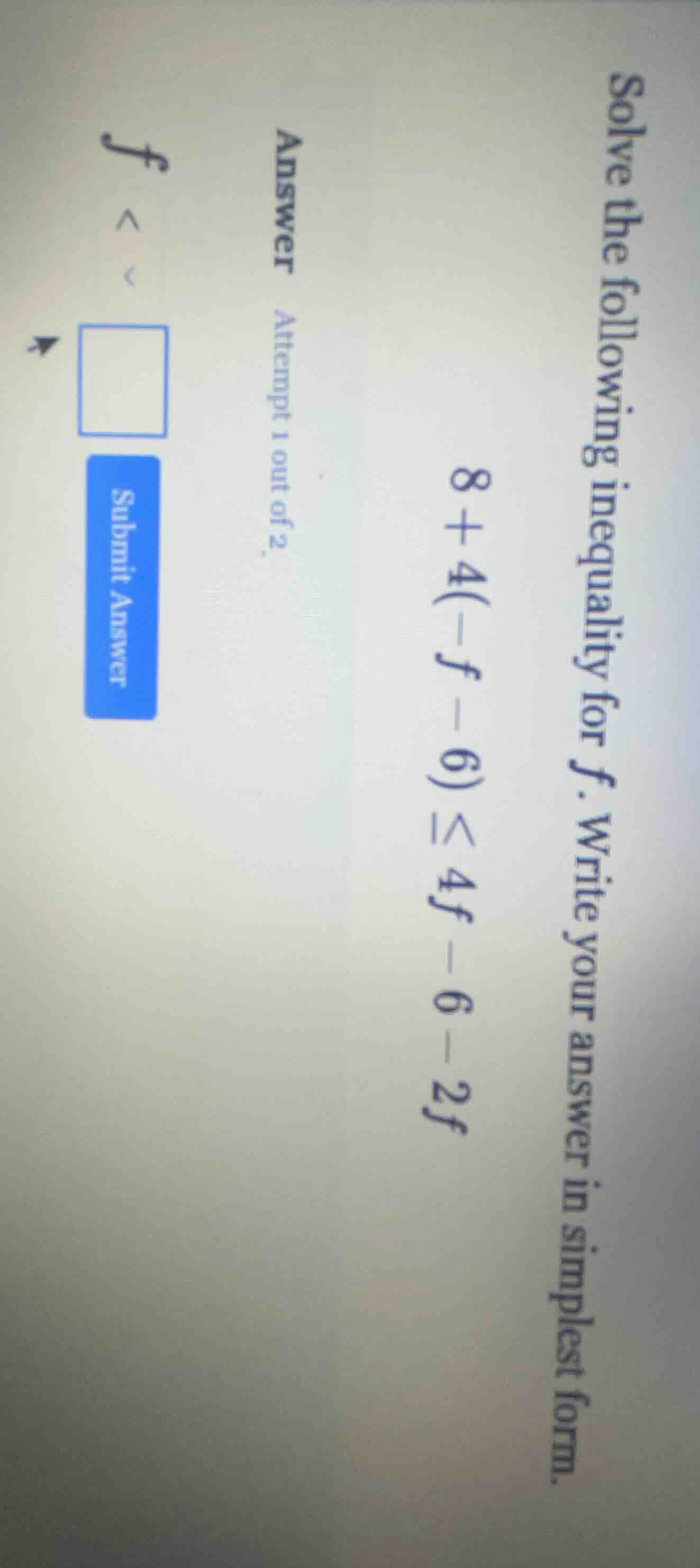
solve the following inequality for f. write your answer in simplest form. 8 + 4(-f - 6) ≤ 4f - 6 - 2f
Step1: Expand the left side
First, we expand \( 4(-f - 6) \) using the distributive property \( a(b + c)=ab+ac \). So \( 4(-f - 6)=-4f-24 \). Then the left side of the inequality \( 8 + 4(-f - 6) \) becomes \( 8-4f - 24 \). Combine like terms: \( 8-24=-16 \), so the left side is \( -4f-16 \). The inequality now is \( -4f - 16\leq4f-6 - 2f \).
Step2: Simplify the right side
Combine like terms on the right side: \( 4f-2f = 2f \), so the right side is \( 2f-6 \). Now the inequality is \( -4f - 16\leq2f-6 \).
Step3: Move all f terms to one side
Add \( 4f \) to both sides to get rid of the \( -4f \) on the left. \( -4f+4f - 16\leq2f + 4f-6 \), which simplifies to \( -16\leq6f-6 \).
Step4: Move constant terms to the other side
Add 6 to both sides: \( -16 + 6\leq6f-6 + 6 \), so \( -10\leq6f \).
Step5: Solve for f
Divide both sides by 6: \( \frac{-10}{6}\leq f \). Simplify \( \frac{-10}{6} \) to \( -\frac{5}{3} \). So \( f\geq-\frac{5}{3} \) (note that when we divide by a positive number, the inequality sign remains the same). Wait, let's check the steps again for errors. Wait, original inequality: \( 8 + 4(-f - 6)\leq4f - 6-2f \)
Wait, step 1: \( 8 + 4(-f)-4*6 = 8-4f -24=-4f -16 \). Right side: \( 4f-2f -6=2f -6 \). So inequality: \( -4f -16\leq2f -6 \)
Then, add \( 4f \) to both sides: \( -16\leq6f -6 \)
Add 6 to both sides: \( -10\leq6f \)
Divide both sides by 6: \( f\geq\frac{-10}{6}=-\frac{5}{3} \). Wait, but let's check the original problem again. Wait, maybe I made a mistake in the sign. Wait, let's re-express the original inequality:
\( 8 + 4(-f - 6)\leq4f -6 -2f \)
Left side: \( 8 -4f -24=-4f -16 \)
Right side: \( 2f -6 \)
So \( -4f -16\leq2f -6 \)
Subtract \( 2f \) from both sides: \( -6f -16\leq -6 \)
Add 16 to both sides: \( -6f\leq10 \)
Divide both sides by -6 (remember to reverse the inequality sign when dividing by a negative number): \( f\geq-\frac{10}{6}=-\frac{5}{3} \). Yes, that's correct. Wait, but let's check with an example. Let \( f = -1 \) (which is greater than \( -\frac{5}{3}\approx -1.666 \)). Left side: \( 8 + 4(-(-1)-6)=8 + 4(1 -6)=8 + 4(-5)=8 -20=-12 \). Right side: \( 4(-1)-6 -2(-1)=-4 -6 +2=-8 \). Is \( -12\leq -8 \)? Yes. Now let \( f = -2 \) (less than \( -\frac{5}{3}\)). Left side: \( 8 + 4(-(-2)-6)=8 + 4(2 -6)=8 + 4(-4)=8 -16=-8 \). Right side: \( 4(-2)-6 -2(-2)=-8 -6 +4=-10 \). Is \( -8\leq -10 \)? No. So the solution is \( f\geq-\frac{5}{3} \).

Snap & solve any problem in the app
Get step-by-step solutions on Sovi AI
Photo-based solutions with guided steps
Explore more problems and detailed explanations
\( f \geq -\dfrac{5}{3} \)