QUESTION IMAGE
Question
solve the following questions.
use the following information to answer questions 2–4.
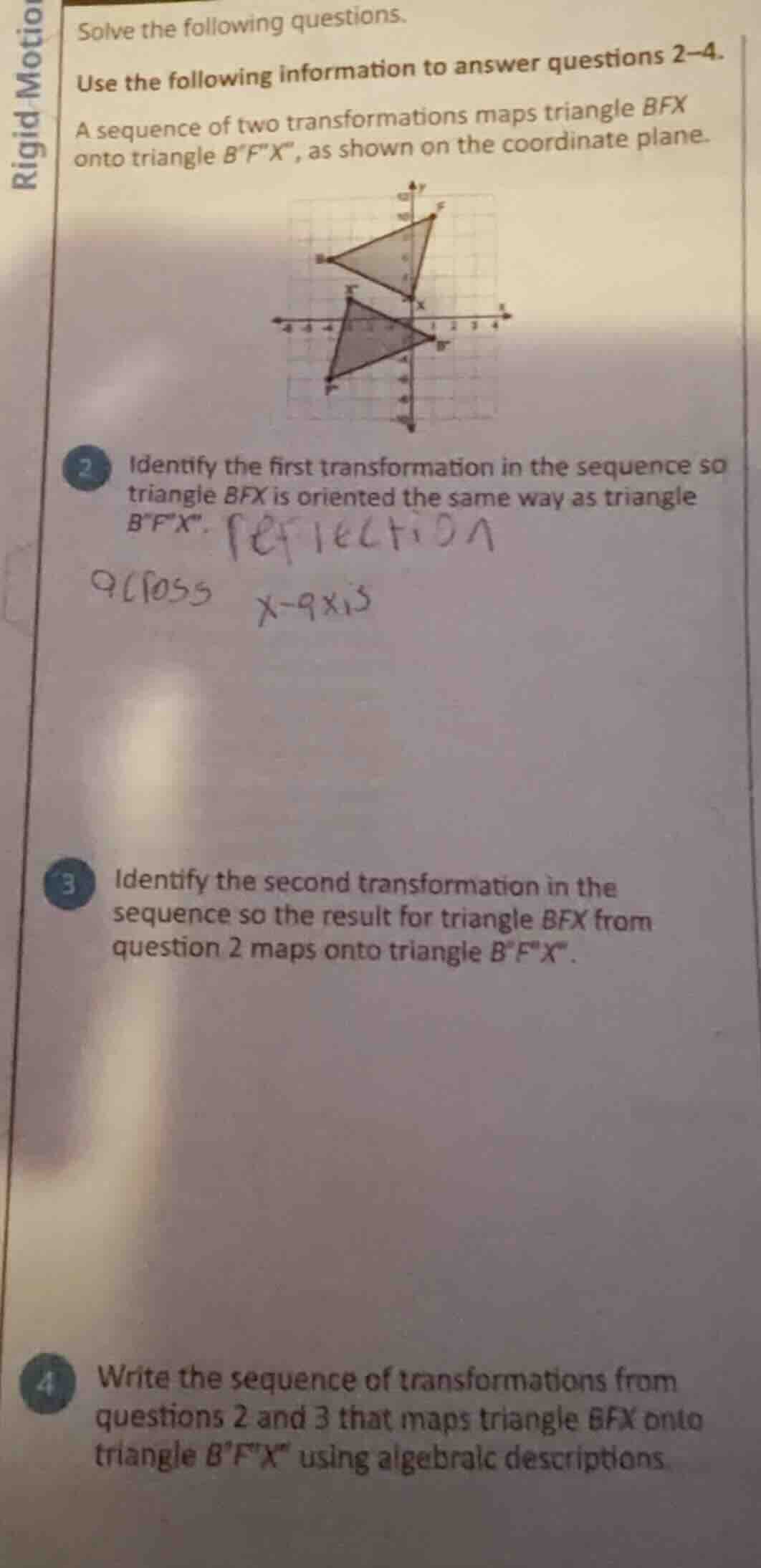
a sequence of two transformations maps triangle bfx onto triangle bfx, as shown on the coordinate plane.
2 identify the first transformation in the sequence so triangle bfx is oriented the same way as triangle bfx.
3 identify the second transformation in the sequence so the result for triangle bfx from question 2 maps onto triangle bfx.
4 write the sequence of transformations from questions 2 and 3 that maps triangle bfx onto triangle bfx using algebraic descriptions
Question 2
To make triangle \( BFX \) oriented the same as \( B''F''X'' \), we analyze the orientation. A reflection across the \( x \)-axis changes the vertical orientation (flips over the \( x \)-axis), which aligns the orientation of \( BFX \) with \( B''F''X'' \).
After reflecting over the \( x \)-axis (from question 2), the next transformation to map the reflected triangle onto \( B''F''X'' \) is a translation (slide). By observing the coordinate plane, we can see that a translation (horizontal and/or vertical shift) is needed to move the reflected triangle to the position of \( B''F''X'' \). Typically, from the diagram, a translation (e.g., shifting right and up or other directions) is the second transformation. Assuming the reflection is over \( x \)-axis, the second transformation is a translation (specifically, we can determine the vector, but generally, translation is the second step here).
Step 1: Reflection across \( x \)-axis
For a point \((x,y)\) in triangle \( BFX \), reflecting across the \( x \)-axis changes the \( y \)-coordinate sign. So the algebraic rule is \((x,y) \to (x, -y)\).
Step 2: Translation
Let's assume the translation vector is \((h,k)\) (found by comparing coordinates of reflected triangle and \( B''F''X'' \)). For example, if after reflection, we need to shift right by \( a \) units and up by \( b \) units, the rule is \((x, -y) \to (x + a, -y + b)\). Combining these, the sequence is: First, reflect across \( x \)-axis: \((x,y) \to (x, -y)\), then translate by \((a,b)\): \((x, -y) \to (x + a, -y + b)\).

Snap & solve any problem in the app
Get step-by-step solutions on Sovi AI
Photo-based solutions with guided steps
Explore more problems and detailed explanations
Reflection across the \( x \)-axis