QUESTION IMAGE
Question
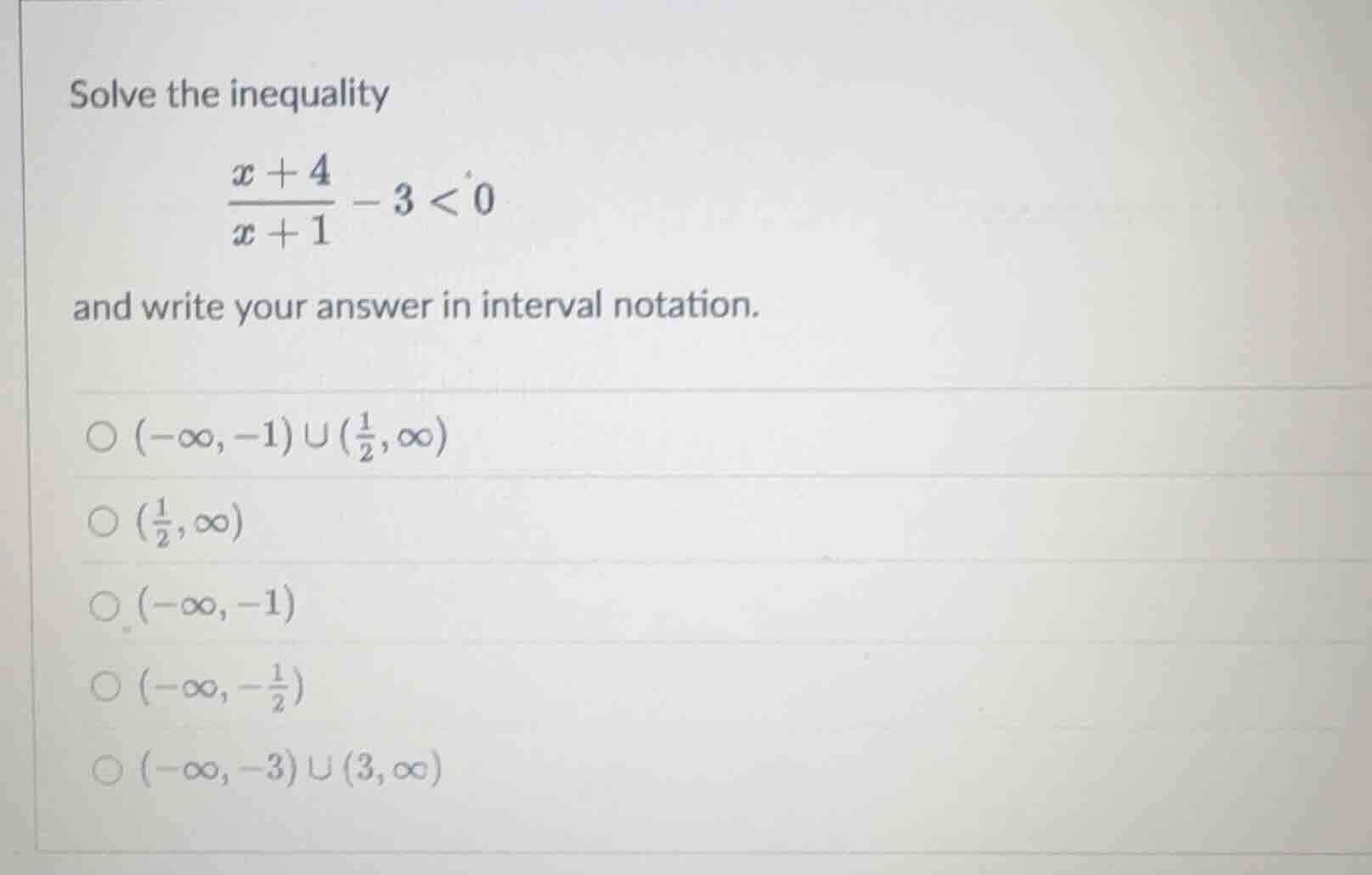
solve the inequality
\\(\frac{x + 4}{x + 1} - 3 < 0\\)
and write your answer in interval notation.
\\(\bigcirc (-\infty, -1) \cup (\frac{1}{2}, \infty)\\)
\\(\bigcirc (\frac{1}{2}, \infty)\\)
\\(\bigcirc (-\infty, -1)\\)
\\(\bigcirc (-\infty, -\frac{1}{2})\\)
\\(\bigcirc (-\infty, -3) \cup (3, \infty)\\)
Step1: Simplify the inequality
First, we combine the terms in the inequality \(\frac{x + 4}{x + 1}-3<0\). We get a common denominator of \(x + 1\):
\[
\frac{x + 4-3(x + 1)}{x + 1}<0
\]
Then, we expand and simplify the numerator:
\[
\frac{x + 4-3x - 3}{x + 1}<0\implies\frac{-2x + 1}{x + 1}<0
\]
Step2: Find critical points
The critical points occur where the numerator is zero or the denominator is zero.
- For the numerator \(-2x+1 = 0\), we solve for \(x\):
\[
-2x=-1\implies x=\frac{1}{2}
\]
- For the denominator \(x + 1=0\), we solve for \(x\):
\[
x=-1
\]
Step3: Test intervals
We divide the number line into three intervals based on the critical points \(x=-1\) and \(x = \frac{1}{2}\):
- Interval \((-\infty,-1)\): Let's choose a test point, say \(x=-2\). Substitute into \(\frac{-2x + 1}{x + 1}\):
\[
\frac{-2(-2)+1}{-2 + 1}=\frac{4 + 1}{-1}=-5<0
\]
So the inequality is satisfied in this interval.
- Interval \((-1,\frac{1}{2})\): Let's choose a test point, say \(x = 0\). Substitute into \(\frac{-2x + 1}{x + 1}\):
\[
\frac{-2(0)+1}{0 + 1}=1>0
\]
So the inequality is not satisfied in this interval.
- Interval \((\frac{1}{2},\infty)\): Let's choose a test point, say \(x = 1\). Substitute into \(\frac{-2x + 1}{x + 1}\):
\[
\frac{-2(1)+1}{1+1}=\frac{-1}{2}<0
\]
So the inequality is satisfied in this interval.
We also need to note that \(x=-1\) makes the denominator zero, so it is not included in the domain, and \(x=\frac{1}{2}\) makes the numerator zero, and at \(x = \frac{1}{2}\), the expression is zero, which does not satisfy the strict inequality \(<0\).

Snap & solve any problem in the app
Get step-by-step solutions on Sovi AI
Photo-based solutions with guided steps
Explore more problems and detailed explanations
\((-\infty,-1)\cup(\frac{1}{2},\infty)\)