QUESTION IMAGE
Question
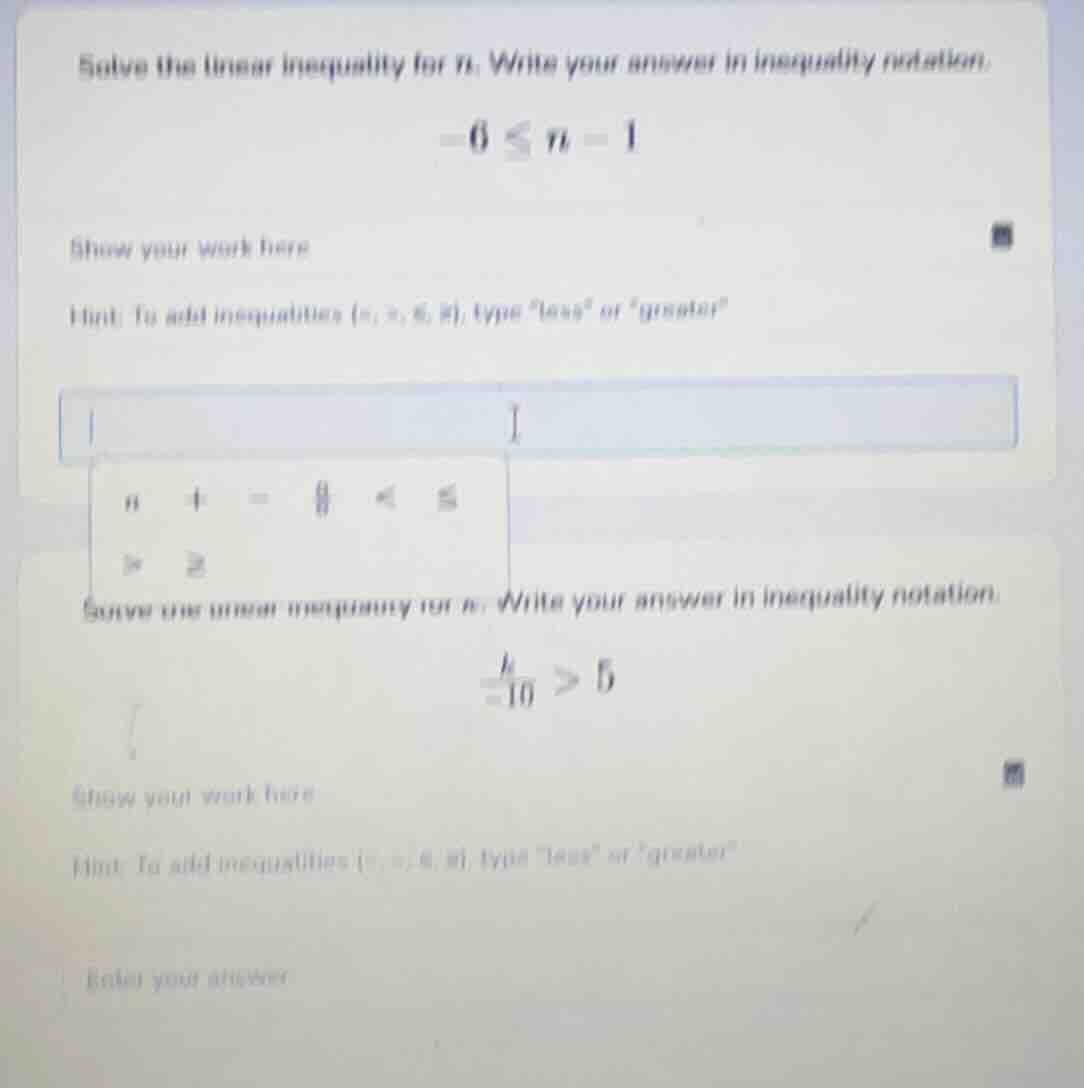
solve the linear inequality for n. write your answer in inequality notation.
$-6 \le n - 1$
show your work here
hint: to add inequalities (<, >, ≤, ≥), type \less\ or \greater\
solve the linear inequality for n. write your answer in inequality notation.
$\frac{h}{-10} > 5$
show your work here
hint: to add inequalities (<, >, ≤, ≥), type \less\ or \greater\
First Inequality: \(-6 \leq n - 1\)
Step1: Add 1 to both sides
To isolate \(n\), we add 1 to both sides of the inequality. This is allowed because adding the same number to both sides of an inequality does not change the direction of the inequality.
\[
-6 + 1 \leq n - 1 + 1
\]
Step2: Simplify both sides
Simplifying the left side: \(-6 + 1=-5\). Simplifying the right side: \(n - 1+ 1 = n\). So we get:
\[
-5 \leq n
\]
Which can also be written as \(n\geq - 5\)
Second Inequality: \(\frac{h}{- 10}>5\)
Step1: Multiply both sides by - 10
To isolate \(h\), we multiply both sides of the inequality by - 10. When we multiply or divide an inequality by a negative number, the direction of the inequality sign changes.
\[
\frac{h}{-10}\times(-10)<5\times(-10)
\]
Step2: Simplify both sides
Simplifying the left side: \(\frac{h}{-10}\times(-10)=h\). Simplifying the right side: \(5\times(-10)=- 50\). So we get:
\[
h < - 50
\]

Snap & solve any problem in the app
Get step-by-step solutions on Sovi AI
Photo-based solutions with guided steps
Explore more problems and detailed explanations
For \(-6\leq n - 1\), the solution is \(n\geq - 5\)
For \(\frac{h}{-10}>5\), the solution is \(h < - 50\)