QUESTION IMAGE
Question
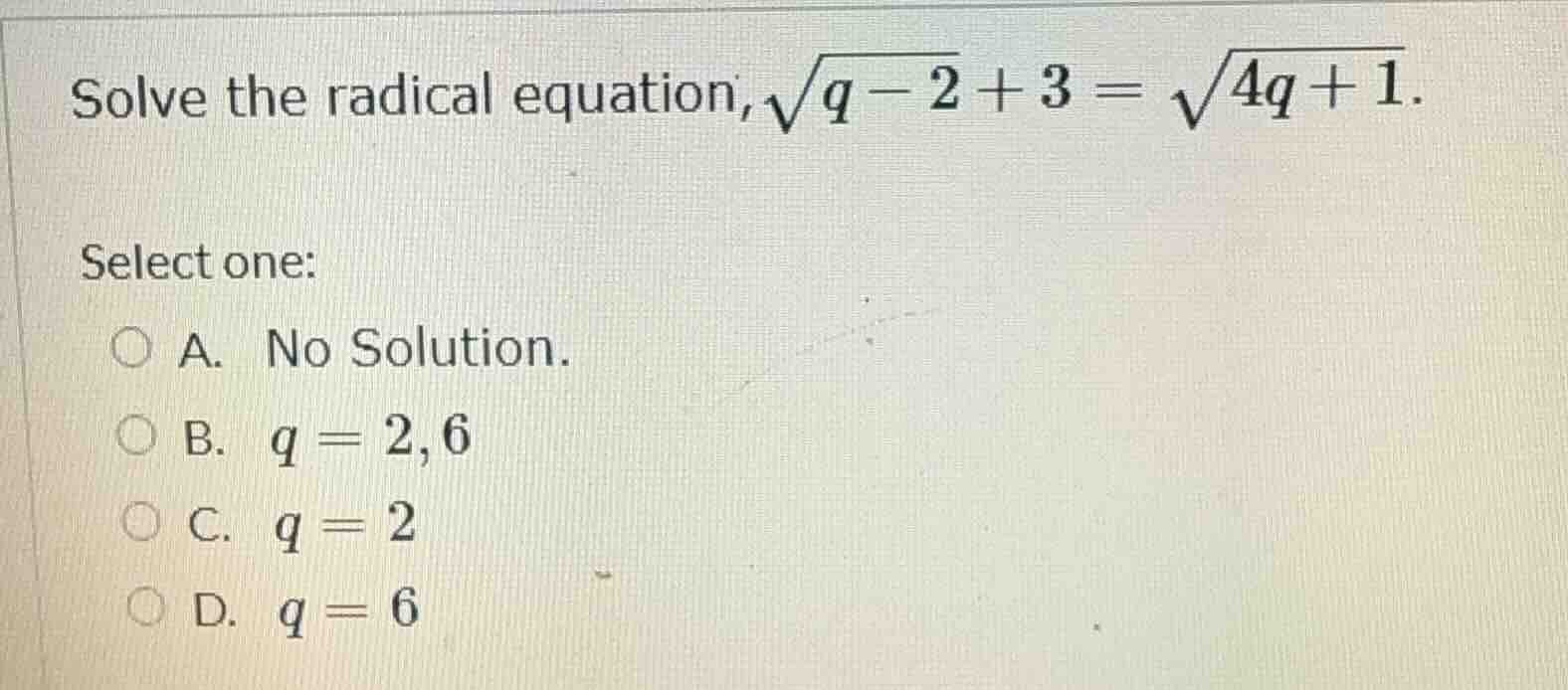
solve the radical equation, \\(\sqrt{q - 2} + 3 = \sqrt{4q + 1}\\). select one: \\(\bigcirc\\) a. no solution. \\(\bigcirc\\) b. \\(q = 2, 6\\) \\(\bigcirc\\) c. \\(q = 2\\) \\(\bigcirc\\) d. \\(q = 6\\)
Step1: Isolate one radical term
$\sqrt{q-2} = \sqrt{4q+1} - 3$
Step2: Square both sides
$(\sqrt{q-2})^2 = (\sqrt{4q+1} - 3)^2$
$q - 2 = (4q + 1) - 6\sqrt{4q+1} + 9$
Step3: Simplify the equation
$q - 2 = 4q + 10 - 6\sqrt{4q+1}$
$-3q - 12 = -6\sqrt{4q+1}$
Divide both sides by $-3$:
$q + 4 = 2\sqrt{4q+1}$
Step4: Square both sides again
$(q + 4)^2 = (2\sqrt{4q+1})^2$
$q^2 + 8q + 16 = 4(4q + 1)$
$q^2 + 8q + 16 = 16q + 4$
Step5: Rearrange to quadratic form
$q^2 - 8q + 12 = 0$
Factor:
$(q - 2)(q - 6) = 0$
Potential solutions: $q=2, q=6$
Step6: Verify solutions
For $q=2$:
Left side: $\sqrt{2-2}+3=0+3=3$
Right side: $\sqrt{4*2+1}=\sqrt{9}=3$ (valid)
For $q=6$:
Left side: $\sqrt{6-2}+3=2+3=5$
Right side: $\sqrt{4*6+1}=\sqrt{25}=5$ (valid)

Snap & solve any problem in the app
Get step-by-step solutions on Sovi AI
Photo-based solutions with guided steps
Explore more problems and detailed explanations
B. $q = 2, 6$