QUESTION IMAGE
Question
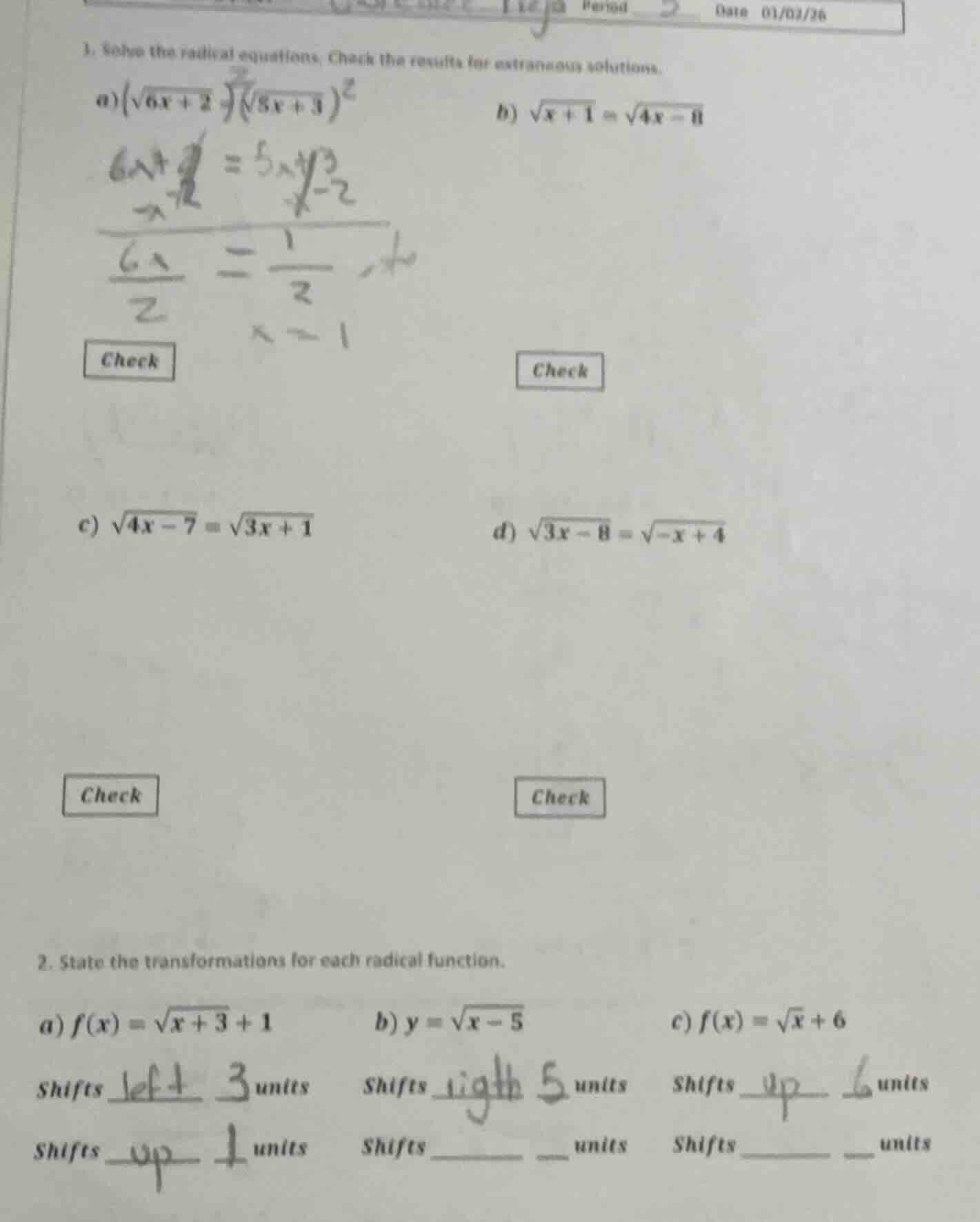
- solve the radical equations. check the results for extraneous solutions.
a) $(sqrt{6x + 2})^2 = (sqrt{5x + 3})^2$
b) $sqrt{x + 1} = sqrt{4x - 8}$
c) $sqrt{4x - 7} = sqrt{3x + 1}$
d) $sqrt{3x - 8} = sqrt{-x + 4}$
- state the transformations for each radical function.
a) $f(x) = sqrt{x + 3} + 1$
b) $y = sqrt{x - 5}$
c) $f(x) = sqrt{x} + 6$
Part 1: Solve Radical Equations (a - d)
a) Solve \(\boldsymbol{\sqrt{6x + 2} = \sqrt{5x + 3}}\)
Step 1: Square both sides
To eliminate the square roots, square both sides of the equation:
\((\sqrt{6x + 2})^2 = (\sqrt{5x + 3})^2\)
Simplify: \(6x + 2 = 5x + 3\)
Step 2: Solve for \(x\)
Subtract \(5x\) and \(2\) from both sides:
\(6x - 5x = 3 - 2\)
Simplify: \(x = 1\)
Step 3: Check for extraneous solutions
Substitute \(x = 1\) into the original equation:
Left: \(\sqrt{6(1) + 2} = \sqrt{8}\)
Right: \(\sqrt{5(1) + 3} = \sqrt{8}\)
Both sides are equal, so \(x = 1\) is valid.
Step 1: Square both sides
Square both sides to eliminate roots:
\((\sqrt{x + 1})^2 = (\sqrt{4x - 8})^2\)
Simplify: \(x + 1 = 4x - 8\)
Step 2: Solve for \(x\)
Subtract \(x\) and add \(8\) to both sides:
\(1 + 8 = 4x - x\)
Simplify: \(9 = 3x\)
Divide by \(3\): \(x = 3\)
Step 3: Check for extraneous solutions
Substitute \(x = 3\) into the original equation:
Left: \(\sqrt{3 + 1} = \sqrt{4} = 2\)
Right: \(\sqrt{4(3) - 8} = \sqrt{4} = 2\)
Both sides are equal, so \(x = 3\) is valid.
Step 1: Square both sides
Square both sides:
\((\sqrt{4x - 7})^2 = (\sqrt{3x + 1})^2\)
Simplify: \(4x - 7 = 3x + 1\)
Step 2: Solve for \(x\)
Subtract \(3x\) and add \(7\) to both sides:
\(4x - 3x = 1 + 7\)
Simplify: \(x = 8\)
Step 3: Check for extraneous solutions
Substitute \(x = 8\) into the original equation:
Left: \(\sqrt{4(8) - 7} = \sqrt{25} = 5\)
Right: \(\sqrt{3(8) + 1} = \sqrt{25} = 5\)
Both sides are equal, so \(x = 8\) is valid.

Snap & solve any problem in the app
Get step-by-step solutions on Sovi AI
Photo-based solutions with guided steps
Explore more problems and detailed explanations
\(x = 1\)