QUESTION IMAGE
Question
solve.
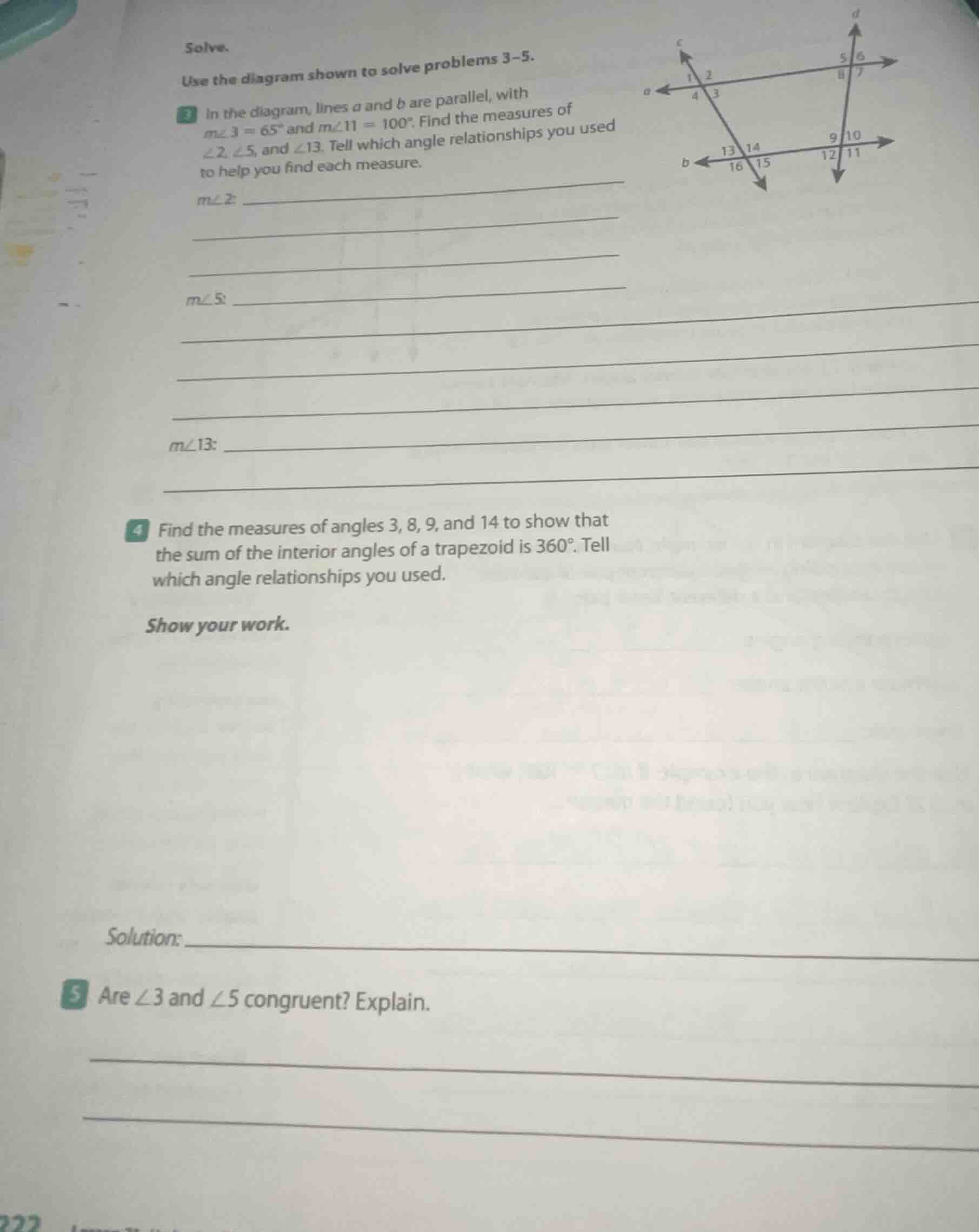
use the diagram shown to solve problems 3–5.
3 in the diagram, lines a and b are parallel, with
m∠3 = 65° and m∠11 = 100°. find the measures of
∠2, ∠5, and ∠13. tell which angle relationships you used
to help you find each measure.
m∠2:
m∠5:
m∠13:
4 find the measures of angles 3, 8, 9, and 14 to show that
the sum of the interior angles of a trapezoid is 360°. tell
which angle relationships you used.
show your work.
solution:
5 are ∠3 and ∠5 congruent? explain.
Problem 3
Step 1: Find \( m\angle 2 \)
\(\angle 2\) and \(\angle 3\) are supplementary (linear pair), so \( m\angle 2 + m\angle 3 = 180^\circ \). Given \( m\angle 3 = 65^\circ \), then \( m\angle 2 = 180^\circ - 65^\circ = 115^\circ \).
Step 2: Find \( m\angle 5 \)
\(\angle 5\) and \(\angle 11\) are related by the transversal and parallel lines. \(\angle 5\) and \(\angle 11\) are same - side interior angles? Wait, no. Wait, \(\angle 5\) and \(\angle 11\): since lines \(a\) and \(b\) are parallel, and the transversal is \(d\)? Wait, no, \(\angle 5\) and \(\angle 11\): actually, \(\angle 5\) and \(\angle 11\) are same - side interior angles? Wait, no, \(\angle 5\) and \(\angle 11\): let's see, \(\angle 11\) and \(\angle 9\) are vertical angles? No, \(\angle 11\) and \(\angle 9\) are supplementary? Wait, no, \(\angle 11\) and \(\angle 9\): since \(\angle 11 = 100^\circ\), and \(\angle 9\) and \(\angle 11\) are same - side interior angles? Wait, no, lines \(a\) and \(b\) are parallel, cut by transversal \(d\). So \(\angle 5\) and \(\angle 9\) are corresponding angles? Wait, maybe a better approach: \(\angle 5\) and \(\angle 11\): \(\angle 5\) and \(\angle 11\) are same - side interior angles? Wait, no, \(\angle 5\) and \(\angle 11\): let's use the fact that \(\angle 5\) and \(\angle 8\) are vertical angles? No, \(\angle 5\) and \(\angle 8\) are supplementary (linear pair). Wait, maybe I made a mistake. Let's start over.
\(\angle 11 = 100^\circ\), \(\angle 11\) and \(\angle 9\) are same - side interior angles? No, lines \(a\) and \(b\) are parallel, cut by transversal \(d\). So \(\angle 5\) and \(\angle 9\) are corresponding angles. \(\angle 11\) and \(\angle 9\) are supplementary (linear pair? No, \(\angle 11\) and \(\angle 9\): \(\angle 11 + \angle 9=180^\circ\) (since they are same - side interior angles? Wait, no, if lines \(a\) and \(b\) are parallel, and transversal \(d\) cuts them, then \(\angle 5\) and \(\angle 9\) are corresponding angles, so \(m\angle 5=m\angle 9\). And \(\angle 9\) and \(\angle 11\) are supplementary (linear pair), so \(m\angle 9 = 180^\circ - m\angle 11=180 - 100 = 80^\circ\)? Wait, no, that can't be. Wait, \(\angle 11\) and \(\angle 9\): \(\angle 11\) and \(\angle 9\) are same - side interior angles? No, same - side interior angles add up to \(180^\circ\). So if lines \(a\) and \(b\) are parallel, then \(\angle 5+\angle 11 = 180^\circ\)? Wait, no, \(\angle 5\) and \(\angle 11\) are same - side interior angles. So \(m\angle 5=180^\circ - m\angle 11 = 180 - 100=80^\circ\)? Wait, no, maybe \(\angle 5\) and \(\angle 11\) are alternate interior angles? No, alternate interior angles are equal. Wait, I think I messed up the angle relationships. Let's use the fact that \(\angle 5\) and \(\angle 2\): no, \(\angle 2 = 115^\circ\), \(\angle 5\) and \(\angle 2\): are they corresponding angles? No, \(\angle 2\) and \(\angle 14\) are corresponding angles. Wait, maybe the transversal for \(\angle 5\) and \(\angle 11\) is the line \(d\). So \(\angle 5\) and \(\angle 11\) are same - side interior angles, so \(m\angle 5 = 180^\circ - 100^\circ=80^\circ\).
Step 3: Find \( m\angle 13 \)
\(\angle 13\) and \(\angle 3\) are alternate interior angles (since lines \(a\) and \(b\) are parallel, cut by transversal \(c\)). So \(m\angle 13=m\angle 3 = 65^\circ\) (alternate interior angles are congruent).
Problem 4
We know that \(m\angle 3 = 65^\circ\) (given).
\(\angle 8\) and \(\angle 3\): \(\angle 8\) and \(\angle 3\) are same - side interior angles? Wait, no, \(\angle 8\) and \(\angle 3\): lines \(a\) and…

Snap & solve any problem in the app
Get step-by-step solutions on Sovi AI
Photo-based solutions with guided steps
Explore more problems and detailed explanations
Problem 3
Step 1: Find \( m\angle 2 \)
\(\angle 2\) and \(\angle 3\) are supplementary (linear pair), so \( m\angle 2 + m\angle 3 = 180^\circ \). Given \( m\angle 3 = 65^\circ \), then \( m\angle 2 = 180^\circ - 65^\circ = 115^\circ \).
Step 2: Find \( m\angle 5 \)
\(\angle 5\) and \(\angle 11\) are related by the transversal and parallel lines. \(\angle 5\) and \(\angle 11\) are same - side interior angles? Wait, no. Wait, \(\angle 5\) and \(\angle 11\): since lines \(a\) and \(b\) are parallel, and the transversal is \(d\)? Wait, no, \(\angle 5\) and \(\angle 11\): actually, \(\angle 5\) and \(\angle 11\) are same - side interior angles? Wait, no, \(\angle 5\) and \(\angle 11\): let's see, \(\angle 11\) and \(\angle 9\) are vertical angles? No, \(\angle 11\) and \(\angle 9\) are supplementary? Wait, no, \(\angle 11\) and \(\angle 9\): since \(\angle 11 = 100^\circ\), and \(\angle 9\) and \(\angle 11\) are same - side interior angles? Wait, no, lines \(a\) and \(b\) are parallel, cut by transversal \(d\). So \(\angle 5\) and \(\angle 9\) are corresponding angles? Wait, maybe a better approach: \(\angle 5\) and \(\angle 11\): \(\angle 5\) and \(\angle 11\) are same - side interior angles? Wait, no, \(\angle 5\) and \(\angle 11\): let's use the fact that \(\angle 5\) and \(\angle 8\) are vertical angles? No, \(\angle 5\) and \(\angle 8\) are supplementary (linear pair). Wait, maybe I made a mistake. Let's start over.
\(\angle 11 = 100^\circ\), \(\angle 11\) and \(\angle 9\) are same - side interior angles? No, lines \(a\) and \(b\) are parallel, cut by transversal \(d\). So \(\angle 5\) and \(\angle 9\) are corresponding angles. \(\angle 11\) and \(\angle 9\) are supplementary (linear pair? No, \(\angle 11\) and \(\angle 9\): \(\angle 11 + \angle 9=180^\circ\) (since they are same - side interior angles? Wait, no, if lines \(a\) and \(b\) are parallel, and transversal \(d\) cuts them, then \(\angle 5\) and \(\angle 9\) are corresponding angles, so \(m\angle 5=m\angle 9\). And \(\angle 9\) and \(\angle 11\) are supplementary (linear pair), so \(m\angle 9 = 180^\circ - m\angle 11=180 - 100 = 80^\circ\)? Wait, no, that can't be. Wait, \(\angle 11\) and \(\angle 9\): \(\angle 11\) and \(\angle 9\) are same - side interior angles? No, same - side interior angles add up to \(180^\circ\). So if lines \(a\) and \(b\) are parallel, then \(\angle 5+\angle 11 = 180^\circ\)? Wait, no, \(\angle 5\) and \(\angle 11\) are same - side interior angles. So \(m\angle 5=180^\circ - m\angle 11 = 180 - 100=80^\circ\)? Wait, no, maybe \(\angle 5\) and \(\angle 11\) are alternate interior angles? No, alternate interior angles are equal. Wait, I think I messed up the angle relationships. Let's use the fact that \(\angle 5\) and \(\angle 2\): no, \(\angle 2 = 115^\circ\), \(\angle 5\) and \(\angle 2\): are they corresponding angles? No, \(\angle 2\) and \(\angle 14\) are corresponding angles. Wait, maybe the transversal for \(\angle 5\) and \(\angle 11\) is the line \(d\). So \(\angle 5\) and \(\angle 11\) are same - side interior angles, so \(m\angle 5 = 180^\circ - 100^\circ=80^\circ\).
Step 3: Find \( m\angle 13 \)
\(\angle 13\) and \(\angle 3\) are alternate interior angles (since lines \(a\) and \(b\) are parallel, cut by transversal \(c\)). So \(m\angle 13=m\angle 3 = 65^\circ\) (alternate interior angles are congruent).
Problem 4
We know that \(m\angle 3 = 65^\circ\) (given).
\(\angle 8\) and \(\angle 3\): \(\angle 8\) and \(\angle 3\) are same - side interior angles? Wait, no, \(\angle 8\) and \(\angle 3\): lines \(a\) and \(b\) are parallel, cut by transversal \(d\)? No, \(\angle 8\) and \(\angle 3\): \(\angle 8\) and \(\angle 3\) are supplementary? Wait, no, \(\angle 8\) and \(\angle 5\) are linear pair, \(m\angle 5 = 80^\circ\) (from problem 3), so \(m\angle 8=180^\circ - 80^\circ = 100^\circ\).
\(\angle 9\) and \(\angle 11\) are same - side interior angles? Wait, \(m\angle 9 = 180^\circ - m\angle 11=180 - 100 = 80^\circ\) (since lines \(a\) and \(b\) are parallel, cut by transversal \(d\), same - side interior angles are supplementary).
\(\angle 14\) and \(\angle 2\) are corresponding angles (lines \(a\) and \(b\) are parallel, cut by transversal \(c\)). Since \(m\angle 2 = 115^\circ\) (from problem 3), \(m\angle 14 = 115^\circ\).
Now, sum of angles: \(m\angle 3+m\angle 8+m\angle 9+m\angle 14=65^\circ + 100^\circ+80^\circ + 115^\circ=(65 + 115)+(100 + 80)=180+180 = 360^\circ\).
Problem 5
To determine if \(\angle 3\) and \(\angle 5\) are congruent, we compare their measures. From problem 3, \(m\angle 3 = 65^\circ\) and \(m\angle 5 = 80^\circ\). Since \(65^\circ
eq80^\circ\), \(\angle 3\) and \(\angle 5\) are not congruent. The reason is that their angle measures are different (\(m\angle 3 = 65^\circ\) and \(m\angle 5 = 80^\circ\)), so they do not have the same measure and thus are not congruent.
Final Answers
Problem 3
\(m\angle 2=\boldsymbol{115^\circ}\) (supplementary to \(\angle 3\)), \(m\angle 5=\boldsymbol{80^\circ}\) (same - side interior angles with \(\angle 11\)), \(m\angle 13=\boldsymbol{65^\circ}\) (alternate interior angles with \(\angle 3\))
Problem 4
\(m\angle 3 = 65^\circ\), \(m\angle 8 = 100^\circ\), \(m\angle 9 = 80^\circ\), \(m\angle 14 = 115^\circ\), and \(65 + 100+80 + 115 = 360^\circ\)
Problem 5
\(\angle 3\) and \(\angle 5\) are not congruent because \(m\angle 3 = 65^\circ\) and \(m\angle 5 = 80^\circ\), and congruent angles must have equal measures.