QUESTION IMAGE
Question
solving algebraically for unknown values
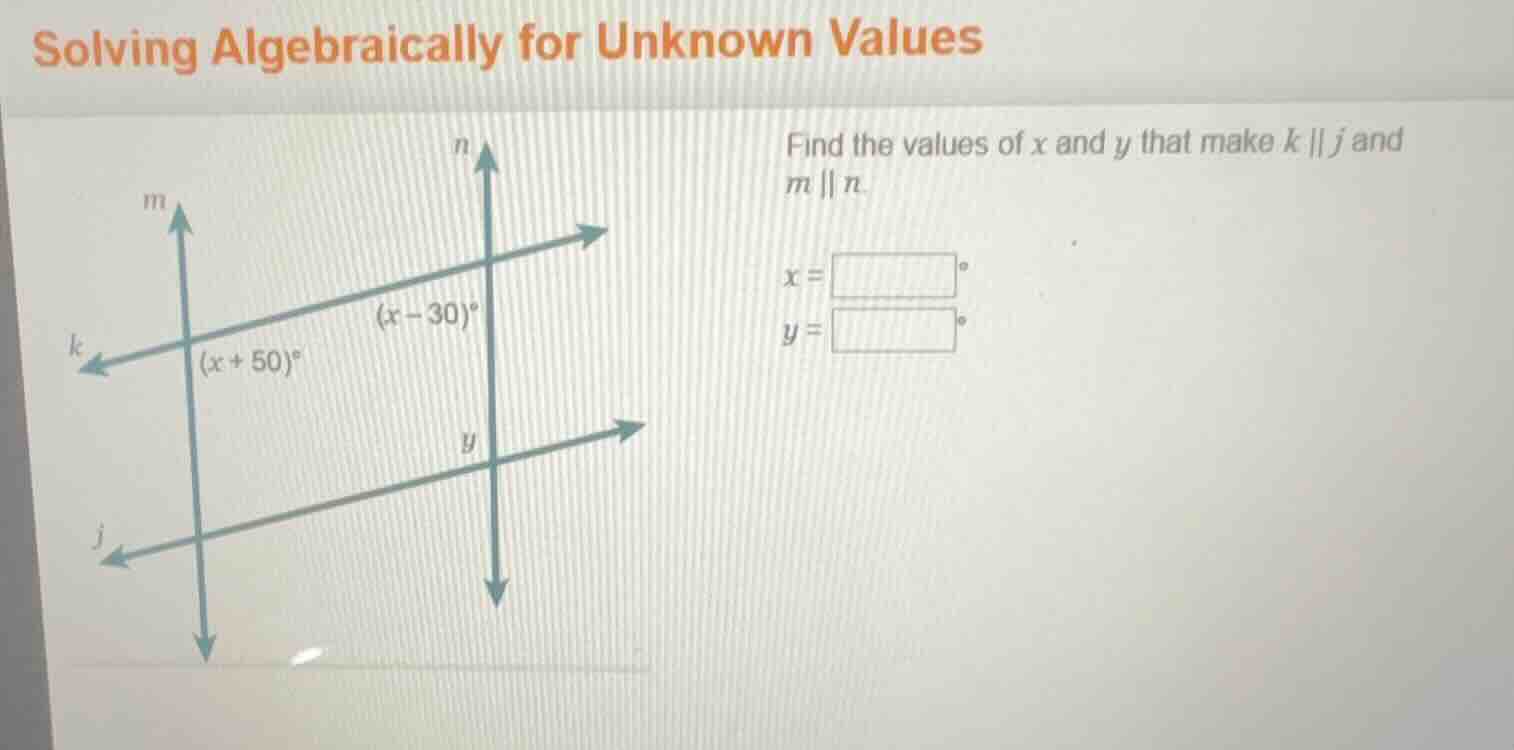
find the values of x and y that make ( k parallel j ) and ( m parallel n ).
( x = square^circ )
( y = square^circ )
Step1: Use alternate interior angles (m || n)
Since \( m \parallel n \), the alternate interior angles are equal. So, \( x + 50 = x - 30 \)? Wait, no, that can't be. Wait, actually, when \( k \parallel j \) and \( m \parallel n \), the consecutive interior angles or maybe same - side? Wait, no, let's re - examine. Wait, if \( m \parallel n \), then the same - side interior angles should be supplementary? Wait, no, the angles \( (x + 50)^\circ \) and \( (x - 30)^\circ \): Wait, maybe I made a mistake. Wait, actually, when two parallel lines are cut by a transversal, the alternate interior angles are equal. Wait, no, let's look at the lines. The line \( k \) and \( j \) are parallel, and \( m \) and \( n \) are parallel. So the angle \( (x + 50)^\circ \) and \( (x - 30)^\circ \): Wait, no, maybe the sum of \( (x + 50) \) and \( (x - 30) \) is 180? Wait, let's set up the equation. If \( m \parallel n \), then the consecutive interior angles are supplementary. So \( (x + 50)+(x - 30)=180 \).
Simplify the left - hand side: \( x + 50+x - 30 = 2x+20 \).
So \( 2x + 20=180 \).
Subtract 20 from both sides: \( 2x=180 - 20=160 \).
Divide both sides by 2: \( x = 80 \).
Step2: Find the value of \( y \)
Now that we know \( x = 80 \), the angle \( (x - 30)^\circ=(80 - 30)^\circ = 50^\circ \). Since \( k \parallel j \) and \( m \parallel n \), the angle \( y \) and \( (x - 30)^\circ \) are same - side interior angles? Wait, no, actually, since \( m \parallel n \) and the line cutting them (the one with \( y \) and \( (x - 30)^\circ \)) is a transversal, and also \( k \parallel j \). Wait, the angle \( (x - 30)^\circ = 50^\circ \), and \( y \) and \( (x - 30)^\circ \) are supplementary? No, wait, if \( k \parallel j \), then the angle \( y \) and \( (x + 50)^\circ \): Wait, \( x + 50=80 + 50 = 130^\circ \). Wait, no, let's see. Alternatively, since \( m \parallel n \), the angle \( (x - 30)^\circ = 50^\circ \), and \( y \) is equal to \( (x + 50)^\circ \)? Wait, no. Wait, when \( x = 80 \), \( x+50 = 130 \), \( x - 30 = 50 \). Now, since \( k \parallel j \), the angle \( y \) and \( (x + 50)^\circ \) are equal? Wait, no, let's look at the vertical angles or corresponding angles. Wait, the angle \( (x + 50)^\circ=130^\circ \), and since \( k \parallel j \), the angle \( y \) should be equal to \( (x + 50)^\circ \)? Wait, no, actually, the angle \( (x - 30)^\circ = 50^\circ \), and \( y \) and \( (x - 30)^\circ \) are supplementary? No, wait, \( y \) and \( (x - 30)^\circ \) are same - side interior angles? Wait, no, let's think again. Since \( m \parallel n \), the angle \( (x - 30)^\circ \) and \( y \): Wait, the line with \( y \) is parallel to the line with \( (x + 50)^\circ \) (because \( k \parallel j \)). So the angle \( y \) and \( (x + 50)^\circ \) are equal? Wait, \( x + 50=130 \), but that can't be. Wait, no, the angle \( (x - 30)^\circ = 50^\circ \), and \( y \) and \( (x - 30)^\circ \) are supplementary? Wait, no, if \( k \parallel j \), then the angle \( y \) and \( (x - 30)^\circ \) are same - side interior angles? Wait, no, let's use the fact that \( x = 80 \), so \( x+50 = 130 \), \( x - 30 = 50 \). Now, since \( m \parallel n \), the angle \( (x + 50)^\circ \) and \( y \) are same - side interior angles? Wait, no, the angle \( (x - 30)^\circ = 50^\circ \), and \( y \) is equal to \( 180 - 50=130 \)? Wait, no, I'm getting confused. Wait, actually, when \( k \parallel j \), the angle \( y \) and the angle \( (x + 50)^\circ \) are corresponding angles? Wait, \( x + 50=130 \), so \( y = 130 \)? Wait, no, let's check the parallel…

Snap & solve any problem in the app
Get step-by-step solutions on Sovi AI
Photo-based solutions with guided steps
Explore more problems and detailed explanations
\( x=\boxed{80} \), \( y=\boxed{130} \)