QUESTION IMAGE
Question
solving equations with grouping symbols
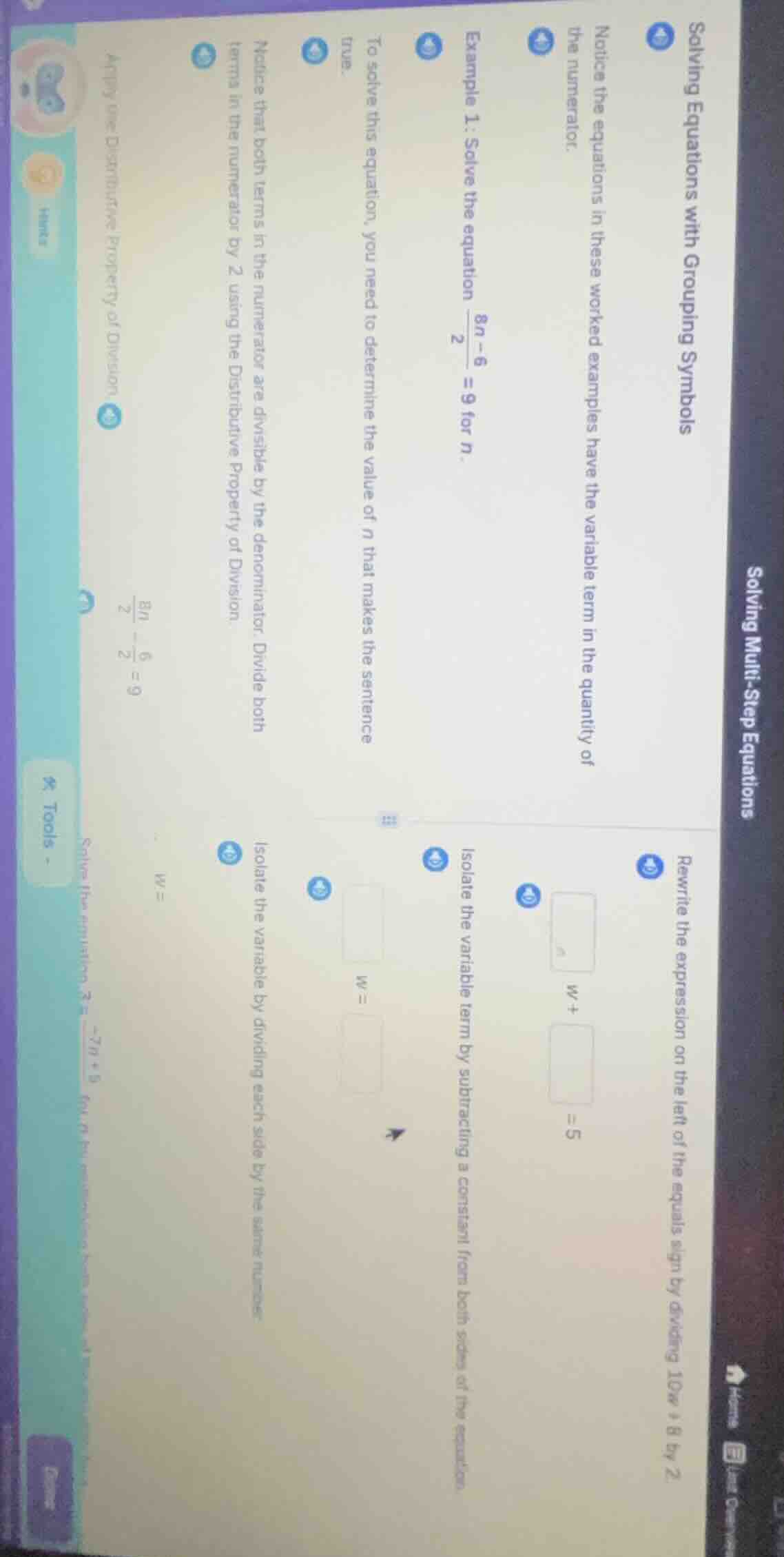
notice the equations in these worked examples have the variable term in the quantity of the numerator.
example 1: solve the equation \\(\frac{8n - 6}{2} = 9\\) for \\(n\\).
to solve this equation, you need to determine the value of \\(n\\) that makes the sentence true.
notice that both terms in the numerator are divisible by the denominator. divide both terms in the numerator by 2 using the distributive property of division
apply the distributive property of division
\\(\frac{8n}{2} - \frac{6}{2} = 9\\)
solving multi - step equations
rewrite the expression on the left of the equals sign by dividing \\(10w + 8\\) by 2.
\\(w + \square = 5\\)
isolate the variable term by subtracting a constant from both sides of the equation.
\\(w = \square\\)
isolate the variable by dividing each side by the same number.
Step1: Apply Distributive Property of Division
We have the equation \(\frac{8n - 6}{2}=9\). Using the distributive property of division \(\frac{a - b}{c}=\frac{a}{c}-\frac{b}{c}\), we can rewrite the left - hand side as \(\frac{8n}{2}-\frac{6}{2}=9\). Simplifying \(\frac{8n}{2}\) gives \(4n\) and \(\frac{6}{2}\) gives \(3\), so the equation becomes \(4n-3 = 9\).
Step2: Isolate the Variable Term
To isolate the variable term \(4n\), we add \(3\) to both sides of the equation \(4n-3 = 9\). According to the addition property of equality (if \(a=b\), then \(a + c=b + c\)), we have \(4n-3+3=9 + 3\), which simplifies to \(4n=12\).
Step3: Solve for \(n\)
To solve for \(n\), we divide both sides of the equation \(4n = 12\) by \(4\). Using the division property of equality (if \(a=b\), then \(\frac{a}{c}=\frac{b}{c}\) for \(c
eq0\)), we get \(\frac{4n}{4}=\frac{12}{4}\), so \(n = 3\).

Snap & solve any problem in the app
Get step-by-step solutions on Sovi AI
Photo-based solutions with guided steps
Explore more problems and detailed explanations
\(n = 3\)