QUESTION IMAGE
Question
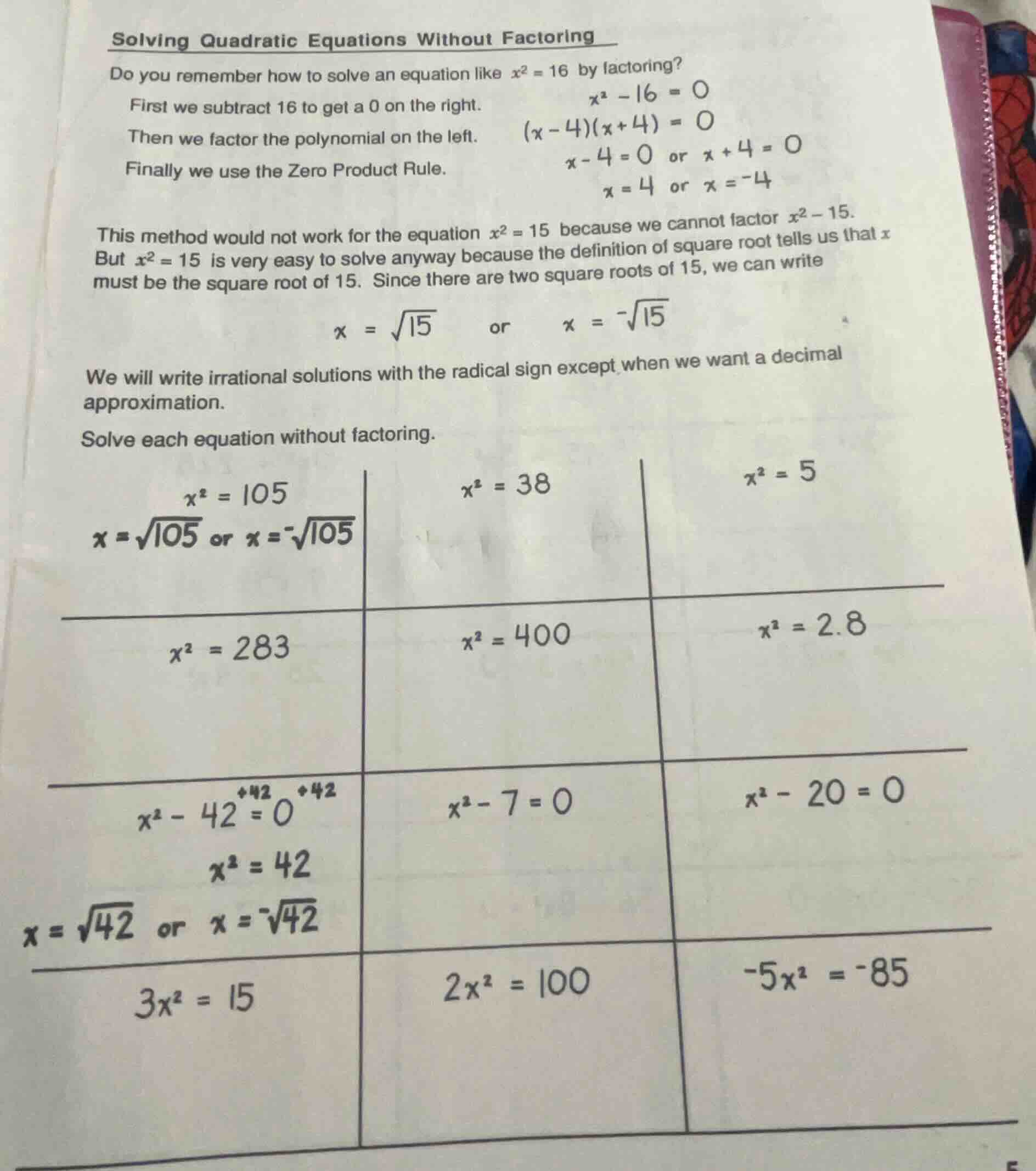
solving quadratic equations without factoring
do you remember how to solve an equation like $x^2 = 16$ by factoring?
first we subtract 16 to get a 0 on the right. $x^2 - 16 = 0$
then we factor the polynomial on the left. $(x - 4)(x + 4) = 0$
finally we use the zero product rule. $x - 4 = 0$ or $x + 4 = 0$
$x = 4$ or $x = -4$
this method would not work for the equation $x^2 = 15$ because we cannot factor $x^2 - 15$.
but $x^2 = 15$ is very easy to solve anyway because the definition of square root tells us that $x$
must be the square root of 15. since there are two square roots of 15, we can write
$x = \sqrt{15}$ or $x = -\sqrt{15}$
we will write irrational solutions with the radical sign except when we want a decimal
approximation.
solve each equation without factoring.
$x^2 = 105$ $x = \sqrt{105}$ or $x = -\sqrt{105}$ | $x^2 = 38$ | $x^2 = 5$
$x^2 = 283$ | $x^2 = 400$ | $x^2 = 2.8$
$x^2 - 42 = 0$ $x^2 = 42$ $x = \sqrt{42}$ or $x = -\sqrt{42}$ | $x^2 - 7 = 0$ | $x^2 - 20 = 0$
$3x^2 = 15$ | $2x^2 = 100$ | $-5x^2 = -85$
For \( x^2 = 38 \)
Step1: Apply square root property
For an equation \( x^2 = a \) (where \( a\geq0 \)), the solutions are \( x = \sqrt{a} \) or \( x = -\sqrt{a} \). Here, \( a = 38 \), so we take the square root of both sides.
\( x = \sqrt{38} \) or \( x = -\sqrt{38} \)
For \( x^2 = 5 \)
Step1: Apply square root property
Using the property for \( x^2 = a \) (\( a\geq0 \)), with \( a = 5 \), we get the solutions by taking the square root of both sides.
\( x = \sqrt{5} \) or \( x = -\sqrt{5} \)
For \( x^2 = 283 \)
Step1: Apply square root property
For \( x^2 = 283 \), since \( 283\geq0 \), we use the square root property.
\( x = \sqrt{283} \) or \( x = -\sqrt{283} \)
For \( x^2 = 400 \)

Snap & solve any problem in the app
Get step-by-step solutions on Sovi AI
Photo-based solutions with guided steps
Explore more problems and detailed explanations
Step1: Isolate \( x^2 \)
Divide both sides of \( -5x^2 = -85 \) by -5:
\( x^2=\frac{-85}{-5}=17 \)
Step2: Apply square root property
Using the property for \( x^2 = 17 \):
\( x = \sqrt{17} \) or \( x = -\sqrt{17} \)
Final Answers (summarized for each equation):
- \( x^2 = 38 \): \( \boldsymbol{x = \sqrt{38}} \) or \( \boldsymbol{x = -\sqrt{38}} \)
- \( x^2 = 5 \): \( \boldsymbol{x = \sqrt{5}} \) or \( \boldsymbol{x = -\sqrt{5}} \)
- \( x^2 = 283 \): \( \boldsymbol{x = \sqrt{283}} \) or \( \boldsymbol{x = -\sqrt{283}} \)
- \( x^2 = 400 \): \( \boldsymbol{x = 20} \) or \( \boldsymbol{x = -20} \)
- \( x^2 = 2.8 \): \( \boldsymbol{x = \sqrt{2.8}} \) or \( \boldsymbol{x = -\sqrt{2.8}} \)
- \( x^2 - 7 = 0 \): \( \boldsymbol{x = \sqrt{7}} \) or \( \boldsymbol{x = -\sqrt{7}} \)
- \( x^2 - 20 = 0 \): \( \boldsymbol{x = 2\sqrt{5}} \) or \( \boldsymbol{x = -2\sqrt{5}} \)
- \( 3x^2 = 15 \): \( \boldsymbol{x = \sqrt{5}} \) or \( \boldsymbol{x = -\sqrt{5}} \)
- \( 2x^2 = 100 \): \( \boldsymbol{x = 5\sqrt{2}} \) or \( \boldsymbol{x = -5\sqrt{2}} \)
- \( -5x^2 = -85 \): \( \boldsymbol{x = \sqrt{17}} \) or \( \boldsymbol{x = -\sqrt{17}} \)