QUESTION IMAGE
Question
solving systems of linear equations: linear combinations
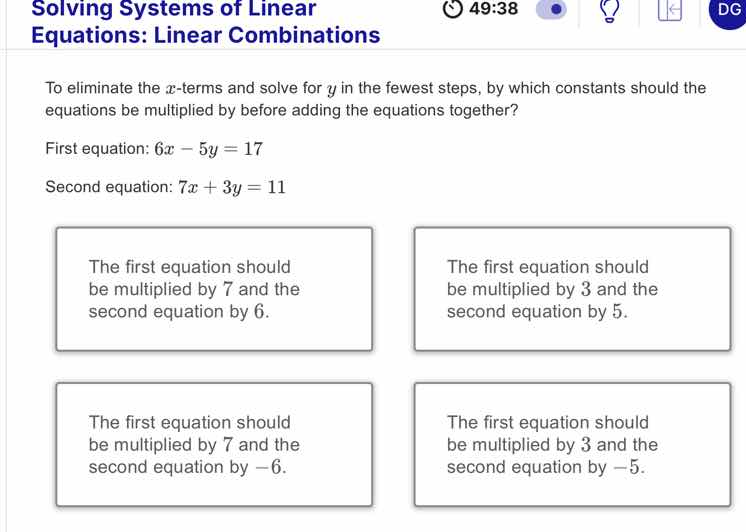
to eliminate the x-terms and solve for y in the fewest steps, by which constants should the equations be multiplied by before adding the equations together?
first equation: 6x - 5y = 17
second equation: 7x + 3y = 11
the first equation should be multiplied by 7 and the second equation by 6.
the first equation should be multiplied by 3 and the second equation by 5.
the first equation should be multiplied by 7 and the second equation by -6.
the first equation should be multiplied by 3 and the second equation by -5.
Step1: Recall elimination method
To eliminate \(x\)-terms, we need the coefficients of \(x\) in both equations to be equal in magnitude and opposite in sign (or same sign, but we want to eliminate, so opposite is better). The coefficients of \(x\) are \(6\) (in first equation: \(6x - 5y = 17\)) and \(7\) (in second equation: \(7x + 3y = 11\)).
Step2: Analyze each option
- Option 1: Multiply first by \(7\) (\(7\times(6x - 5y)=7\times17\Rightarrow42x - 35y = 119\)) and second by \(6\) (\(6\times(7x + 3y)=6\times11\Rightarrow42x + 18y = 66\)). Now, coefficients of \(x\) are both \(42\) (same sign), so subtracting would eliminate \(x\), but the question is about adding. If we add, \(42x + 42x = 84x\), which doesn't eliminate \(x\). So this is wrong.
- Option 2: Multiply first by \(3\) (\(3\times(6x - 5y)=3\times17\Rightarrow18x - 15y = 51\)) and second by \(5\) (\(5\times(7x + 3y)=5\times11\Rightarrow35x + 15y = 55\)). Coefficients of \(y\) are \(-15\) and \(+15\), but coefficients of \(x\) are \(18\) and \(35\), not related to elimination of \(x\). So this is wrong (we need to eliminate \(x\), not \(y\)).
- Option 3: Multiply first by \(7\) (\(42x - 35y = 119\)) and second by \(-6\) (\(-6\times(7x + 3y)=-6\times11\Rightarrow - 42x - 18y = - 66\)). Now, add the two equations: \((42x - 35y)+(-42x - 18y)=119 + (-66)\Rightarrow42x - 42x - 35y - 18y = 53\Rightarrow - 53y = 53\), which eliminates \(x\) (since \(42x - 42x = 0\)). Wait, but let's check Option 4.
- Option 4: Multiply first by \(3\) (\(18x - 15y = 51\)) and second by \(-5\) (\(-5\times(7x + 3y)=-5\times11\Rightarrow - 35x - 15y = - 55\)). Coefficients of \(x\) are \(18\) and \(-35\), not equal in magnitude. So elimination of \(x\) won't happen by adding. Wait, no, wait. Wait, the first equation's \(x\) coefficient is \(6\), second is \(7\). To eliminate \(x\) by adding, we need \(6a + 7b = 0\) (where \(a\) and \(b\) are multipliers). Let's solve \(6a + 7b = 0\Rightarrow6a=-7b\Rightarrow\frac{a}{b}=-\frac{7}{6}\). So \(a = 7\), \(b=-6\) (since \(6\times7 + 7\times(-6)=42 - 42 = 0\)). Wait, Option 3: first multiplied by \(7\) (so \(a = 7\)), second multiplied by \(-6\) (so \(b=-6\)). Then, when we add, the \(x\) terms: \(6\times7x+7\times(-6)x = 42x - 42x = 0\), which eliminates \(x\). Let's re - check Option 4: first multiplied by \(3\) ( \(a = 3\)), second multiplied by \(-5\) ( \(b=-5\)). Then \(6\times3x+7\times(-5)x = 18x - 35x=-17x
eq0\), so \(x\) terms are not eliminated. Option 3: \(6\times7x+7\times(-6)x = 42x - 42x = 0\), so \(x\) is eliminated. Also, let's check the operation: add the two equations after multiplication. First equation after multiplying by \(7\): \(42x - 35y = 119\). Second equation after multiplying by \(-6\): \(-42x - 18y = - 66\). Adding them: \(42x - 42x - 35y - 18y = 119 - 66\Rightarrow - 53y = 53\), which allows us to solve for \(y\) (which is what the question wants: solve for \(y\) by eliminating \(x\) in fewest steps). Wait, but let's check the other options again. Wait, maybe I made a mistake in Option 4. Wait, the question says "to eliminate the \(x\)-terms and solve for \(y\)". So we need the coefficients of \(x\) to be such that when we add the equations, the \(x\) terms cancel. So the coefficient of \(x\) in first equation is \(6\), second is \(7\). So we need \(6\times m+7\times n = 0\), where \(m\) and \(n\) are the multipliers for first and second equation. So \(6m=-7n\Rightarrow m = 7\), \(n=-6\) (since \(6\times7 = 42\), \(7\times(-6)=-42\), \(42-42 = 0\)). So that's Option 3: first equation multiplied by \(7\), second by \(-6\)…

Snap & solve any problem in the app
Get step-by-step solutions on Sovi AI
Photo-based solutions with guided steps
Explore more problems and detailed explanations
The first equation should be multiplied by 7 and the second equation by −6.