QUESTION IMAGE
Question
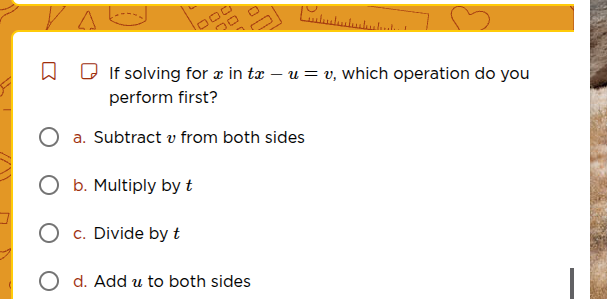
if solving for ( x ) in ( tx - u = v ), which operation do you perform first?
a. subtract ( v ) from both sides
b. multiply by ( t )
c. divide by ( t )
d. add ( u ) to both sides
To solve for \( x \) in the equation \( tx - u = v \), we use the properties of equality. The goal is to isolate \( x \). First, we need to get rid of the \( -u \) term on the left side. To do that, we perform the inverse operation of subtraction, which is addition. So we add \( u \) to both sides of the equation. This will give us \( tx = v + u \), and then we can proceed to divide by \( t \) to solve for \( x \). The other options are incorrect: subtracting \( v \) doesn't help isolate \( x \), multiplying by \( t \) would complicate the equation, and dividing by \( t \) first would still leave the \( -u \) term to deal with.

Snap & solve any problem in the app
Get step-by-step solutions on Sovi AI
Photo-based solutions with guided steps
Explore more problems and detailed explanations
d. Add \( u \) to both sides