QUESTION IMAGE
Question
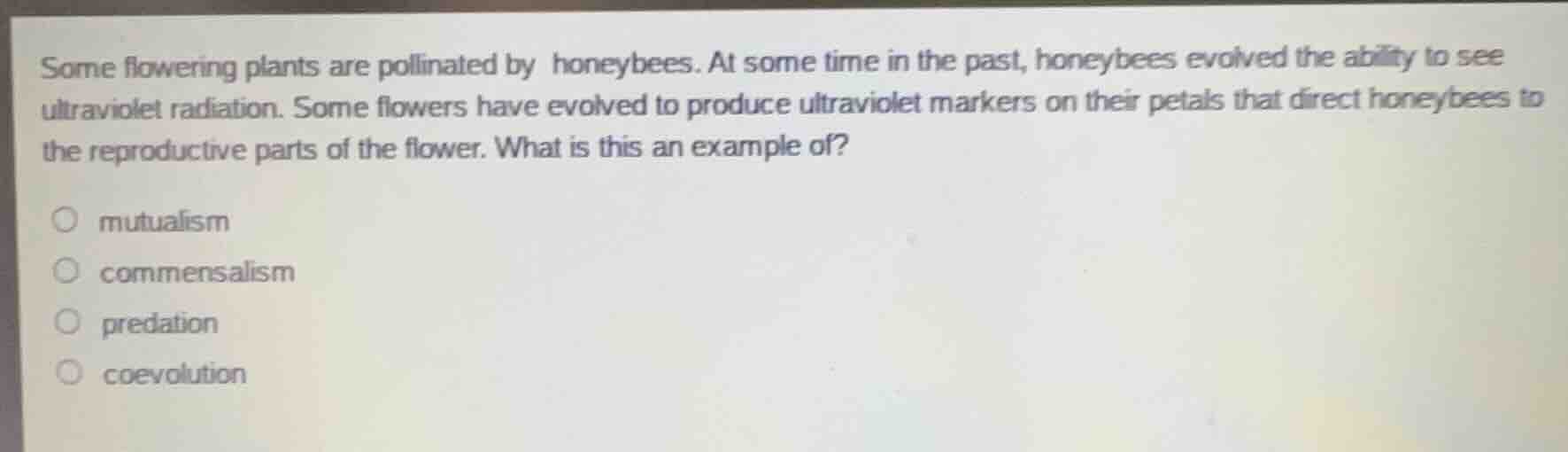
some flowering plants are pollinated by honeybees. at some time in the past, honeybees evolved the ability to see ultraviolet radiation. some flowers have evolved to produce ultraviolet markers on their petals that direct honeybees to the reproductive parts of the flower. what is this an example of?
○ mutualism
○ commensalism
○ predation
○ coevolution
Brief Explanations
- Mutualism: It is a symbiotic relationship where both species benefit, but this question focuses on the evolutionary changes in both species over time, not just the mutual benefit. So mutualism is not the answer.
- Commensalism: In commensalism, one species benefits and the other is neither helped nor harmed. Here, both honeybees and flowers are undergoing evolutionary changes, so commensalism is incorrect.
- Predation: Predation involves one organism (predator) killing and eating another (prey). This scenario is about pollination and evolutionary changes, not predation.
- Coevolution: Coevolution is the process where two or more species evolve in response to each other. Honeybees evolved the ability to see ultraviolet radiation, and flowers evolved to produce ultraviolet markers. These evolutionary changes are in response to each other, so this is an example of coevolution.

Snap & solve any problem in the app
Get step-by-step solutions on Sovi AI
Photo-based solutions with guided steps
Explore more problems and detailed explanations
D. coevolution