QUESTION IMAGE
Question
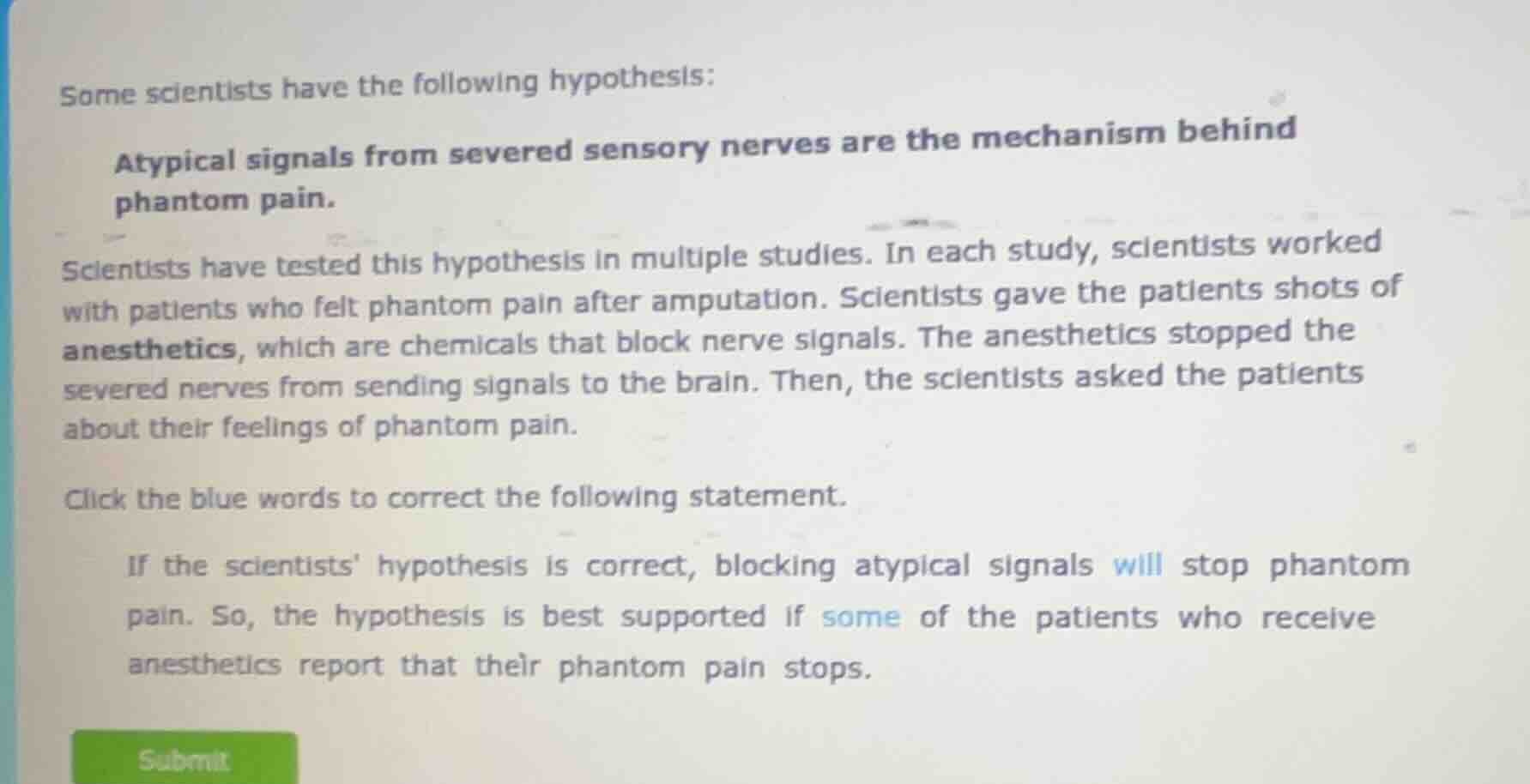
some scientists have the following hypothesis:
atypical signals from severed sensory nerves are the mechanism behind phantom pain.
scientists have tested this hypothesis in multiple studies. in each study, scientists worked with patients who felt phantom pain after amputation. scientists gave the patients shots of anesthetics, which are chemicals that block nerve signals. the anesthetics stopped the severed nerves from sending signals to the brain. then, the scientists asked the patients about their feelings of phantom pain.
click the blue words to correct the following statement.
if the scientists hypothesis is correct, blocking atypical signals will stop phantom pain. so, the hypothesis is best supported if some of the patients who receive anesthetics report that their phantom pain stops.
The hypothesis states atypical signals from severed sensory nerves cause phantom pain, and anesthetics block these nerve signals. To best support the hypothesis, blocking these signals should consistently stop the pain, so most or all patients (not just some) should report pain stopping, and the logical link is that blocking the signals would (not just "will" in a vague sense) stop pain. The key correction is replacing "some" with "all (or most)" and ensuring the verb aligns, but the critical flawed term here is "some"—strong support for the causal hypothesis requires that the intervention (blocking signals) reliably produces the effect, so the majority or all patients should have pain relief.

Snap & solve any problem in the app
Get step-by-step solutions on Sovi AI
Photo-based solutions with guided steps
Explore more problems and detailed explanations
Corrected statement: If the scientists' hypothesis is correct, blocking atypical signals would stop phantom pain. So, the hypothesis is best supported if all (or most) of the patients who receive anesthetics report that their phantom pain stops.