QUESTION IMAGE
Question
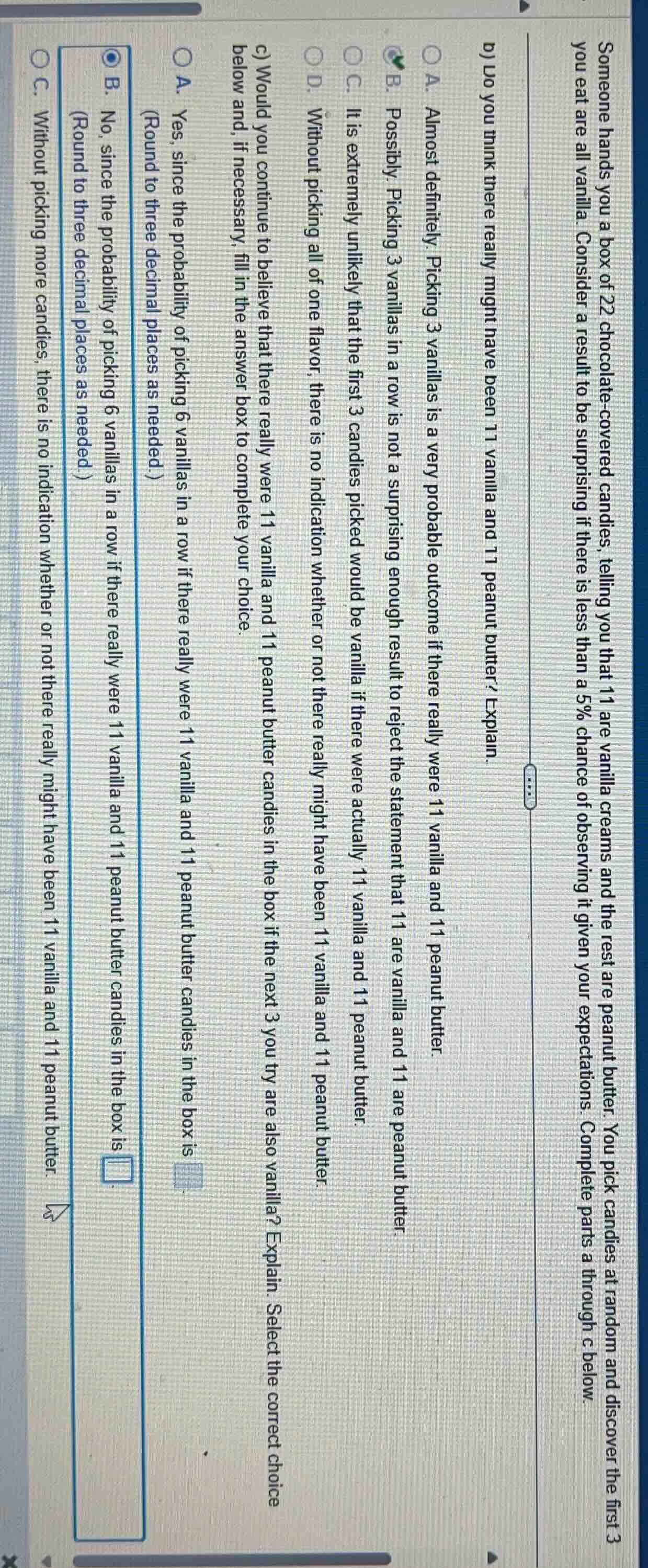
someone hands you a box of 22 chocolate - covered candies, telling you that 11 are vanilla creams and the rest are peanut butter. you pick candies at random and discover the first 3 you eat are all vanilla. consider a result to be surprising if there is less than a 5% chance of observing it given your expectations. complete parts a through c below.
b) do you think there really might have been 11 vanilla and 11 peanut butter? explain.
a. almost definitely. picking 3 vanillas is a very probable outcome if there really were 11 vanilla and 11 peanut butter.
b. possibly. picking 3 vanillas in a row is not a surprising enough result to reject the statement that 11 are vanilla and 11 are peanut butter.
c. it is extremely unlikely that the first 3 candies picked would be vanilla if there were actually 11 vanilla and 11 peanut butter.
d. without picking all of one flavor, there is no indication whether or not there really might have been 11 vanilla and 11 peanut butter.
c) would you continue to believe that there really were 11 vanilla and 11 peanut butter candies in the box if the next 3 you try are also vanilla? explain. select the correct choice below and, if necessary, fill in the answer box to complete your choice.
a. yes, since the probability of picking 6 vanillas in a row if there really were 11 vanilla and 11 peanut butter in the box is
(round to three decimal places as needed.)
b. no, since the probability of picking 6 vanillas in a row if there really were 11 vanilla and 11 peanut butter in the box is
(round to three decimal places as needed.)
c. without picking more candies, there is no indication whether or not there really might have been 11 vanilla and 11 peanut butter.
Step1: Calculate 3-vanilla probability
If there are 11 vanilla out of 22 candies, the probability of picking vanilla once is $\frac{11}{22}=0.5$. For 3 in a row (without replacement, since candies are picked and not put back):
$$P(\text{3 vanillas}) = \frac{11}{22} \times \frac{10}{21} \times \frac{9}{20} = \frac{990}{9240} \approx 0.107$$
This is greater than 5%, so it is not a surprising result.
Step2: Calculate 6-vanilla probability
If there are 11 vanilla out of 22 candies, probability of 6 vanillas in a row (without replacement):
$$P(\text{6 vanillas}) = \frac{11}{22} \times \frac{10}{21} \times \frac{9}{20} \times \frac{8}{19} \times \frac{7}{18} \times \frac{6}{17}$$
$$= \frac{332640}{53721360} \approx 0.006$$

Snap & solve any problem in the app
Get step-by-step solutions on Sovi AI
Photo-based solutions with guided steps
Explore more problems and detailed explanations
b) B. Possibly. Picking 3 vanillas in a row is not a surprising enough result to reject the statement that 11 are vanilla and 11 are peanut butter.
c) B. No, since the probability of picking 6 vanillas in a row if there really were 11 vanilla and 11 peanut butter candies in the box is 0.006.