QUESTION IMAGE
Question
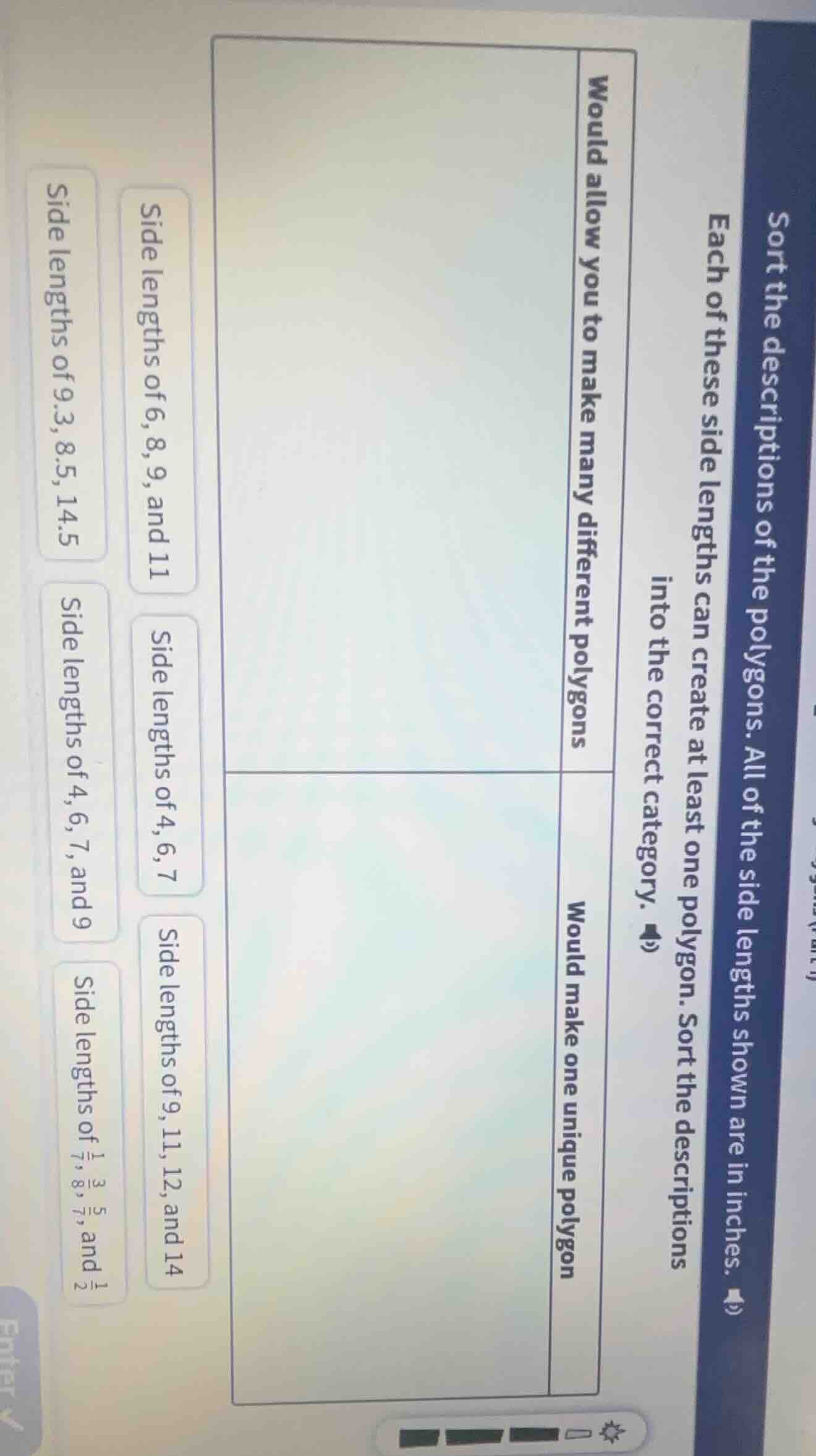
sort the descriptions of the polygons. all of the side lengths shown are in inches. each of these side lengths can create at least one polygon. sort the descriptions into the correct category. would allow you to make many different polygons would make one unique polygon side lengths of 6, 8, 9, and 11 side lengths of 4, 6, 7 side lengths of 9, 11, 12, and 14 side lengths of 9.3, 8.5, 14.5 side lengths of 4, 6, 7, and 9 side lengths of \\(\frac{1}{7}\\), 8, \\(\frac{3}{7}\\), and \\(\frac{1}{2}\\)
To solve this, we use the concept of polygon construction:
Key Concepts:
- Many different polygons: For a set of side lengths, if we can rearrange the order of sides (or adjust angles while keeping side lengths), we get many polygons. This applies to sets with 4 or more sides (since triangles have fixed shapes by SSS, but quadrilaterals and higher can be "flexible").
- One unique polygon: Triangles (3 sides) have a unique shape by the SSS (Side - Side - Side) congruence theorem—only one triangle can be formed with a given set of 3 side lengths.
Sorting the Side Lengths:
- Would allow many different polygons (Quadrilaterals or more, flexible):
- Side lengths of 6, 8, 9, and 11 (4 sides, quadrilateral—can be flexed into different shapes).
- Side lengths of 4, 6, 7, and 9 (4 sides, quadrilateral—flexible).
- Side lengths of 9, 11, 12, and 14 (4 sides, quadrilateral—flexible).
- Side lengths of \(\frac{1}{7}, 8, \frac{3}{7}, \) and \(\frac{1}{2}\) (4 sides, quadrilateral—flexible).
- Would make one unique polygon (Triangles, 3 sides—SSS uniqueness):
- Side lengths of 4, 6, 7 (3 sides, triangle—unique by SSS).
- Side lengths of 9.3, 8.5, 14.5 (3 sides, triangle—unique by SSS).
Final Sorting:
| Would allow many different polygons | Would make one unique polygon |
|---|---|
| 4, 6, 7, 9 | 9.3, 8.5, 14.5 |
| 9, 11, 12, 14 | |
| \(\frac{1}{7}, 8, \frac{3}{7}, \frac{1}{2}\) |
(Note: The table organizes the side - length sets into the two categories based on the number of sides and the flexibility of polygon construction.)

Snap & solve any problem in the app
Get step-by-step solutions on Sovi AI
Photo-based solutions with guided steps
Explore more problems and detailed explanations
To solve this, we use the concept of polygon construction:
Key Concepts:
- Many different polygons: For a set of side lengths, if we can rearrange the order of sides (or adjust angles while keeping side lengths), we get many polygons. This applies to sets with 4 or more sides (since triangles have fixed shapes by SSS, but quadrilaterals and higher can be "flexible").
- One unique polygon: Triangles (3 sides) have a unique shape by the SSS (Side - Side - Side) congruence theorem—only one triangle can be formed with a given set of 3 side lengths.
Sorting the Side Lengths:
- Would allow many different polygons (Quadrilaterals or more, flexible):
- Side lengths of 6, 8, 9, and 11 (4 sides, quadrilateral—can be flexed into different shapes).
- Side lengths of 4, 6, 7, and 9 (4 sides, quadrilateral—flexible).
- Side lengths of 9, 11, 12, and 14 (4 sides, quadrilateral—flexible).
- Side lengths of \(\frac{1}{7}, 8, \frac{3}{7}, \) and \(\frac{1}{2}\) (4 sides, quadrilateral—flexible).
- Would make one unique polygon (Triangles, 3 sides—SSS uniqueness):
- Side lengths of 4, 6, 7 (3 sides, triangle—unique by SSS).
- Side lengths of 9.3, 8.5, 14.5 (3 sides, triangle—unique by SSS).
Final Sorting:
| Would allow many different polygons | Would make one unique polygon |
|---|---|
| 4, 6, 7, 9 | 9.3, 8.5, 14.5 |
| 9, 11, 12, 14 | |
| \(\frac{1}{7}, 8, \frac{3}{7}, \frac{1}{2}\) |
(Note: The table organizes the side - length sets into the two categories based on the number of sides and the flexibility of polygon construction.)