QUESTION IMAGE
Question
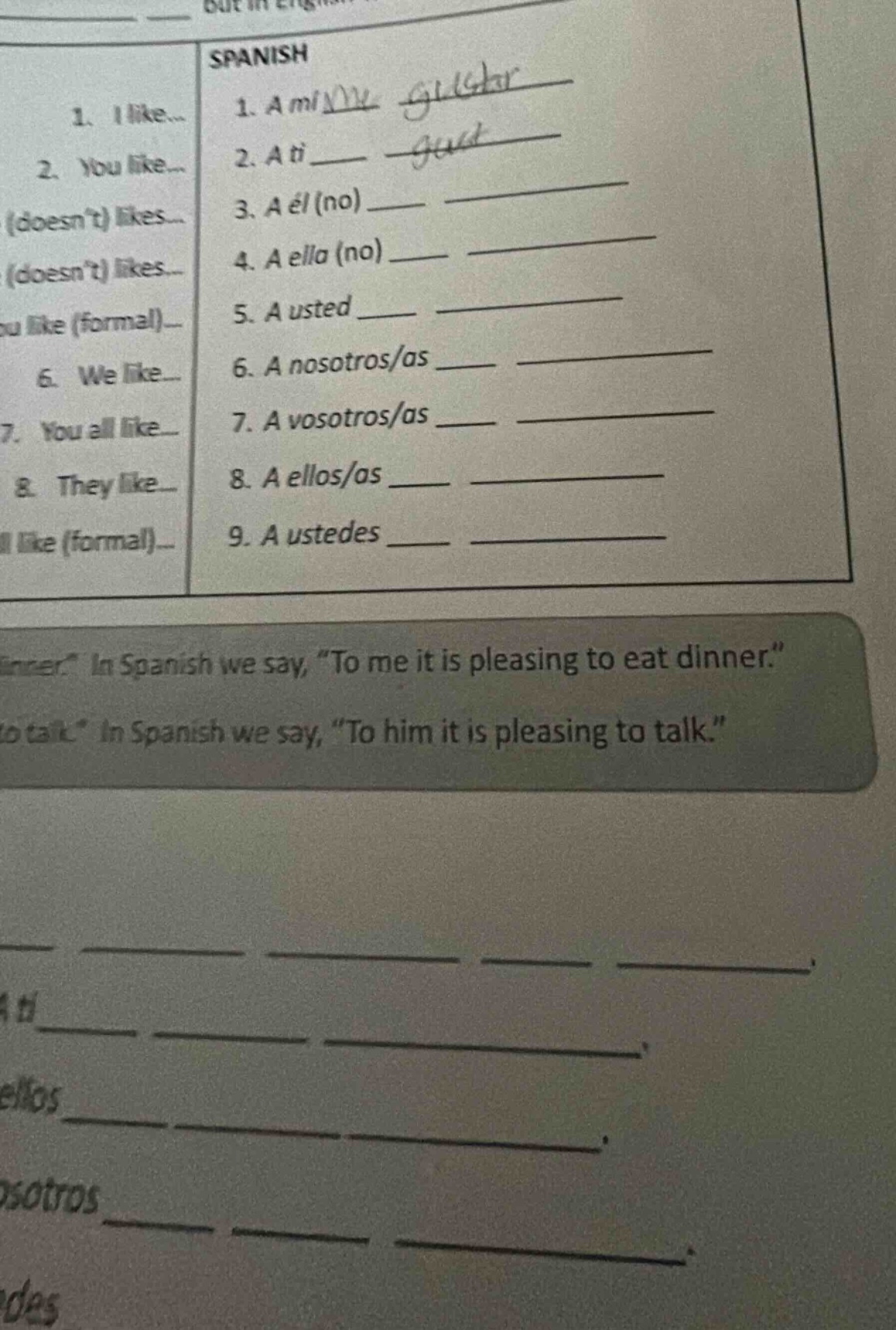
spanish
- a mí __ __
- a ti __ __
- a él (no) __ __
- a ella (no) __ __
- a usted __ __
- a nosotros/as __ __
- a vosotros/as __ __
- a ellos/as __ __
- a ustedes __ __
in spanish we say, \to me it is pleasing to eat dinner.\
in spanish we say, \to him it is pleasing to talk.\
To solve this, we use the structure of "gustar" in Spanish, where the verb agrees with the thing liked, and we use indirect object pronouns. The formula is "A + indirect object + indirect object pronoun + gusta(n)".
Step 1: For "A mí"
The indirect object pronoun for "mí" (me) is "me". Since we are talking about a singular liking (usually), we use "gusta". So it's "A mí me gusta".
Step 2: For "A ti"
The indirect object pronoun for "ti" (you, informal) is "te". So "A ti te gusta".
Step 3: For "A él (no)"
The indirect object pronoun for "él" (him) is "le". With "no" for negative, it's "A él (no) le gusta".
Step 4: For "A ella (no)"
The indirect object pronoun for "ella" (her) is "le". So "A ella (no) le gusta".
Step 5: For "A usted"
The indirect object pronoun for "usted" (you, formal) is "le". So "A usted le gusta".
Step 6: For "A nosotros/as"
The indirect object pronoun for "nosotros/as" (we) is "nos". Since it's plural (we), we use "gustan". So "A nosotros/as nos gustan".
Step 7: For "A vosotros/as"
The indirect object pronoun for "vosotros/as" (you all, informal, Spain) is "os". So "A vosotros/as os gustan".
Step 8: For "A ellos/os"
The indirect object pronoun for "ellos/ellas" (them) is "les". So "A ellos/os les gustan".
Step 9: For "A ustedes"
The indirect object pronoun for "ustedes" (you all, formal or Latin America) is "les". So "A ustedes les gustan".
Final Answers (filling in the blanks):
- A mí me gusta
- A ti te gusta
- A él (no) le gusta
- A ella (no) le gusta
- A usted le gusta
- A nosotros/as nos gustan
- A vosotros/as os gustan
- A ellos/os les gustan
- A ustedes les gustan
(Note: If the "like" is for plural nouns, we use "gustan", for singular, "gusta". The above assumes singular unless the context of the liked item is plural, but the standard structure is as above.)

Snap & solve any problem in the app
Get step-by-step solutions on Sovi AI
Photo-based solutions with guided steps
Explore more problems and detailed explanations
To solve this, we use the structure of "gustar" in Spanish, where the verb agrees with the thing liked, and we use indirect object pronouns. The formula is "A + indirect object + indirect object pronoun + gusta(n)".
Step 1: For "A mí"
The indirect object pronoun for "mí" (me) is "me". Since we are talking about a singular liking (usually), we use "gusta". So it's "A mí me gusta".
Step 2: For "A ti"
The indirect object pronoun for "ti" (you, informal) is "te". So "A ti te gusta".
Step 3: For "A él (no)"
The indirect object pronoun for "él" (him) is "le". With "no" for negative, it's "A él (no) le gusta".
Step 4: For "A ella (no)"
The indirect object pronoun for "ella" (her) is "le". So "A ella (no) le gusta".
Step 5: For "A usted"
The indirect object pronoun for "usted" (you, formal) is "le". So "A usted le gusta".
Step 6: For "A nosotros/as"
The indirect object pronoun for "nosotros/as" (we) is "nos". Since it's plural (we), we use "gustan". So "A nosotros/as nos gustan".
Step 7: For "A vosotros/as"
The indirect object pronoun for "vosotros/as" (you all, informal, Spain) is "os". So "A vosotros/as os gustan".
Step 8: For "A ellos/os"
The indirect object pronoun for "ellos/ellas" (them) is "les". So "A ellos/os les gustan".
Step 9: For "A ustedes"
The indirect object pronoun for "ustedes" (you all, formal or Latin America) is "les". So "A ustedes les gustan".
Final Answers (filling in the blanks):
- A mí me gusta
- A ti te gusta
- A él (no) le gusta
- A ella (no) le gusta
- A usted le gusta
- A nosotros/as nos gustan
- A vosotros/as os gustan
- A ellos/os les gustan
- A ustedes les gustan
(Note: If the "like" is for plural nouns, we use "gustan", for singular, "gusta". The above assumes singular unless the context of the liked item is plural, but the standard structure is as above.)