QUESTION IMAGE
Question
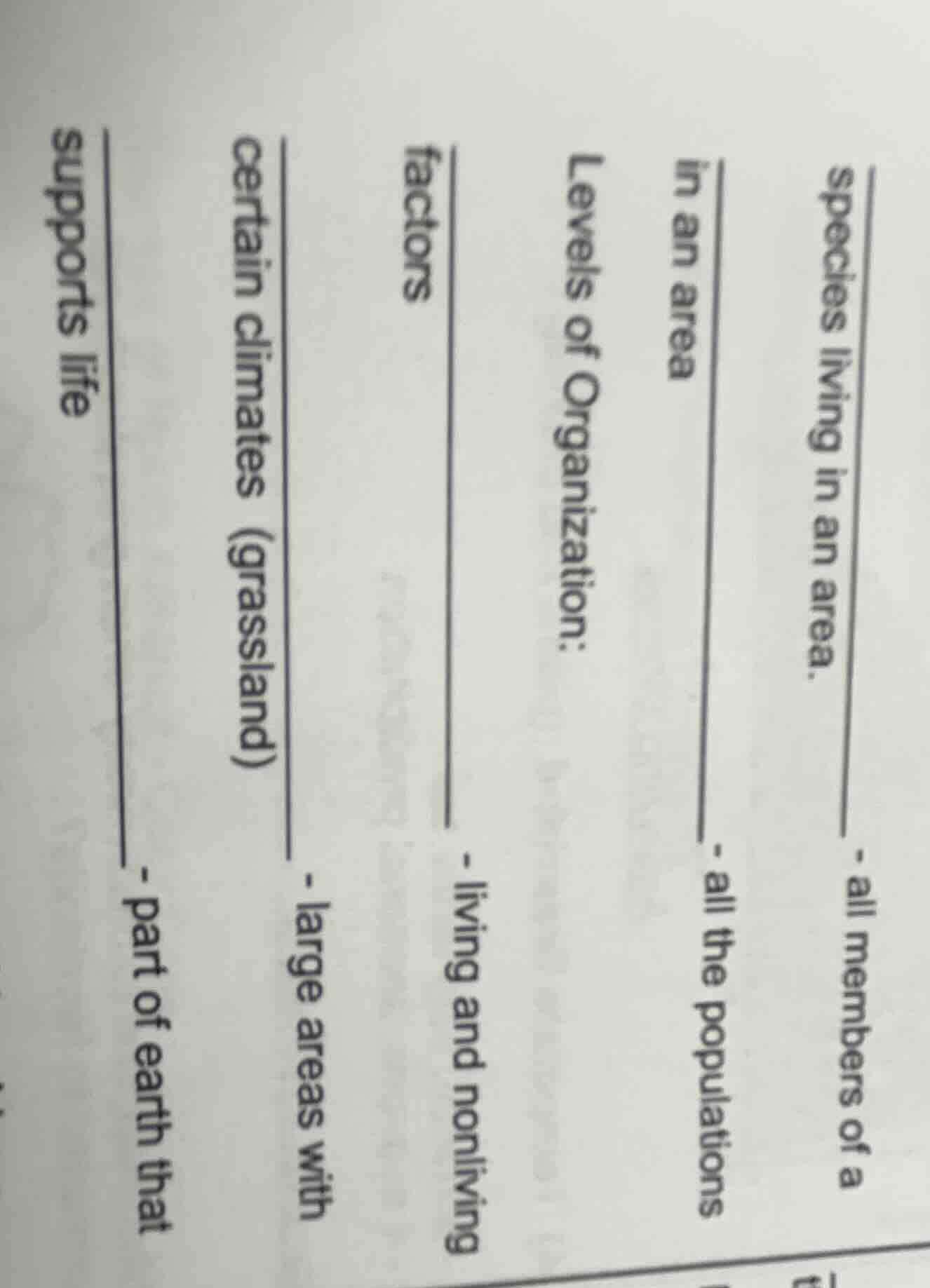
species living in an area.
- all members of a
in an area
- all the populations
levels of organization:
factors
- living and nonliving
certain climates (grassland)
- large areas with
supports life
- part of earth that
This appears to be a fill - in - the - blank exercise related to ecological concepts. Let's analyze each blank:
1. "species living in an area. - all members of a ____"
The term that fits here is "population". A population is defined as all the members of a particular species that live in a given area.
2. "in an area - all the populations ____"
The word here is "community". A community consists of all the different populations (of various species) that live and interact in a specific area.
3. "Levels of Organization: factors - living and nonliving ____"
The appropriate term is "ecological factors" or more specifically, "ecological components" but in the context of levels of organization and factors, it's "ecosystem factors" (but more precisely, the term for living and non - living factors in an ecosystem is "environmental factors" or "ecological factors", and when considering the level of organization, the combination of living (biotic) and non - living (abiotic) factors is part of an "ecosystem". So the blank can be filled with "components" or more accurately, "biotic and abiotic factors" but for the blank, "factors" here refer to the components of an ecosystem, so the term is "ecosystem" related, but the blank is for the type of factors, so "biotic and abiotic" but since the structure is "living and nonliving __", the word is "factors" (but that's repetitive). Wait, maybe the first blank under "species living in an area" is "population", the second "in an area - all the populations" is "community", the third "Levels of Organization: factors - living and nonliving" is "biotic and abiotic" (but the blank is a noun, so "components" or "elements"). Then "certain climates (grassland) - large areas with " is "biome". A biome is a large area with a particular climate and characteristic plant and animal communities. And "supports life - part of earth that __" is "biosphere". The biosphere is the part of the Earth that supports life.
Let's re - list:
- For "species living in an area. - all members of a ____": population (A population is a group of individuals of the same species living in a specific area.)
- For "in an area - all the populations ____": community (A community is all the different populations that interact in a given area.)
- For "Levels of Organization: factors - living and nonliving ____": biotic and abiotic factors (But if we need a single word, "components" or "elements", but more accurately, in ecological terms, the living factors are biotic and non - living are abiotic, so the blank can be "factors" (but that's the word above). Wait, maybe the term is "ecosystem" related, but the blank is for the type of factors, so "biotic and abiotic" is an adjective - noun combination, but the blank is a noun. Maybe the intended answer is "ecosystem" but no, the factors are part of the ecosystem. Alternatively, the term is "environmental factors".
- For "certain climates (grassland) - large areas with ____": biome (A biome is a large geographical area with a distinct climate and characteristic plant and animal communities, like grasslands are a type of biome.)
- For "supports life - part of earth that ____": biosphere (The biosphere is the global sum of all ecosystems, the part of the Earth (including air, land, water) that supports life.)
If we assume the blanks are to be filled with the correct ecological terms:
- population
- community
- biotic and abiotic (or "factors" but that's not right, maybe "components")
- biome
- biosphere
But let's check the standard ecological hier…

Snap & solve any problem in the app
Get step-by-step solutions on Sovi AI
Photo-based solutions with guided steps
Explore more problems and detailed explanations
This appears to be a fill - in - the - blank exercise related to ecological concepts. Let's analyze each blank:
1. "species living in an area. - all members of a ____"
The term that fits here is "population". A population is defined as all the members of a particular species that live in a given area.
2. "in an area - all the populations ____"
The word here is "community". A community consists of all the different populations (of various species) that live and interact in a specific area.
3. "Levels of Organization: factors - living and nonliving ____"
The appropriate term is "ecological factors" or more specifically, "ecological components" but in the context of levels of organization and factors, it's "ecosystem factors" (but more precisely, the term for living and non - living factors in an ecosystem is "environmental factors" or "ecological factors", and when considering the level of organization, the combination of living (biotic) and non - living (abiotic) factors is part of an "ecosystem". So the blank can be filled with "components" or more accurately, "biotic and abiotic factors" but for the blank, "factors" here refer to the components of an ecosystem, so the term is "ecosystem" related, but the blank is for the type of factors, so "biotic and abiotic" but since the structure is "living and nonliving __", the word is "factors" (but that's repetitive). Wait, maybe the first blank under "species living in an area" is "population", the second "in an area - all the populations" is "community", the third "Levels of Organization: factors - living and nonliving" is "biotic and abiotic" (but the blank is a noun, so "components" or "elements"). Then "certain climates (grassland) - large areas with " is "biome". A biome is a large area with a particular climate and characteristic plant and animal communities. And "supports life - part of earth that __" is "biosphere". The biosphere is the part of the Earth that supports life.
Let's re - list:
- For "species living in an area. - all members of a ____": population (A population is a group of individuals of the same species living in a specific area.)
- For "in an area - all the populations ____": community (A community is all the different populations that interact in a given area.)
- For "Levels of Organization: factors - living and nonliving ____": biotic and abiotic factors (But if we need a single word, "components" or "elements", but more accurately, in ecological terms, the living factors are biotic and non - living are abiotic, so the blank can be "factors" (but that's the word above). Wait, maybe the term is "ecosystem" related, but the blank is for the type of factors, so "biotic and abiotic" is an adjective - noun combination, but the blank is a noun. Maybe the intended answer is "ecosystem" but no, the factors are part of the ecosystem. Alternatively, the term is "environmental factors".
- For "certain climates (grassland) - large areas with ____": biome (A biome is a large geographical area with a distinct climate and characteristic plant and animal communities, like grasslands are a type of biome.)
- For "supports life - part of earth that ____": biosphere (The biosphere is the global sum of all ecosystems, the part of the Earth (including air, land, water) that supports life.)
If we assume the blanks are to be filled with the correct ecological terms:
- population
- community
- biotic and abiotic (or "factors" but that's not right, maybe "components")
- biome
- biosphere
But let's check the standard ecological hierarchy:
- Population: All individuals of one species in a given area.
- Community: All populations (of different species) in a given area.
- Ecosystem: A community plus its abiotic (non - living) environment (so living and non - living factors).
- Biome: A large area with a characteristic climate, vegetation, and animal life (like grasslands, deserts, etc.).
- Biosphere: The entire portion of the Earth that supports life, including the atmosphere, hydrosphere, and lithosphere.
So filling the blanks:
- "species living in an area. - all members of a population"
- "in an area - all the populations community"
- "Levels of Organization: factors - living and nonliving (biotic and abiotic) factors" (or "ecosystem" if we consider the level, but the blank is after "living and nonliving", so "factors" is repeated, maybe the term is "components" but the standard term for living (biotic) and non - living (abiotic) factors in an ecosystem is "biotic and abiotic factors")
- "certain climates (grassland) - large areas with biome"
- "supports life - part of earth that biosphere"
So the answers for each blank (from left to right, top to bottom as per the image layout):
- population
- community
- (biotic and abiotic) factors (or just "factors" but that's not accurate, the correct term for the combination of living and non - living factors is "biotic and abiotic factors")
- biome
- biosphere