QUESTION IMAGE
Question
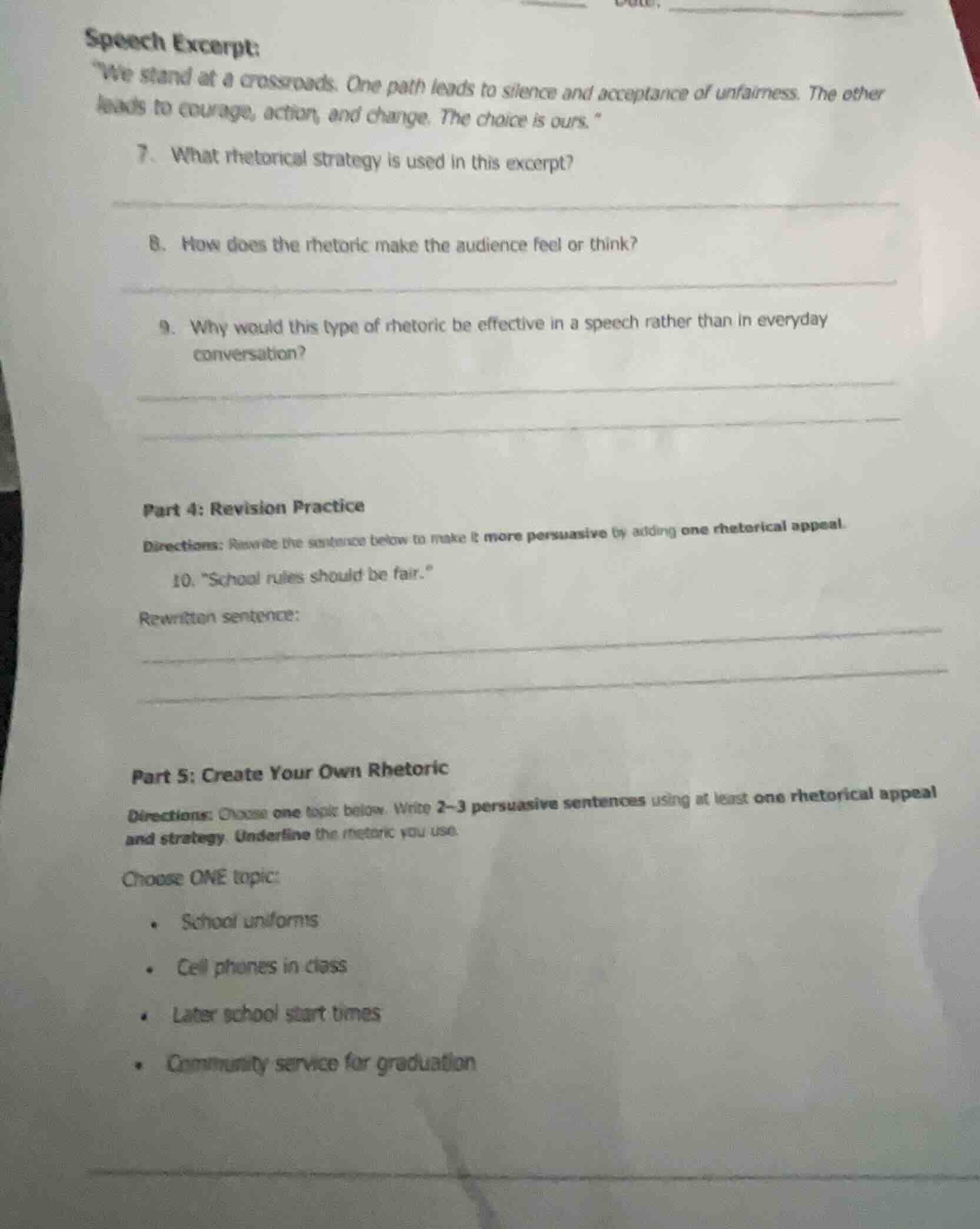
speech excerpt:
\we stand at a crossroads. one path leads to silence and acceptance of unfairness. the other leads to courage, action, and change. the choice is ours.\
- what rhetorical strategy is used in this excerpt?
- how does the rhetoric make the audience feel or think?
- why would this type of rhetoric be effective in a speech rather than in everyday conversation?
part 4: revision practice
directions: rewrite the sentence below to make it more persuasive by adding one rhetorical appeal.
- \school rules should be fair.\
rewritten sentence:
part 5: create your own rhetoric
directions: choose one topic below. write 2-3 persuasive sentences using at least one rhetorical appeal and strategy. underline the rhetoric you use.
choose one topic:
- school uniforms
- cell phones in class
- later school start times
- community service for graduation
For Question 7:
The excerpt uses a rhetorical strategy called dichotomy (either-or reasoning)—it frames a clear, binary choice between two opposing paths, with no middle ground presented.
For Question 8:
This rhetoric makes the audience feel empowered by placing the decision in their hands, and it pushes them to think critically about the consequences of inaction vs. action. It creates a sense of urgency and moral clarity, framing inaction as acceptance of unfairness and action as a courageous, positive choice.
For Question 9:
In a speech, this type of rhetoric is effective because speeches aim to persuade and rally an audience; the clear binary simplifies complex issues, making the message memorable and easy to rally around. Everyday conversation is usually more nuanced and collaborative, so rigid either-or framing can feel confrontational and unrealistic in casual, back-and-forth dialogue.
For Question 10 (Revision Practice):
Adding an ethical (ethos) or emotional (pathos) appeal makes the sentence persuasive. For example, referencing student well-being (pathos) or educational ethics (ethos) grounds the claim in relatable, meaningful context.
For Part 5 (Create Your Own Rhetoric):
Choosing "Later school start times," we use a logical appeal (logos) with data and emotional appeal (pathos) with student experience, and frame the choice as a clear binary (dichotomy) to persuade.

Snap & solve any problem in the app
Get step-by-step solutions on Sovi AI
Photo-based solutions with guided steps
Explore more problems and detailed explanations
- The rhetorical strategy used is dichotomy (either-or reasoning), framing a strict binary choice between two opposing paths.
- It makes the audience feel empowered (as the choice is theirs) and pushes them to view inaction as complicity with unfairness, while framing action as a brave, moral choice.
- Speeches rely on clear, rallying messages to persuade large groups; this binary simplifies complex issues into a memorable, call-to-ready choice. Everyday conversation is more nuanced, so rigid either-or framing feels confrontational and unrealistic for casual, collaborative dialogue.
- Rewritten sentence: "As educators tasked with supporting student growth, we must ensure school rules are fair—rules that punish students arbitrarily erode trust and hinder learning." (uses ethos, an appeal to ethical responsibility)
- (Topic chosen: Later school start times)
- When teens are forced to wake at 6 a.m. for a 7:30 a.m. first period, they operate on just 6 hours of sleep on average—far less than the 8-10 hours the American Academy of Pediatrics recommends (logos: cites expert data).
- We stand at a crossroads: either we continue prioritizing rigid schedules over student health, leading to lower grades and higher anxiety, or we shift to later start times, letting teens thrive academically and emotionally (dichotomy + pathos: frames choice around student well-being).
- To ignore this evidence is to ignore the very students we claim to support; later school start times are not a luxury—they are a necessity for fair, effective education (ethos: appeals to educational ethics).