QUESTION IMAGE
Question
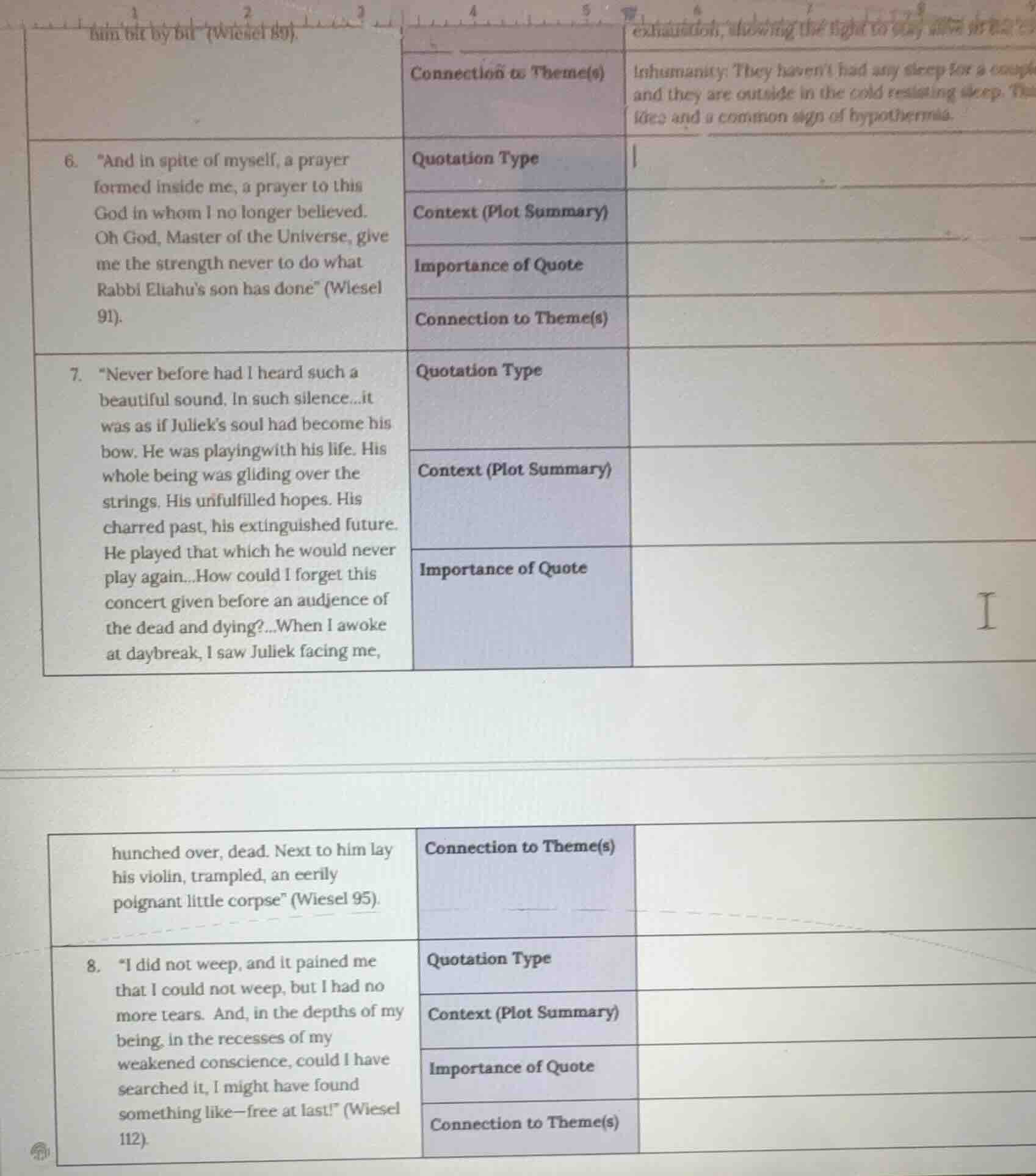
- \and in spite of myself, a prayer formed inside me, a prayer to this god in whom i no longer believed. oh god, master of the universe, give me the strength never to do what rabbi eliahus son has done\ (wiesel 91).
7.
ever before had i heard such a beautiful sound. in such silence...it was as if julieks soul had become his bow. he was playing with his life. his whole being was gliding over the strings. his unfulfilled hopes. his charred past, his extinguished future. he played that which he would never play again...how could i forget this concert given before an audience of the dead and dying?...when i awoke at daybreak, i saw juliek facing me, hunched over, dead. next to him lay his violin, trampled, an eerily poignant little corpse\ (wiesel 95).
- \i did not weep, and it pained me that i could not weep, but i had no more tears. and, in the depths of my being, in the recesses of my weakened conscience, could i have searched it, i might have found something like—free at last!\ (wiesel 112).
Brief Explanations
For Quotation 6:
- Quotation Type: Direct internal dialogue (prayer)
- Context (Plot Summary): Eliezer, after seeing Rabbi Eliahu's son abandon his father during a death march, prays to a God he no longer believes in to avoid becoming like that son.
- Importance of Quote: It reveals Eliezer's moral conflict, his lingering (even broken) faith, and his fear of losing his humanity in the camps.
- Connection to Theme(s): Faith (crisis of belief) and Humanity (struggle to retain moral integrity amid dehumanization).
For Quotation 7:
- Quotation Type: Descriptive reflective narration
- Context (Plot Summary): During a break in a death march, Juliek, a young musician, plays his violin for the dying prisoners in a barracks; Eliezer wakes to find Juliek dead, his violin crushed.
- Importance of Quote: It shows a fleeting act of beauty and humanity in the midst of utter horror, and the loss of art and innocence to the Holocaust.
- Connection to Theme(s): Humanity (preserving dignity through art) and Death (the cost of the Holocaust to individual identity and culture).
For Quotation 8:
- Quotation Type: Direct internal reflection
- Context (Plot Summary): Eliezer's father dies in the Buchenwald camp, and Eliezer feels numb rather than grief, even a twisted sense of relief from the burden of caring for his father.
- Importance of Quote: It exposes the extreme dehumanization Eliezer has endured—he is so emotionally drained that he cannot mourn his own father, showing how the camps stripped away basic human empathy.
- Connection to Theme(s): Dehumanization (loss of emotional capacity) and Survival (the moral cost of surviving the camps).

Snap & solve any problem in the app
Get step-by-step solutions on Sovi AI
Photo-based solutions with guided steps
Explore more problems and detailed explanations
Quotation 6
- Quotation Type: Direct internal prayer/dialogue
- Context (Plot Summary): Eliezer witnesses Rabbi Eliahu's son abandon his father during a death march, then prays to a God he rejects to avoid the same cruelty.
- Importance of Quote: Highlights Eliezer's moral terror and fractured faith.
- Connection to Theme(s): Crisis of Faith; Preservation of Humanity
Quotation 7
- Quotation Type: Reflective descriptive narration
- Context (Plot Summary): Juliek plays his violin for dying prisoners in a barracks; Eliezer wakes to find Juliek dead, his violin crushed.
- Importance of Quote: Captures a rare act of beauty amid Holocaust horror, and the loss of art/innocence.
- Connection to Theme(s): Humanity in Suffering; Death and Cultural Erasure
Quotation 8
- Quotation Type: Direct internal reflection
- Context (Plot Summary): Eliezer's father dies in Buchenwald; Eliezer feels numb, even a twisted relief.
- Importance of Quote: Reveals the extreme emotional dehumanization of camp survivors.
- Connection to Theme(s): Dehumanization; Survival's Moral Cost