QUESTION IMAGE
Question
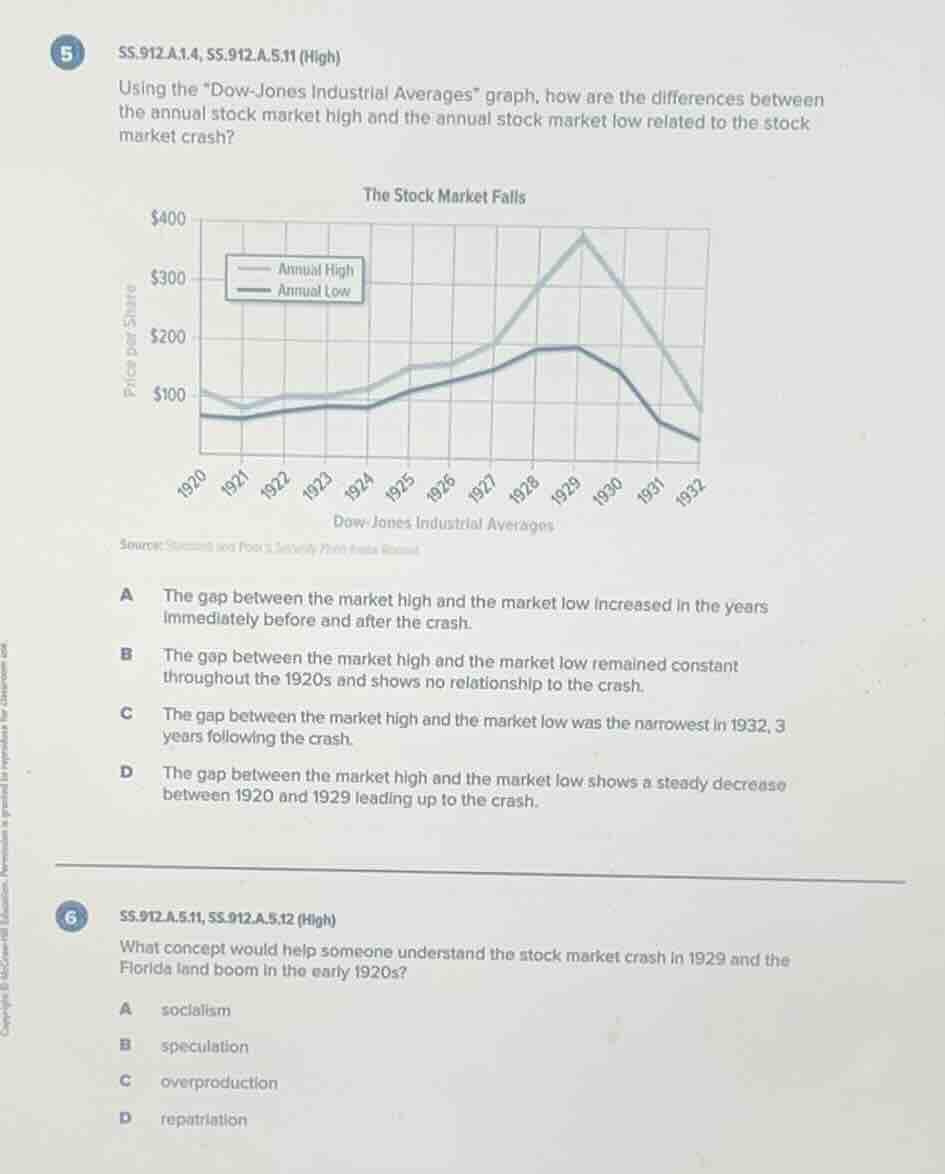
5 ss.912.a.1.4, ss.912.a.5.11 (high)using the \dow-jones industrial averages\ graph, how are the differences between the annual stock market high and the annual stock market low related to the stock market crash?the stock market fallsdow-jones industrial averagessource: standard and poors, seventy-five yearsa the gap between the market high and the market low increased in the years immediately before and after the crash.b the gap between the market high and the market low remained constant throughout the 1920s and shows no relationship to the crash.c the gap between the market high and the market low was the narrowest in 1932, 3 years following the crash.d the gap between the market high and the market low shows a steady decrease between 1920 and 1929 leading up to the crash.6 ss.912.a.5.11, ss.912.a.5.12 (high)what concept would help someone understand the stock market crash in 1929 and the florida land boom in the early 1920s?a socialismb speculationc overproductiond repatriation
For Question 5:
- Analyze the gap between the "Annual High" and "Annual Low" lines on the graph:
- From 1920 to 1929 (before the crash), the gap between the two lines grows larger each year.
- In 1929, the gap reaches its widest point, and after the crash (1930-1932), the gap remains large before narrowing, but the key trend is the increase in the gap leading up to and right after the crash.
- Option B is wrong because the gap does not stay constant. Option C is wrong because 1932 has a wider gap than earlier years like 1920-1923. Option D is wrong because the gap increases, not decreases, from 1920 to 1929.
- Speculation refers to buying assets (like stocks or land) with the expectation of quick, large profits from price increases, rather than from the asset's intrinsic value. The 1929 stock market crash was driven by widespread stock speculation, and the Florida land boom of the early 1920s was fueled by speculative buying of real estate with the hope of flipping it for huge gains.
- Socialism is an economic system focused on public ownership, which is unrelated. Overproduction refers to excess goods, not financial/land speculation. Repatriation is the return of people or funds to their home country, which does not explain these events.

Snap & solve any problem in the app
Get step-by-step solutions on Sovi AI
Photo-based solutions with guided steps
Explore more problems and detailed explanations
A. The gap between the market high and the market low increased in the years immediately before and after the crash.
---