QUESTION IMAGE
Question
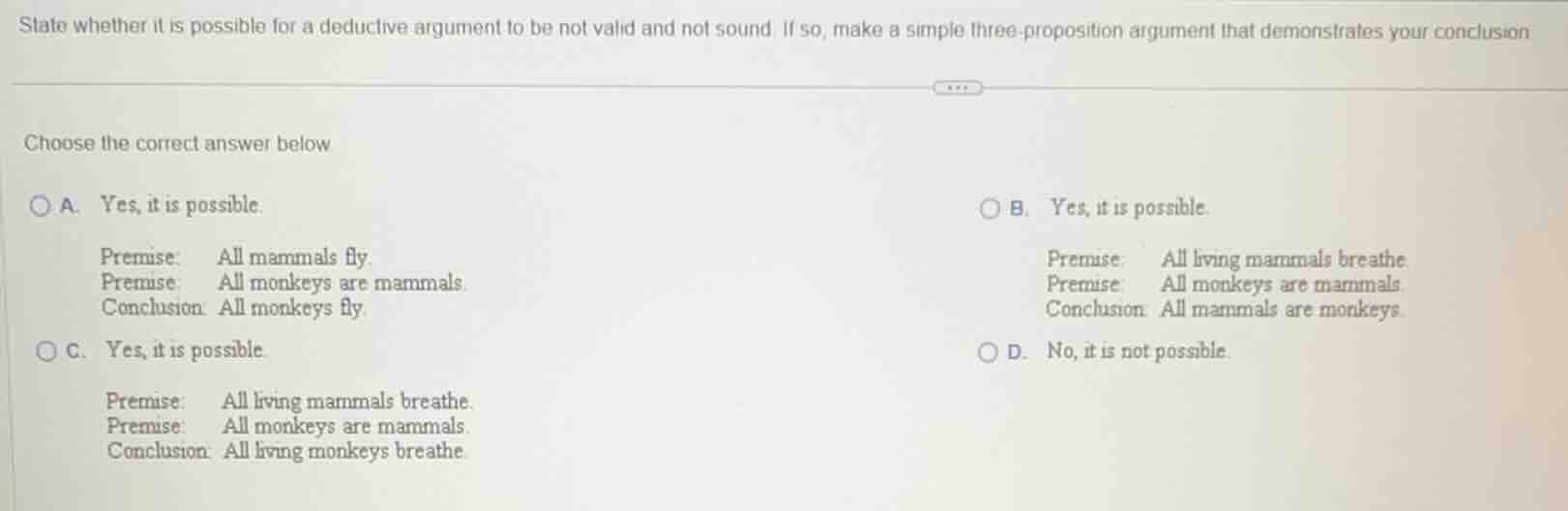
state whether it is possible for a deductive argument to be not valid and not sound. if so, make a simple three - proposition argument that demonstrates your conclusion
choose the correct answer below
a. yes, it is possible.
premise: all mammals fly.
premise: all monkeys are mammals.
conclusion: all monkeys fly.
b. yes, it is possible.
premise: all living mammals breathe.
premise: all monkeys are mammals
conclusion: all mammals are monkeys.
c. yes, it is possible.
premise: all living mammals breathe.
premise: all monkeys are mammals.
conclusion: all living monkeys breathe.
d. no, it is not possible.
To determine the answer, we analyze each option:
- Option A: A deductive argument is valid if the conclusion follows logically from the premises, and sound if it's valid and premises are true. Here, the first premise "All mammals fly" is false (so not sound), and the argument structure (if all A are B, all C are A, then all C are B) is valid in form, but wait—no, wait, the question is about not valid and not sound. Wait, no, let's re - check. Wait, the argument in A: Premise 1: All mammals fly (false), Premise 2: All monkeys are mammals (true), Conclusion: All monkeys fly. The form is valid (syllogism: AAA - 1), but the first premise is false, so it's valid but not sound. Wait, no, maybe I misread. Wait, the question is about not valid and not sound. Wait, let's check Option B: Premise 1: All living mammals breathe (true), Premise 2: All monkeys are mammals (true), Conclusion: All mammals are monkeys (false). The conclusion does not follow from the premises (the premises say monkeys are mammals, not all mammals are monkeys), so the argument is invalid. And since it's invalid, it can't be sound (sound requires valid + true premises). So this argument is invalid and not sound. Wait, but let's check Option A again. Wait, Option A's argument: If we accept the premises (even though the first is false), the conclusion follows. So the form is valid. So it's valid but not sound. Option B: The conclusion does not follow from the premises. So the argument is invalid. And since it's invalid, it's not sound. Option C: The argument is valid (syllogism: All A (living mammals) breathe, all B (monkeys) are A, so all B breathe) and the premises are true, so it's sound. Option D: Is wrong because we can have invalid and unsound arguments. Wait, but the question is "Is it possible for a deductive argument to be not valid and not sound?". So we need an argument that is invalid (conclusion does not follow from premises) and not sound (since it's invalid, it can't be sound). Let's re - examine the options:
- Option A: Argument form is valid (if all mammals fly and all monkeys are mammals, then all monkeys fly—logically follows). So it's valid (even with a false premise), so it's valid but not sound. Not what we want.
- Option B: Premises: All living mammals breathe (true), All monkeys are mammals (true). Conclusion: All mammals are monkeys (false). The conclusion does not follow from the premises (the premises establish that monkeys are a type of mammal, not that all mammals are monkeys). So the argument is invalid. And since it's invalid, it's not sound. So this argument is invalid and not sound, showing that such arguments are possible.
- Option C: Argument is valid (follows syllogistic logic) and premises are true, so it's sound.
- Option D: Is wrong because we have examples (like Option B) of invalid and unsound deductive arguments.
Wait, but the original question's options: Let's re - read the options. Option B says "Yes, it is possible" and provides an argument that is invalid (conclusion does not follow from premises) and since it's invalid, it's not sound. So the correct answer is B.

Snap & solve any problem in the app
Get step-by-step solutions on Sovi AI
Photo-based solutions with guided steps
Explore more problems and detailed explanations
B. Yes, it is possible.
Premise: All living mammals breathe.
Premise: All monkeys are mammals
Conclusion: All mammals are monkeys.