QUESTION IMAGE
Question
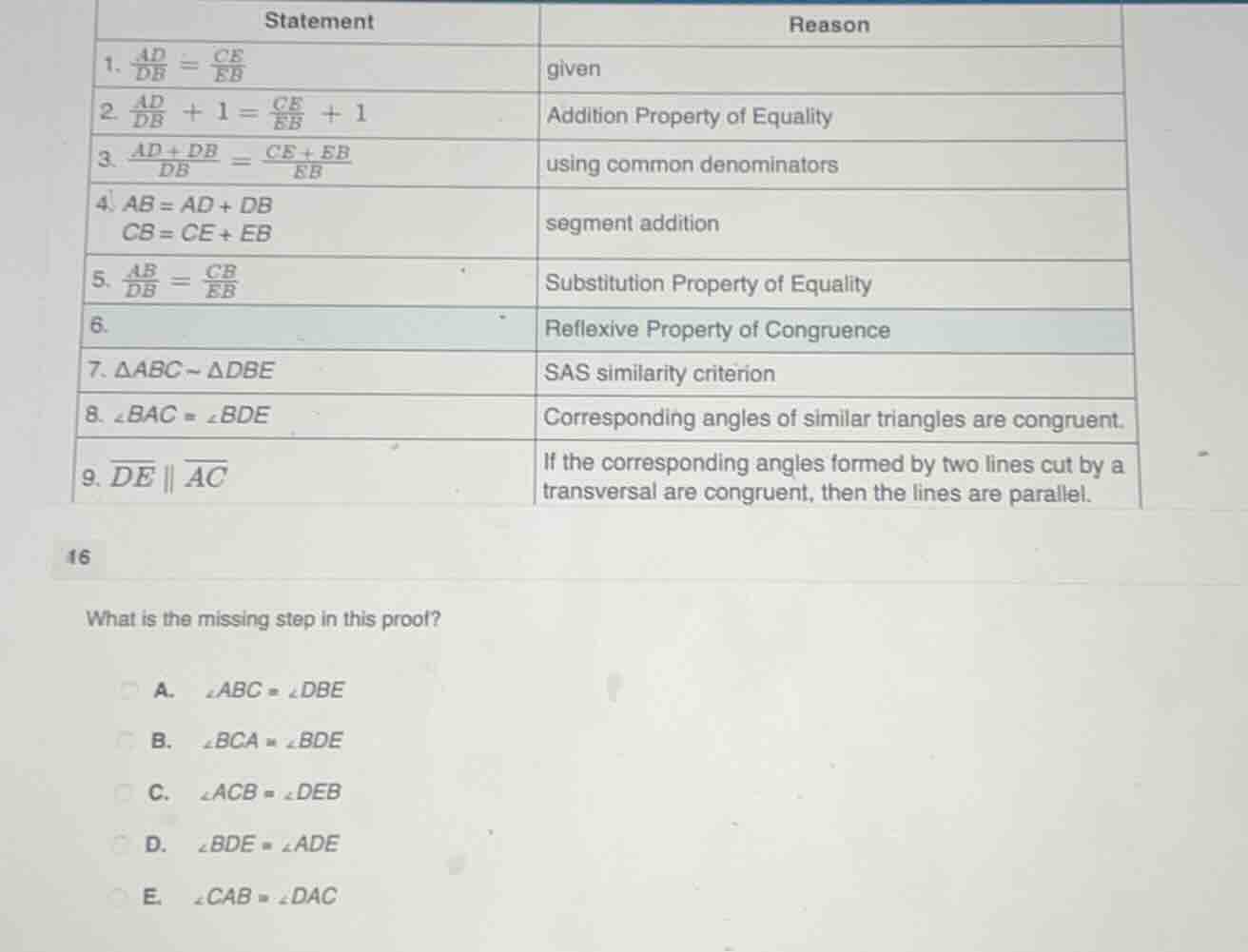
statement reason 1. \\(\frac{ad}{db} = \frac{ce}{eb}\\) given 2 \\(\frac{ad}{db} + 1 = \frac{ce}{eb} + 1\\) addition property of equality 3. \\(\frac{ad + db}{db} = \frac{ce + eb}{eb}\\) using common denominators 4. \\(ab = ad + db\\) \\(cb = ce + eb\\) segment addition 5. \\(\frac{ab}{db} = \frac{cb}{eb}\\) substitution property of equality 6. reflexive property of congruence 7. \\(\triangle abc \sim \triangle dbe\\) sas similarity criterion 8. \\(\angle bac \cong \angle bde\\) corresponding angles of similar triangles are congruent. 9. \\(\overline{de} \parallel \overline{ac}\\) if the corresponding angles formed by two lines cut by a transversal are congruent, then the lines are parallel. 16 what is the missing step in this proof? a. \\(\angle abc \cong \angle dbe\\) b. \\(\angle bca \cong \angle bde\\) c. \\(\angle acb \cong \angle deb\\) d. \\(\angle bde \cong \angle ade\\) e. \\(\angle cab \cong \angle dac\\)
The missing step uses the Reflexive Property of Congruence, which states an angle is congruent to itself. For the SAS similarity criterion (step 7), we need a pair of corresponding sides in proportion (already established in step 5) and the included angle congruent. The shared included angle for triangles $\triangle ABC$ and $\triangle DBE$ is $\angle ABC$ and $\angle DBE$, which are the same angle, so they are congruent by the reflexive property.

Snap & solve any problem in the app
Get step-by-step solutions on Sovi AI
Photo-based solutions with guided steps
Explore more problems and detailed explanations
A. $\angle ABC \cong \angle DBE$