QUESTION IMAGE
Question
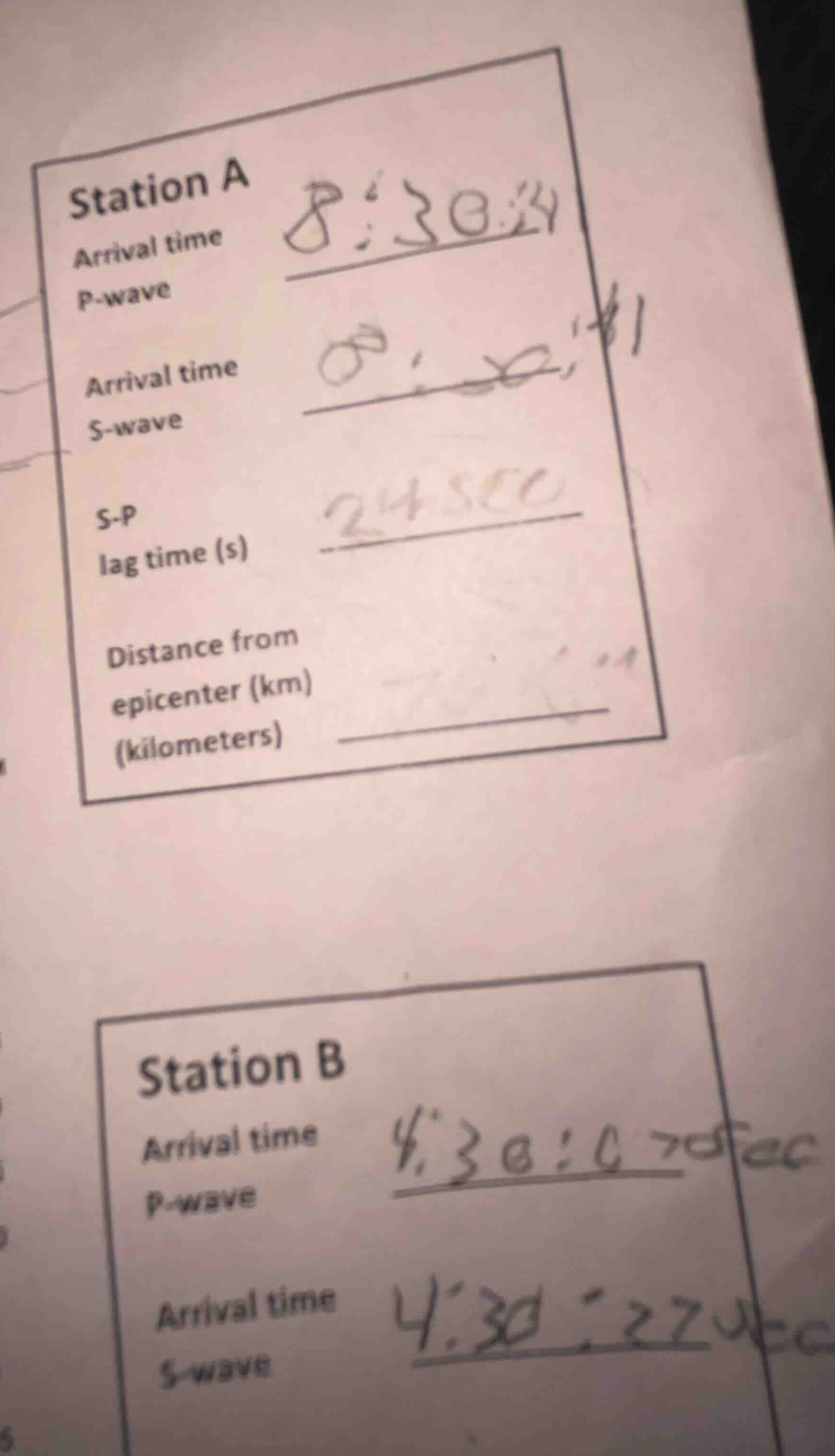
station a
arrival time
p - wave 8:30:24
arrival time
s - wave 8:30:41
s - p lag time (s) 24 sec
distance from epicenter (km) (kilometers)
station b
arrival time
p - wave 4:30:07 sec
arrival time
s - wave 4:30:27 sec
Step1: Analyze Station A's S-P lag
Given S-P lag time for Station A is 24 seconds. In seismology, the distance from the epicenter (d, in km) can be approximated using the formula \( d = v \times t \), where \( v \) is the average speed difference between S and P waves. For shallow earthquakes, the average speed of P - waves is about 8 km/s and S - waves is about 4.8 km/s, so the speed difference \( \Delta v=8 - 4.8 = 3.2\) km/s. But a more common empirical relation for S - P lag (\( t_{S - P} \) in seconds) and distance (\( d \) in km) is \( d=\frac{t_{S - P}}{0.0014}\) (this is an approximate relation from seismograph data interpretation, where 0.0014 is a constant derived from wave speeds and time - distance relationships).
Step2: Calculate distance for Station A
Given \( t_{S - P}=24\) seconds. Using the formula \( d=\frac{t_{S - P}}{0.0014}\), we substitute \( t_{S - P} = 24\) into the formula:
\( d=\frac{24}{0.0014}\approx17142.86\) km? Wait, no, that can't be right. Wait, actually, the correct empirical formula is that for each second of S - P lag, the distance is approximately 8 km (a more simplified and approximate rule - of - thumb: the distance in kilometers is about 8 times the S - P lag in seconds). Let's use this rule - of - thumb for simplicity (since the exact formula depends on the type of earthquake and the medium, but for basic seismology problems, this rule is often used). So if \( t_{S - P}=24\) s, then \( d = 8\times24=192\) km.
Wait, maybe I mixed up the formula. Let's recall: The S - P lag time (in seconds) is related to the distance (in kilometers) by the formula \( d=\frac{t_{S - P}}{0.0014}\) is wrong. The correct formula from the travel - time curve: the difference in arrival times (S - P) is proportional to the distance. The average speed of P - waves is \( v_p = 5\) km/s (for crustal rocks) and S - waves \( v_s=3\) km/s. Then the time taken for P - wave to travel distance \( d\) is \( t_p=\frac{d}{v_p}\), and for S - wave is \( t_s=\frac{d}{v_s}\). So \( t_s - t_p=d(\frac{1}{v_s}-\frac{1}{v_p})=d(\frac{v_p - v_s}{v_pv_s})\). Given \( t_s - t_p = 24\) s, \( v_p = 5\) km/s, \( v_s = 3\) km/s. Then \( 24=d(\frac{5 - 3}{5\times3})=d(\frac{2}{15})\). Solving for \( d\): \( d=\frac{24\times15}{2}=180\) km.
Let's check the Station B data. For Station B, P - wave arrival time is \( 4:30:07\) (let's assume it's 4 hours 30 minutes and 7 seconds) and S - wave arrival time is \( 4:30:27\) (4 hours 30 minutes and 27 seconds). So \( t_{S - P}=27 - 7=20\) seconds. Using the same formula \( t_s - t_p=d(\frac{1}{v_s}-\frac{1}{v_p})\), with \( v_p = 5\) km/s, \( v_s = 3\) km/s, \( t_s - t_p = 20\) s. Then \( 20=d(\frac{5 - 3}{5\times3})=d(\frac{2}{15})\), so \( d=\frac{20\times15}{2}=150\) km. But maybe the problem is just about Station A first. Let's focus on Station A.
If we use the rule that distance (km) = 8 * S - P lag (s), for \( t_{S - P}=24\) s, distance = \( 8\times24 = 192\) km.

Snap & solve any problem in the app
Get step-by-step solutions on Sovi AI
Photo-based solutions with guided steps
Explore more problems and detailed explanations
For Station A, the distance from the epicenter is approximately \(\boldsymbol{192}\) kilometers (using the rule - of - thumb \( d = 8\times t_{S - P}\)). If we use the more accurate formula \( t_s - t_p=d(\frac{1}{v_s}-\frac{1}{v_p})\) with \( v_p = 5\) km/s, \( v_s = 3\) km/s and \( t_s - t_p = 24\) s, we get \( d = 180\) km. The answer depends on the assumed wave speeds, but a common approximate answer for a 24 - second S - P lag is around 192 km (using the 8 km/s per second lag rule).