QUESTION IMAGE
Question
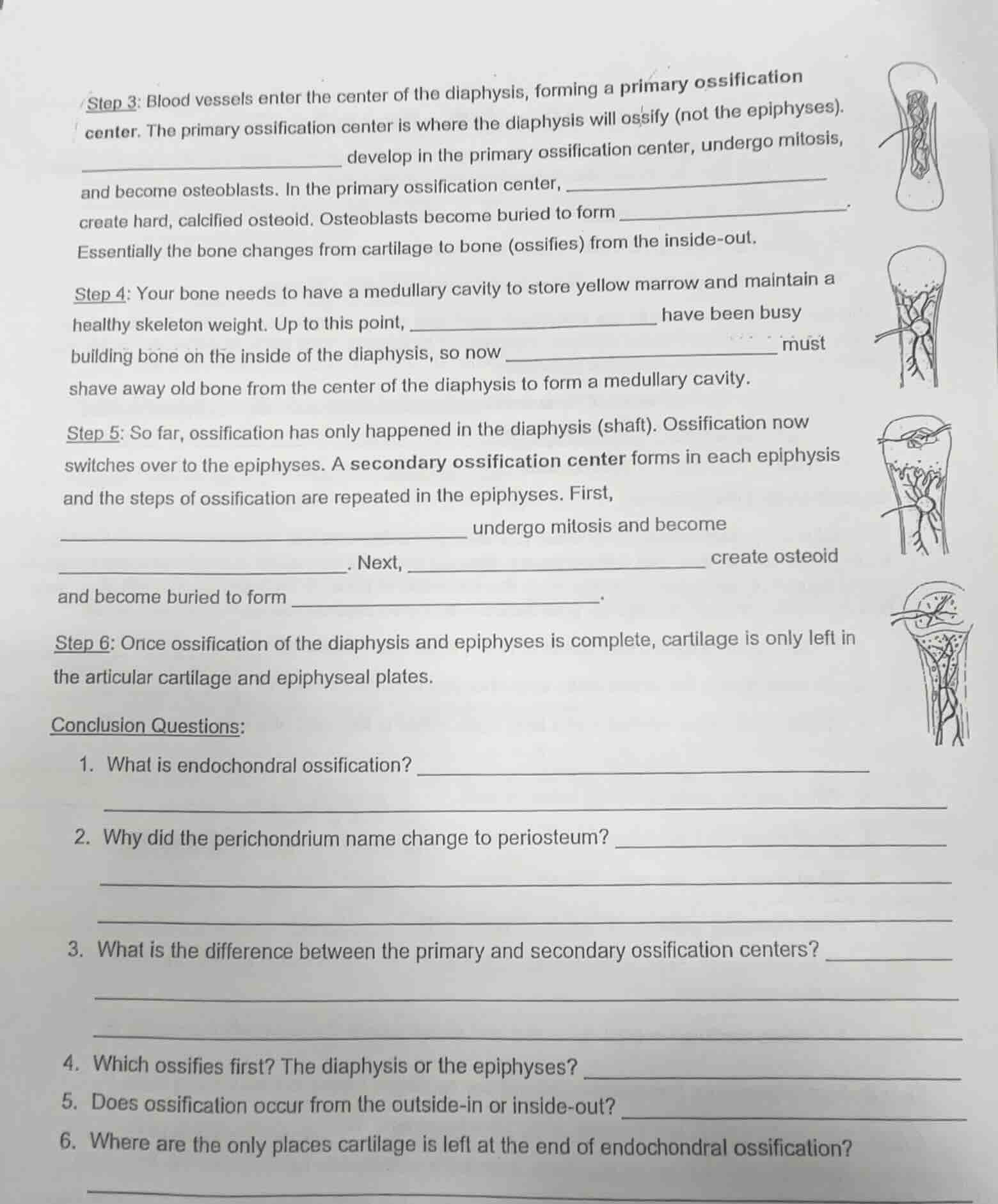
step 3: blood vessels enter the center of the diaphysis, forming a primary ossification center. the primary ossification center is where the diaphysis will ossify (not the epiphyses). _______________ develop in the primary ossification center, undergo mitosis, and become osteoblasts. in the primary ossification center, _____________ create hard, calcified osteoid. osteoblasts become buried to form ____________. essentially the bone changes from cartilage to bone (ossifies) from the inside - out. step 4: your bone needs to have a medullary cavity to store yellow marrow and maintain a healthy skeleton weight. up to this point, _____________ have been busy building bone on the inside of the diaphysis, so now _____________ must shave away old bone from the center of the diaphysis to form a medullary cavity. step 5: so far, ossification has only happened in the diaphysis (shaft). ossification now switches over to the epiphyses. a secondary ossification center forms in each epiphysis and the steps of ossification are repeated in the epiphyses. first, _____________ undergo mitosis and become ____________. next, _____________ create osteoid and become buried to form ____________. step 6: once ossification of the diaphysis and epiphyses is complete, cartilage is only left in the articular cartilage and epiphyseal plates. conclusion questions: 1. what is endochondral ossification? _____________ _____________ 2. why did the perichondrium name change to periosteum? _____________ _____________ _____________ 3. what is the difference between the primary and secondary ossification centers? _______ _____________ _____________ 4. which ossifies first? the diaphysis or the epiphyses? _____________ 5. does ossification occur from the outside - in or inside - out? _______________ 6. where are the only places cartilage is left at the end of endochondral ossification?
Step 3 Fill-Ins:
- Mesenchymal cells differentiate and divide to become bone-forming cells.
- Osteoblasts are the cells that secrete calcified bone matrix.
- Osteoblasts get trapped in the matrix they secrete, maturing into osteocytes.
Step 4 Fill-Ins:
- Osteoblasts are responsible for laying down new bone tissue.
- Osteoclasts are the cells that break down and resorb old bone tissue.
Step 5 Fill-Ins:
- Mesenchymal cells in the epiphyses follow the same differentiation pathway as in the diaphysis.
- They mature into osteoblasts, the bone-forming cells.
- Osteoblasts secrete matrix and become trapped, maturing into osteocytes.
Conclusion Questions:
- Defined as the process of bone formation from a hyaline cartilage model.
- The name changes because the tissue it covers transforms from cartilage (chondrium) to bone (osteum).
- Primary centers form in the diaphysis first; secondary centers form later in the epiphyses.
- The diaphysis starts ossification before the epiphyses, as shown in Step 3 and Step 5.
- Explicitly stated in Step 3 that ossification proceeds from the inside-out.
- Stated in Step 6 that only these two cartilage structures remain after full ossification.

Snap & solve any problem in the app
Get step-by-step solutions on Sovi AI
Photo-based solutions with guided steps
Explore more problems and detailed explanations
Step 3:
Mesenchymal cells develop in the primary ossification center, undergo mitosis, and become osteoblasts. In the primary ossification center, osteoblasts create hard, calcified osteoid. Osteoblasts become buried to form osteocytes.
Step 4:
Up to this point, osteoblasts have been busy building bone on the inside of the diaphysis, so now osteoclasts must shave away old bone from the center of the diaphysis to form a medullary cavity.
Step 5:
First, mesenchymal cells undergo mitosis and become osteoblasts. Next, osteoblasts create osteoid and become buried to form osteocytes.
Conclusion Questions:
- Endochondral ossification is the process by which bone forms by replacing a hyaline cartilage model.
- The perichondrium is renamed periosteum because the tissue it surrounds changes from cartilage to bone, so the term reflects the new underlying tissue (bone/osteum instead of cartilage/chondrium).
- The primary ossification center forms in the diaphysis (shaft) of the bone and is the first site of ossification, while secondary ossification centers form later in the epiphyses (ends) of the bone.
- The diaphysis ossifies first.
- Ossification occurs from the inside-out.
- Cartilage is only left in the articular cartilage (covering the ends of the bone) and the epiphyseal plates (growth plates between diaphysis and epiphyses).