QUESTION IMAGE
Question
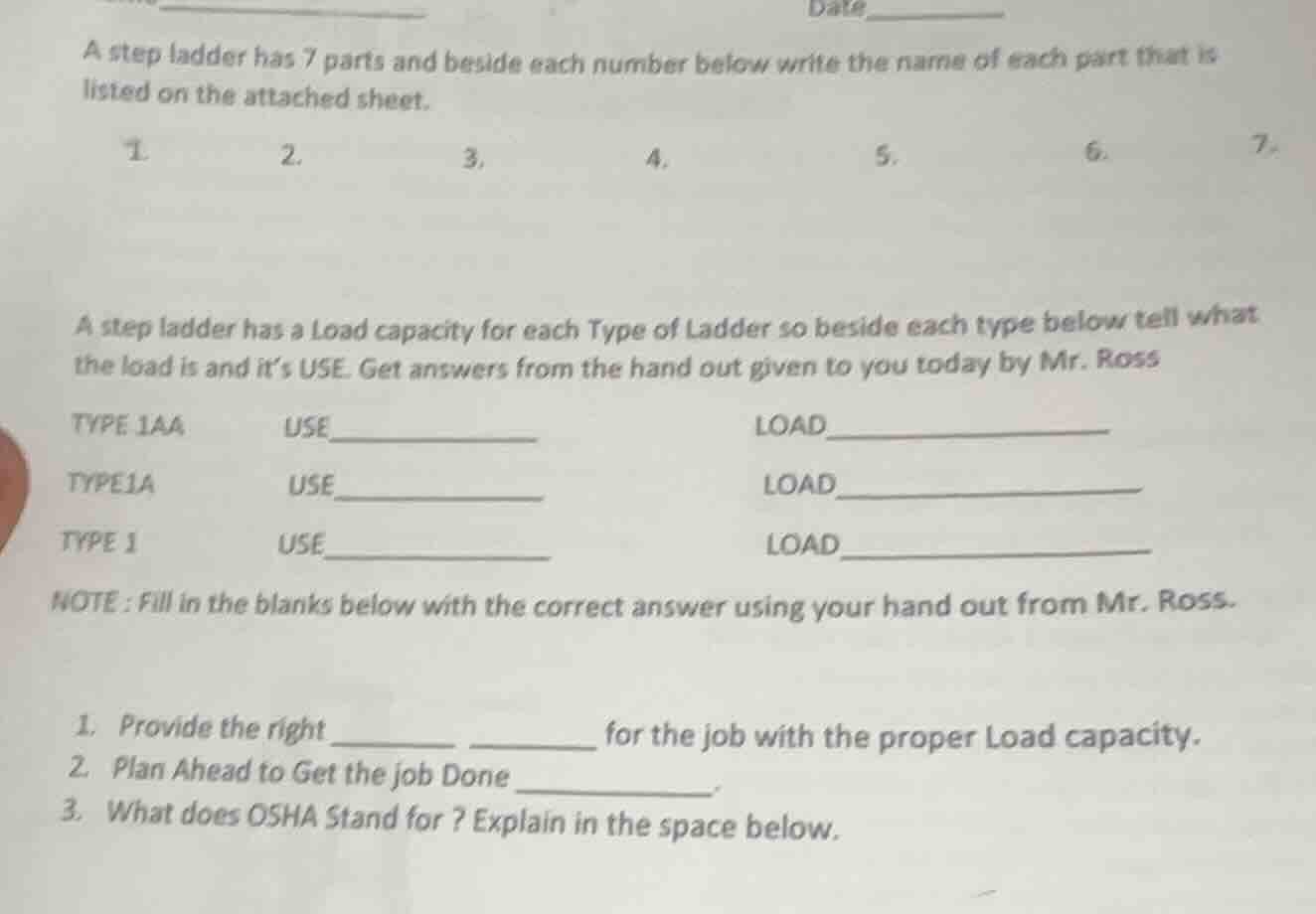
a step ladder has 7 parts and beside each number below write the name of each part that is listed on the attached sheet.
- 2. 3. 4. 5. 6. 7.
a step ladder has a load capacity for each type of ladder so beside each type below tell what the load is and it’s use. get answers from the hand out given to you today by mr. ross
type 1aa use________ load____________
type1a use________ load____________
type 1 use________ load____________
note : fill in the blanks below with the correct answer using your hand out from mr. ross.
- provide the right ____ ____ for the job with the proper load capacity.
- plan ahead to get the job done __________.
- what does osha stand for ? explain in the space below.
To answer these questions, we need to refer to the handout provided by Mr. Ross (since the information about the parts of the step ladder, load capacities, and uses of different ladder types, as well as the OSHA explanation, is likely included there). Here's a general guidance on what the answers might be based on standard ladder safety knowledge (though the exact answers depend on the handout):
Part 1: Naming the 7 parts of a step ladder
Without the attached sheet, we can't provide the exact names, but common parts of a step ladder include:
- Top Cap (or Top Step)
- Steps (Rungs)
- Side Rails (Stiles)
- Spreaders (or Hinges)
- Feet (or Base Pads)
- Back Brace (if applicable)
- Tool Tray (if applicable)
Part 2: Load capacity and use of different ladder types (standard information, may vary by handout)
- TYPE 1AA:
- USE: Heavy-duty industrial use (e.g., in construction, heavy manufacturing)
- LOAD: Typically 375 pounds
- TYPE 1A:
- USE: Medium to heavy-duty commercial/industrial use (e.g., in warehouses, commercial construction)
- LOAD: Typically 300 pounds
- TYPE 1:
- USE: Light to medium-duty commercial use (e.g., in offices, light construction)
- LOAD: Typically 250 pounds
Part 3: Filling in the blanks
- Provide the right ladder type for the job with the proper Load capacity. (The second blank might be "size" or "type" depending on the handout, but "ladder type" is common)
- Plan Ahead to Get the job Done safely (or "efficiently" depending on the handout, but "safely" is a key aspect of ladder safety planning)
- OSHA stands for the Occupational Safety and Health Administration. It is a federal agency in the United States that ensures safe and healthy working conditions by setting and enforcing standards and providing workplace safety training, outreach, education, and assistance.
Since the problem explicitly asks to use the handout from Mr. Ross, the most accurate answers would be found there. If you can share the details from the handout, we can provide more precise answers.

Snap & solve any problem in the app
Get step-by-step solutions on Sovi AI
Photo-based solutions with guided steps
Explore more problems and detailed explanations
To answer these questions, we need to refer to the handout provided by Mr. Ross (since the information about the parts of the step ladder, load capacities, and uses of different ladder types, as well as the OSHA explanation, is likely included there). Here's a general guidance on what the answers might be based on standard ladder safety knowledge (though the exact answers depend on the handout):
Part 1: Naming the 7 parts of a step ladder
Without the attached sheet, we can't provide the exact names, but common parts of a step ladder include:
- Top Cap (or Top Step)
- Steps (Rungs)
- Side Rails (Stiles)
- Spreaders (or Hinges)
- Feet (or Base Pads)
- Back Brace (if applicable)
- Tool Tray (if applicable)
Part 2: Load capacity and use of different ladder types (standard information, may vary by handout)
- TYPE 1AA:
- USE: Heavy-duty industrial use (e.g., in construction, heavy manufacturing)
- LOAD: Typically 375 pounds
- TYPE 1A:
- USE: Medium to heavy-duty commercial/industrial use (e.g., in warehouses, commercial construction)
- LOAD: Typically 300 pounds
- TYPE 1:
- USE: Light to medium-duty commercial use (e.g., in offices, light construction)
- LOAD: Typically 250 pounds
Part 3: Filling in the blanks
- Provide the right ladder type for the job with the proper Load capacity. (The second blank might be "size" or "type" depending on the handout, but "ladder type" is common)
- Plan Ahead to Get the job Done safely (or "efficiently" depending on the handout, but "safely" is a key aspect of ladder safety planning)
- OSHA stands for the Occupational Safety and Health Administration. It is a federal agency in the United States that ensures safe and healthy working conditions by setting and enforcing standards and providing workplace safety training, outreach, education, and assistance.
Since the problem explicitly asks to use the handout from Mr. Ross, the most accurate answers would be found there. If you can share the details from the handout, we can provide more precise answers.