QUESTION IMAGE
Question
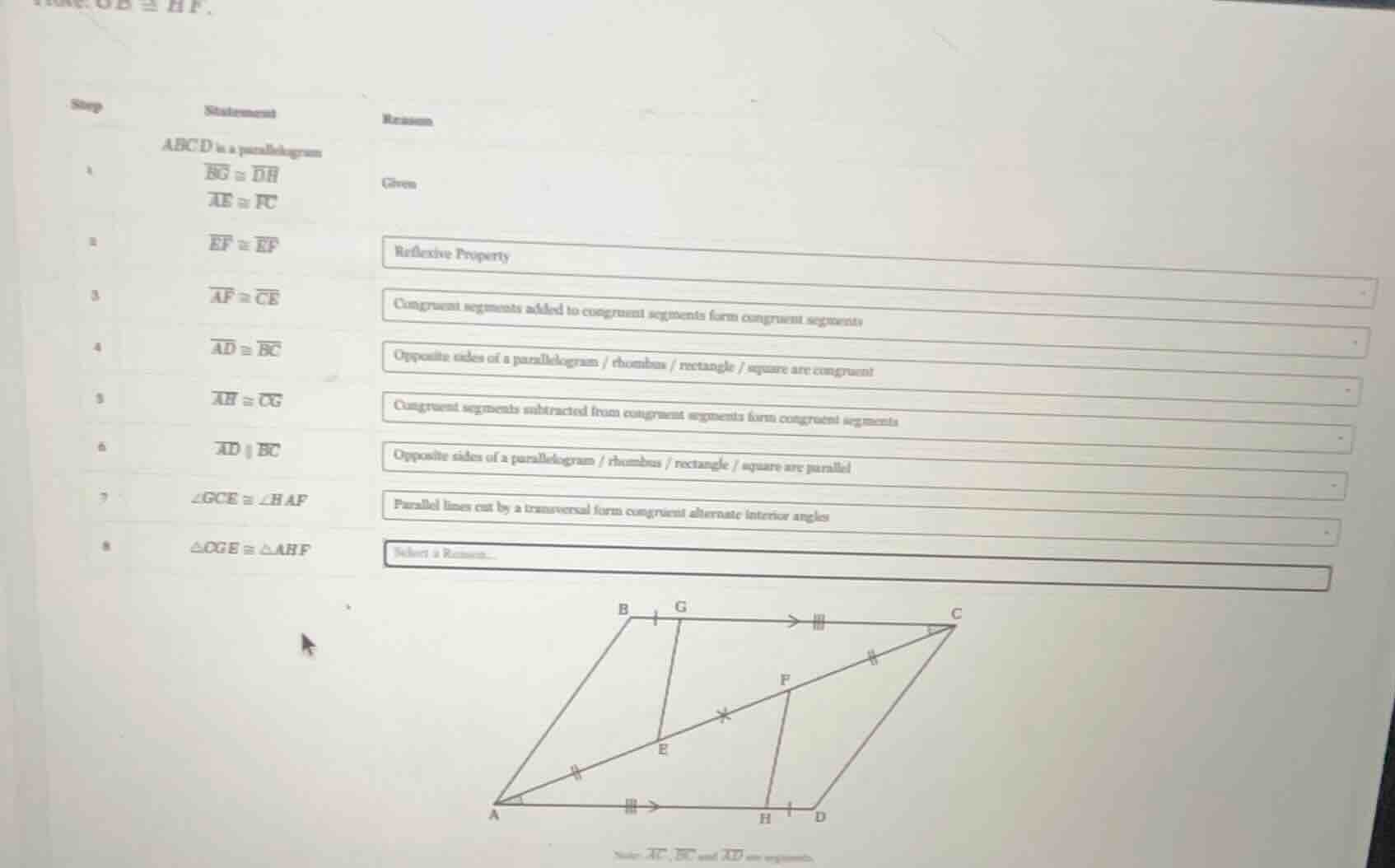
step statement reason abcd is a parallelogram bg ≅ dh given ae ≅ fc ef ≅ ef reflexive property af ≅ ce congruent segments added to congruent segments form congruent segments ad ≅ bc opposite sides of a parallelogram / rhombus / rectangle / square are congruent ah ≅ cg congruent segments subtracted from congruent segments form congruent segments ad || bc opposite sides of a parallelogram / rhombus / rectangle / square are parallel ∠gce ≅ ∠haf parallel lines cut by a transversal form congruent alternate interior angles △cge ≅ △ahf select a reason... note: ae, bc and hd are segments.
Step1: Identify known congruent parts
We know from step 3 that $\overline{AF} \cong \overline{CE}$, from step 5 that $\overline{AH} \cong \overline{CG}$, and from step 7 that $\angle GCE \cong \angle HAF$.
Step2: Apply SAS congruence criterion
To prove $\triangle CGE \cong \triangle AHF$, we can use the Side - Angle - Side (SAS) congruence postulate. We have two pairs of congruent sides ($\overline{AH} \cong \overline{CG}$ and $\overline{AF} \cong \overline{CE}$) and the included angle between them ($\angle GCE \cong \angle HAF$) is congruent. So the reason is "Side - Angle - Side (SAS) Congruence Postulate" (or "SAS" for short), which states that if two sides and the included angle of one triangle are congruent to two sides and the included angle of another triangle, then the two triangles are congruent.

Snap & solve any problem in the app
Get step-by-step solutions on Sovi AI
Photo-based solutions with guided steps
Explore more problems and detailed explanations
The reason for $\triangle CGE \cong \triangle AHF$ is the Side - Angle - Side (SAS) Congruence Postulate (i.e., if two sides and the included angle of one triangle are congruent to two sides and the included angle of another triangle, then the triangles are congruent).