QUESTION IMAGE
Question
step 2
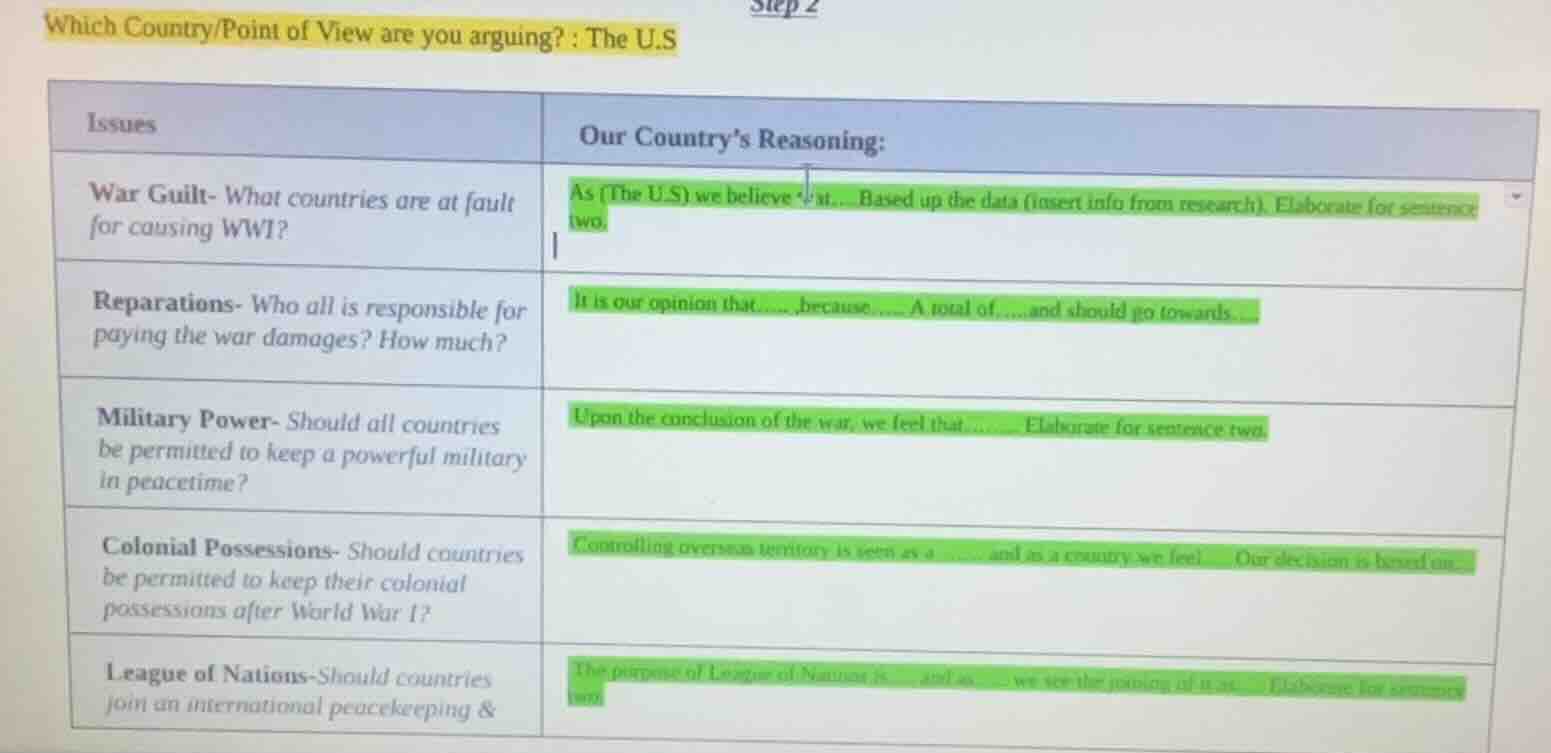
which country/point of view are you arguing? : the u.s
| issues | our countrys reasoning: |
|---|---|
| reparations- who all is responsible for paying the war damages? how much? | it is our opinion that...., because.... a total of.....and should go towards.... |
| military power- should all countries be permitted to keep a powerful military in peacetime? | upon the conclusion of the war, we feel that...... elaborate for sentence two. |
| colonial possessions- should countries be permitted to keep their colonial possessions after world war 1? | controlling overseas territory is seen as a...... and as a country we feel...... our decision is based on.... |
| league of nations-should countries join an international peacekeeping & | the purpose of league of nations is..... and as..... we see the joining of it as..... elaborate for sentence two |
To answer from the U.S. perspective on these WWI - related issues, we analyze each:
War Guilt
The U.S. would likely base its view on historical evidence. Austria - Hungary's ultimatum to Serbia and subsequent actions, along with Germany's support (like the Blank Check) were key triggers. So, "As (The U.S) we believe that Austria - Hungary, with Germany's support, holds significant fault for causing WWI. Based on research, Austria - Hungary's ultimatum to Serbia initiated the chain of events, and Germany's backing of Austria - Hungary escalated tensions. Additionally, the complex web of alliances led to widespread conflict, but the initial aggressive moves from these two nations were pivotal."
Reparations
The U.S. had a more moderate stance compared to France. It would argue that the Central Powers (Germany, Austria - Hungary, etc.) should bear responsibility, but not to the extent of crippling Germany (as seen in the Dawes Plan later). So, "It is our opinion that the Central Powers, primarily Germany, should be responsible for paying war damages. Because they were major aggressors in the conflict. A total of a reasonable sum (not overly burdensome to avoid economic collapse in Germany) should be paid, and these funds should go towards rebuilding war - torn regions in Europe, including both Allied and some Central Power - affected areas to promote stability."
Military Power
The U.S. was cautious about excessive military build - ups post - war. It would support limitations to prevent future conflicts. So, "Upon the conclusion of the war, we feel that countries should have limited military power in peacetime. Elaborate: A large - scale peacetime military can lead to an arms race and increased tensions, as seen in the years leading up to WWI. By restricting military size, we can reduce the likelihood of another catastrophic conflict, while still allowing countries to defend their sovereignty."
Colonial Possessions
The U.S. had an interest in self - determination (later emphasized in Wilson's 14 Points). So, "Controlling overseas territory is seen as a source of international tension and exploitation, and as a country, we feel that colonial powers should consider the right to self - determination of colonized peoples. Our decision is based on the idea that allowing colonies to have a say in their governance or even independence can reduce global unrest. For example, the exploitation of colonial resources by European powers contributed to economic inequalities that fueled tensions before WWI."
League of Nations
The U.S. (under Wilson) was a proponent, but there was domestic opposition. So, "The purpose of the League of Nations is to promote international cooperation and prevent future wars, and as the U.S., we see the joining of it as a crucial step. Elaborate: By having a collective security organization, countries can resolve disputes diplomatically rather than through war. It can also facilitate economic and humanitarian cooperation across nations, helping to rebuild and stabilize the post - war world."

Snap & solve any problem in the app
Get step-by-step solutions on Sovi AI
Photo-based solutions with guided steps
Explore more problems and detailed explanations