QUESTION IMAGE
Question
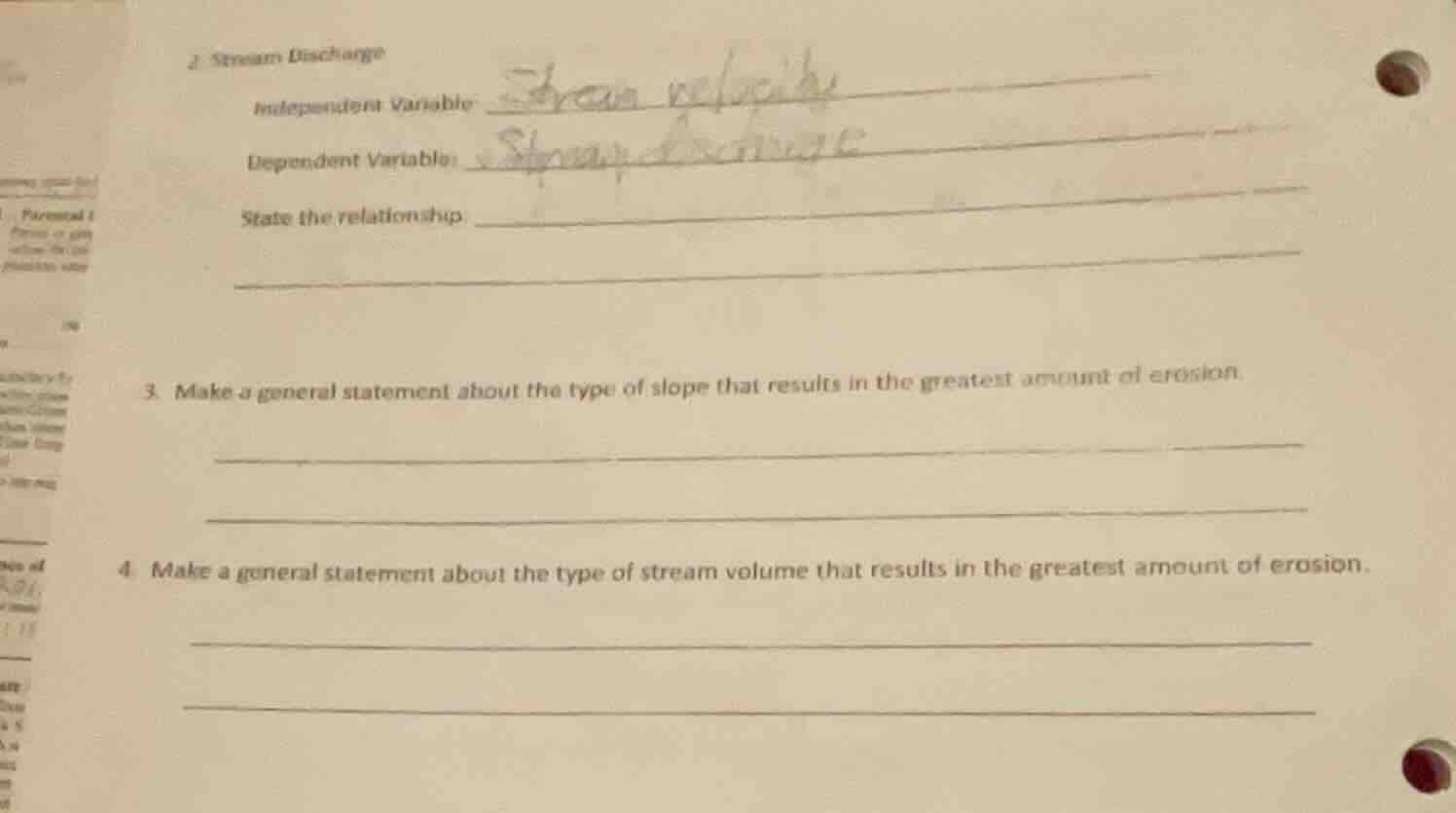
2 stream discharge
independent variable:
dependent variable:
state the relationship.
- make a general statement about the type of slope that results in the greatest amount of erosion.
- make a general statement about the type of stream volume that results in the greatest amount of erosion.
Question 2 (Stream Discharge)
- Independent Variable: In stream discharge studies, factors like stream velocity (or slope, stream width/depth) that we can manipulate or observe as a cause are independent. Here, a common independent variable is Stream Velocity (or slope, stream cross - sectional area).
- Dependent Variable: Stream Discharge depends on other factors, so it's the dependent variable. Discharge ($Q$) is calculated as $Q = V\times A$ (where $V$ is velocity and $A$ is cross - sectional area of the stream).
- Relationship: The relationship between stream velocity (independent) and discharge (dependent) is direct. As stream velocity increases (assuming the cross - sectional area of the stream remains constant or also changes in a way that supports it), stream discharge increases. Mathematically, $Q\propto V$ (when $A$ is constant) or $Q = V\times A$.
Erosion by water (or other agents) is affected by slope steepness. A steeper slope means that water (or the eroding agent) flows more quickly. Faster - moving water has more kinetic energy, which allows it to carry more sediment and erode the land more effectively. So, generally, steeper slopes result in a greater amount of erosion.
Stream volume refers to the amount of water in the stream (related to its cross - sectional area and length, or simply the total amount of water flowing). A greater stream volume means there is more water flowing. More water has a greater capacity to carry sediment, and the force exerted by a larger volume of water (especially when combined with velocity) is greater. So, a greater stream volume (more water flowing in the stream) results in a greater amount of erosion.

Snap & solve any problem in the app
Get step-by-step solutions on Sovi AI
Photo-based solutions with guided steps
Explore more problems and detailed explanations
- Independent Variable: Stream Velocity (or Slope, Stream Cross - Sectional Area)
- Dependent Variable: Stream Discharge
- Relationship: Stream discharge is directly related to the independent variable (e.g., as stream velocity increases, stream discharge increases, given a constant stream cross - sectional area; mathematically $Q = V\times A$ where $Q$ is discharge, $V$ is velocity, and $A$ is cross - sectional area)