QUESTION IMAGE
Question
student copy · unit 2: fahrenheit
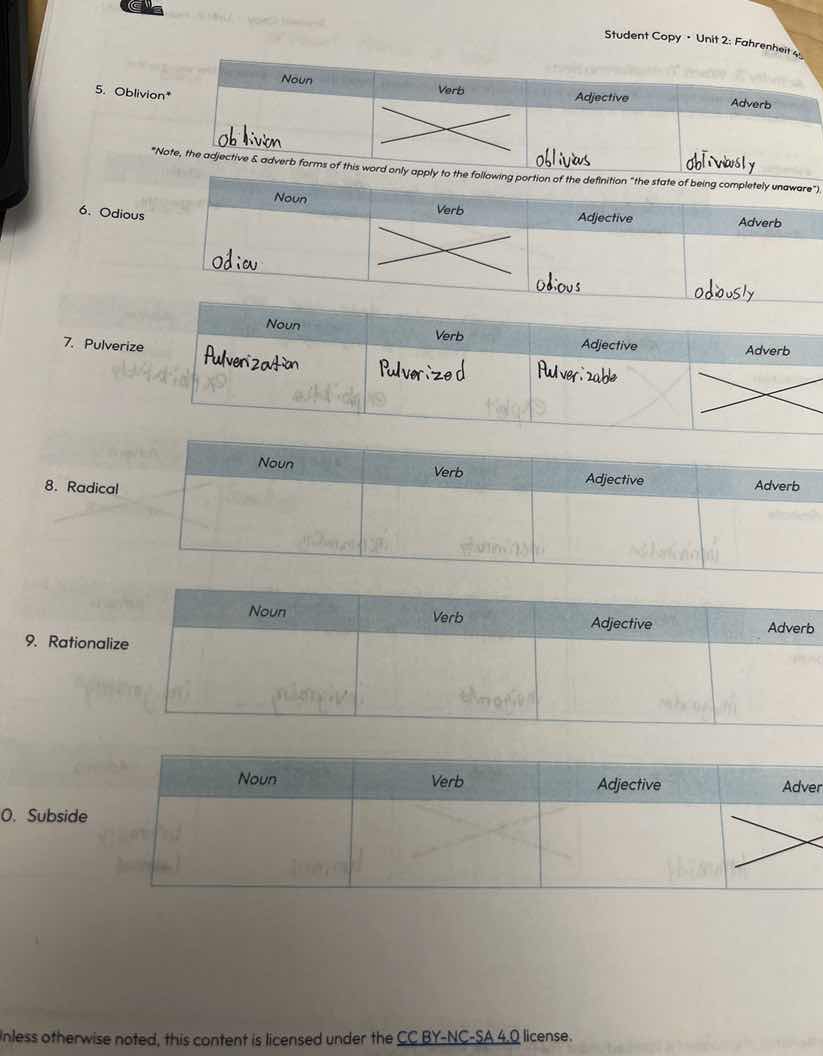
- oblivion*
*note, the adjective & adverb forms of this word only apply to the following portion of the definition: “the state of being completely unaware”
- odious
- pulverize
- radical
- rationalize
- subside
unless otherwise noted, this content is licensed under the cc by - nc - sa 4.0 license.
To solve the word - form transformation for each word, we analyze the parts of speech (noun, verb, adjective, adverb) based on word - building rules (like suffix addition: - ion for noun, - ize/- ed for verb, - ive/- ous for adjective, - ly for adverb, etc.).
8. Radical
- Noun: The noun form of “radical” is “radicalism” (it can also be “radical” as a noun referring to a person with radical ideas, but “radicalism” is a more typical noun form denoting the ideology).
- Verb: There is no common verb form for “radical” in standard English. If we consider a derived verb, it could be “radicalize” (to make something or someone radical).
- Adjective: The adjective form is “radical” (e.g., “a radical idea”).
- Adverb: The adverb form is “radically” (e.g., “He changed his plan radically”).
9. Rationalize
- Noun: The noun form is “rationalization” (formed by adding “- ation” to the verb “rationalize”).
- Verb: The verb form is “rationalize” (the base verb, meaning to justify or explain in a rational way).
- Adjective: The adjective form is “rational” (or “rationalizable” if we consider the ability to be rationalized; “rational” is more common, meaning based on reason).
- Adverb: The adverb form is “rationally” (formed by adding “- ly” to the adjective “rational”).
10. Subside
- Noun: The noun form is “subsidence” (formed by adding “- ence” to the verb “subside”, referring to the act of subsiding).
- Verb: The verb form is “subside” (the base verb, meaning to sink down or decrease).
- Adjective: The adjective form is “subsiding” (a present - participle form used as an adjective, e.g., “the subsiding flood”) or “subsidiary” (though “subsidiary” has a slightly different meaning, related to being subordinate; “subsiding” is more directly related to the verb “subside”).
- Adverb: There is no common adverb form for “subside” in standard English. If we force a form, it could be “subsidedly” but this is non - standard. Usually, we would use an adverb phrase like “in a subsiding manner”.
Final Answers (Filling the Table)
| Word | Noun | Verb | Adjective | Adverb |
|---|---|---|---|---|
| 9. Rationalize | rationalization | rationalize | rational (or rationalizable) | rationally |
| 10. Subside | subsidence | subside | subsiding (or subsidiary) | (no common adverb, or subsidedly (non - standard)) |

Snap & solve any problem in the app
Get step-by-step solutions on Sovi AI
Photo-based solutions with guided steps
Explore more problems and detailed explanations
To solve the word - form transformation for each word, we analyze the parts of speech (noun, verb, adjective, adverb) based on word - building rules (like suffix addition: - ion for noun, - ize/- ed for verb, - ive/- ous for adjective, - ly for adverb, etc.).
8. Radical
- Noun: The noun form of “radical” is “radicalism” (it can also be “radical” as a noun referring to a person with radical ideas, but “radicalism” is a more typical noun form denoting the ideology).
- Verb: There is no common verb form for “radical” in standard English. If we consider a derived verb, it could be “radicalize” (to make something or someone radical).
- Adjective: The adjective form is “radical” (e.g., “a radical idea”).
- Adverb: The adverb form is “radically” (e.g., “He changed his plan radically”).
9. Rationalize
- Noun: The noun form is “rationalization” (formed by adding “- ation” to the verb “rationalize”).
- Verb: The verb form is “rationalize” (the base verb, meaning to justify or explain in a rational way).
- Adjective: The adjective form is “rational” (or “rationalizable” if we consider the ability to be rationalized; “rational” is more common, meaning based on reason).
- Adverb: The adverb form is “rationally” (formed by adding “- ly” to the adjective “rational”).
10. Subside
- Noun: The noun form is “subsidence” (formed by adding “- ence” to the verb “subside”, referring to the act of subsiding).
- Verb: The verb form is “subside” (the base verb, meaning to sink down or decrease).
- Adjective: The adjective form is “subsiding” (a present - participle form used as an adjective, e.g., “the subsiding flood”) or “subsidiary” (though “subsidiary” has a slightly different meaning, related to being subordinate; “subsiding” is more directly related to the verb “subside”).
- Adverb: There is no common adverb form for “subside” in standard English. If we force a form, it could be “subsidedly” but this is non - standard. Usually, we would use an adverb phrase like “in a subsiding manner”.
Final Answers (Filling the Table)
| Word | Noun | Verb | Adjective | Adverb |
|---|---|---|---|---|
| 9. Rationalize | rationalization | rationalize | rational (or rationalizable) | rationally |
| 10. Subside | subsidence | subside | subsiding (or subsidiary) | (no common adverb, or subsidedly (non - standard)) |