QUESTION IMAGE
Question
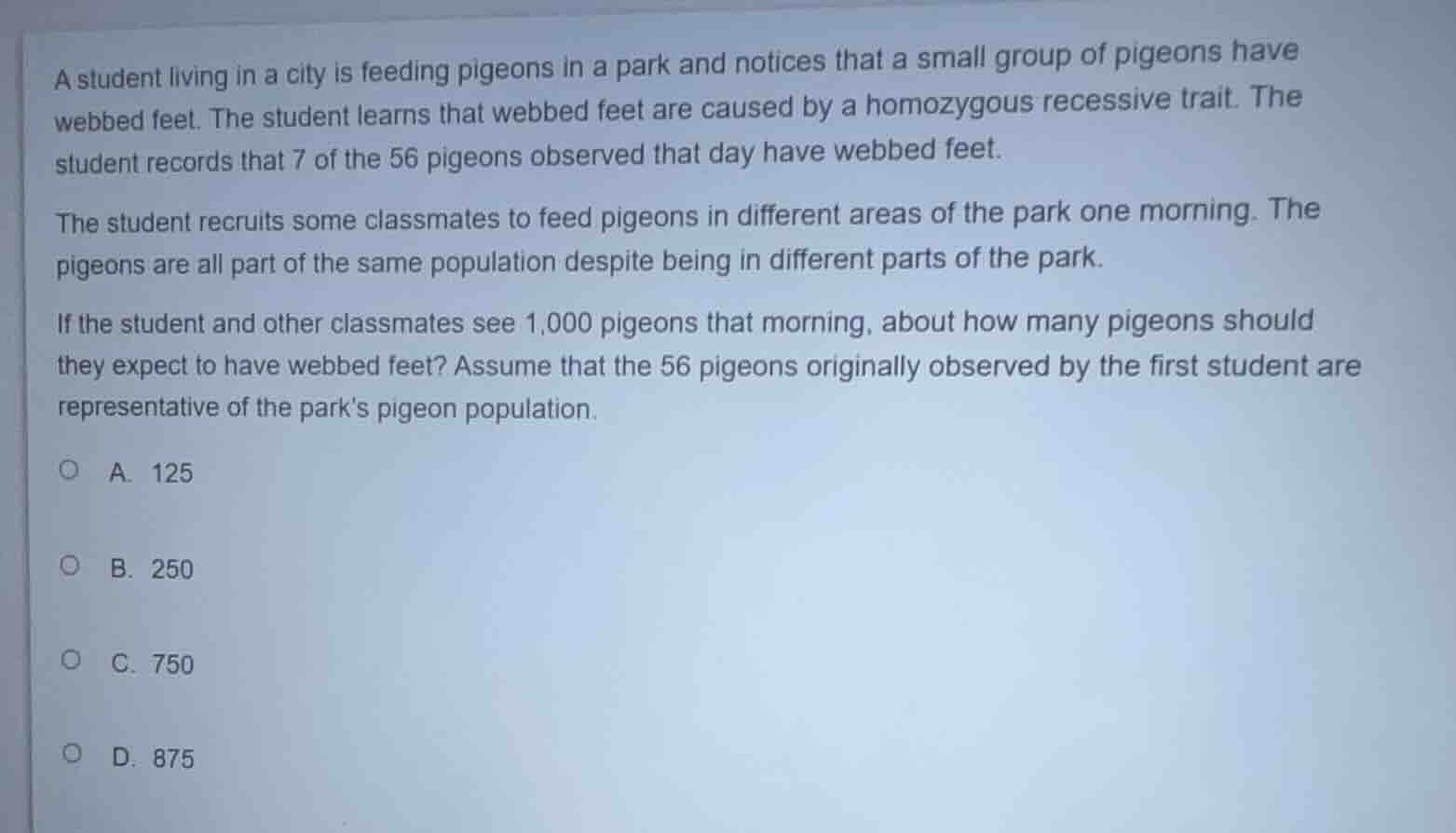
a student living in a city is feeding pigeons in a park and notices that a small group of pigeons have webbed feet. the student learns that webbed feet are caused by a homozygous recessive trait. the student records that 7 of the 56 pigeons observed that day have webbed feet. the student recruits some classmates to feed pigeons in different areas of the park one morning. the pigeons are all part of the same population despite being in different parts of the park. if the student and other classmates see 1,000 pigeons that morning, about how many pigeons should they expect to have webbed feet? assume that the 56 pigeons originally observed by the first student are representative of the park’s pigeon population. a. 125 b. 250 c. 750 d. 875
Step1: Find the proportion of webbed - footed pigeons in the initial sample
The initial sample has 56 pigeons, and 7 of them have webbed feet. The proportion \(p\) of webbed - footed pigeons in the initial sample is calculated as \(p=\frac{\text{Number of webbed - footed pigeons}}{\text{Total number of pigeons in the sample}}\). So, \(p = \frac{7}{56}=\frac{1}{8}\).
Step2: Use the proportion to find the number of webbed - footed pigeons in the larger sample
We have a larger sample of \(n = 1000\) pigeons. To find the expected number of webbed - footed pigeons in this larger sample, we multiply the total number of pigeons in the larger sample by the proportion of webbed - footed pigeons from the initial sample. Let \(x\) be the expected number of webbed - footed pigeons. Then \(x=n\times p\). Substituting \(n = 1000\) and \(p=\frac{1}{8}\), we get \(x = 1000\times\frac{1}{8}=125\).

Snap & solve any problem in the app
Get step-by-step solutions on Sovi AI
Photo-based solutions with guided steps
Explore more problems and detailed explanations
A. 125