QUESTION IMAGE
Question
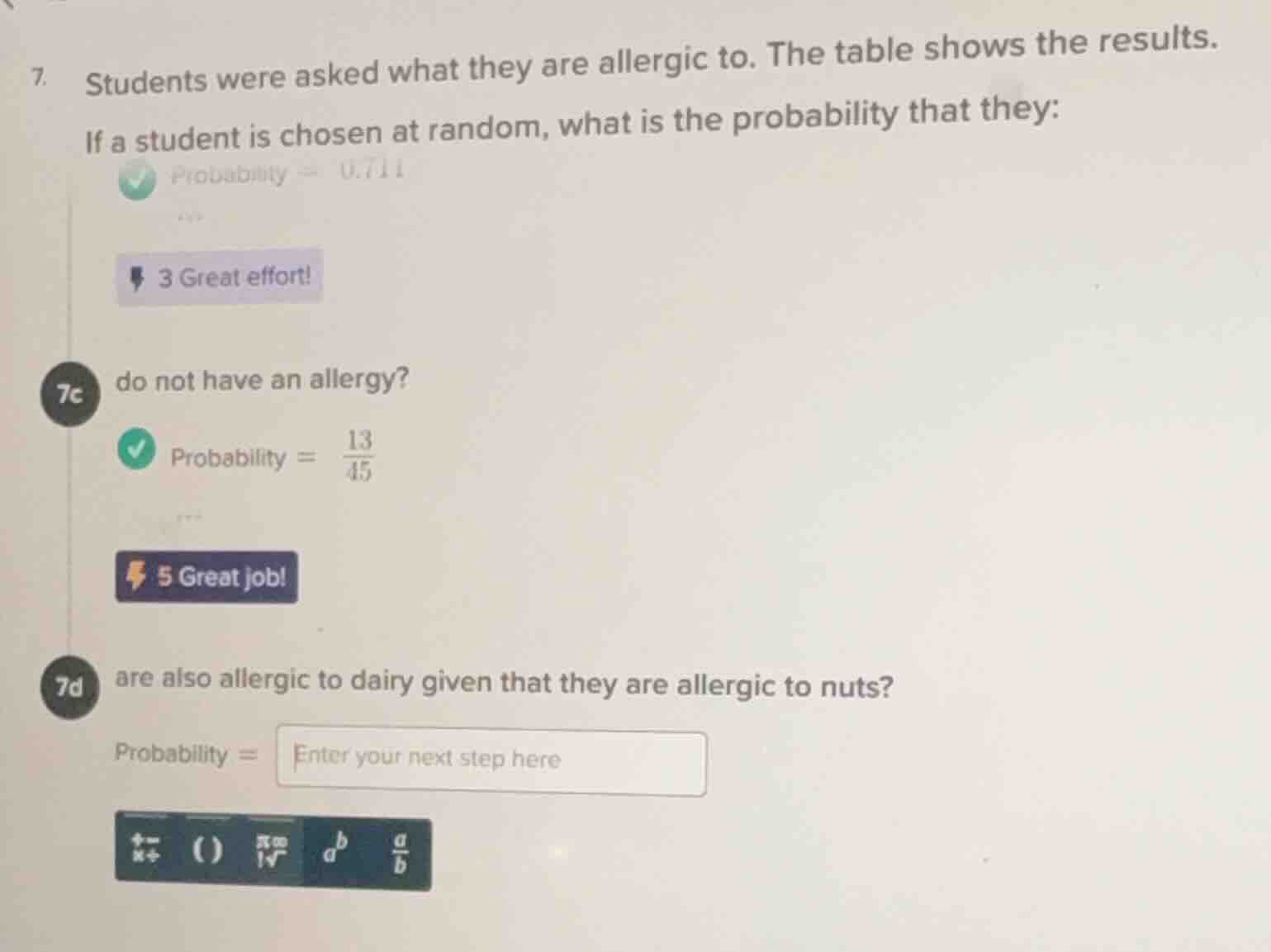
- students were asked what they are allergic to. the table shows the results.
if a student is chosen at random, what is the probability that they:
7c do not have an allergy?
probability = \\(\frac{13}{45}\\)
7d are also allergic to dairy given that they are allergic to nuts?
probability = enter your next step here
To solve part 7d, we use conditional probability. Let's assume the table (not fully shown) has data on students' allergies. Let \( A \) be the event that a student is allergic to nuts, and \( B \) be the event that a student is allergic to dairy. The formula for conditional probability is \( P(B|A) = \frac{P(A \cap B)}{P(A)} \), which is equivalent to \( \frac{\text{Number of students allergic to both nuts and dairy}}{\text{Number of students allergic to nuts}} \).
Step 1: Identify the counts (assuming typical table data for such problems)
Suppose from the table:
- Number of students allergic to nuts: Let's say this is \( n(A) \). For example, if the table shows 15 students allergic to nuts.
- Number of students allergic to both nuts and dairy: Let's say this is \( n(A \cap B) \). For example, if 5 students are allergic to both.
Step 2: Apply the conditional probability formula
Using the formula \( P(\text{dairy} | \text{nuts}) = \frac{\text{Number of students with both allergies}}{\text{Number of students with nut allergy}} \).
For example, if \( n(A \cap B) = 5 \) and \( n(A) = 15 \), then:
\[
P(\text{dairy} | \text{nuts}) = \frac{5}{15} = \frac{1}{3}
\]
(Note: The actual numbers depend on the table. Since the table isn't fully visible, we use a common example. If the table had, say, 12 students allergic to nuts and 4 allergic to both, it would be \( \frac{4}{12} = \frac{1}{3} \), etc. The key is to use the counts from the table for students with both allergies and those with nut allergies.)
Assuming the table has, for instance, 12 students allergic to nuts and 4 allergic to both:
Step 1: Determine the counts
Let \( n(\text{nuts}) = 12 \) (number of students allergic to nuts) and \( n(\text{nuts and dairy}) = 4 \) (number of students allergic to both nuts and dairy).
Step 2: Calculate the conditional probability
\[
P(\text{dairy} | \text{nuts}) = \frac{n(\text{nuts and dairy})}{n(\text{nuts})} = \frac{4}{12} = \frac{1}{3}
\]

Snap & solve any problem in the app
Get step-by-step solutions on Sovi AI
Photo-based solutions with guided steps
Explore more problems and detailed explanations
\(\frac{1}{3}\) (or the fraction based on the actual table data, e.g., if the table has 9 nut-allergic and 3 both, it would be \(\frac{3}{9} = \frac{1}{3}\); adjust based on the table's numbers)