QUESTION IMAGE
Question
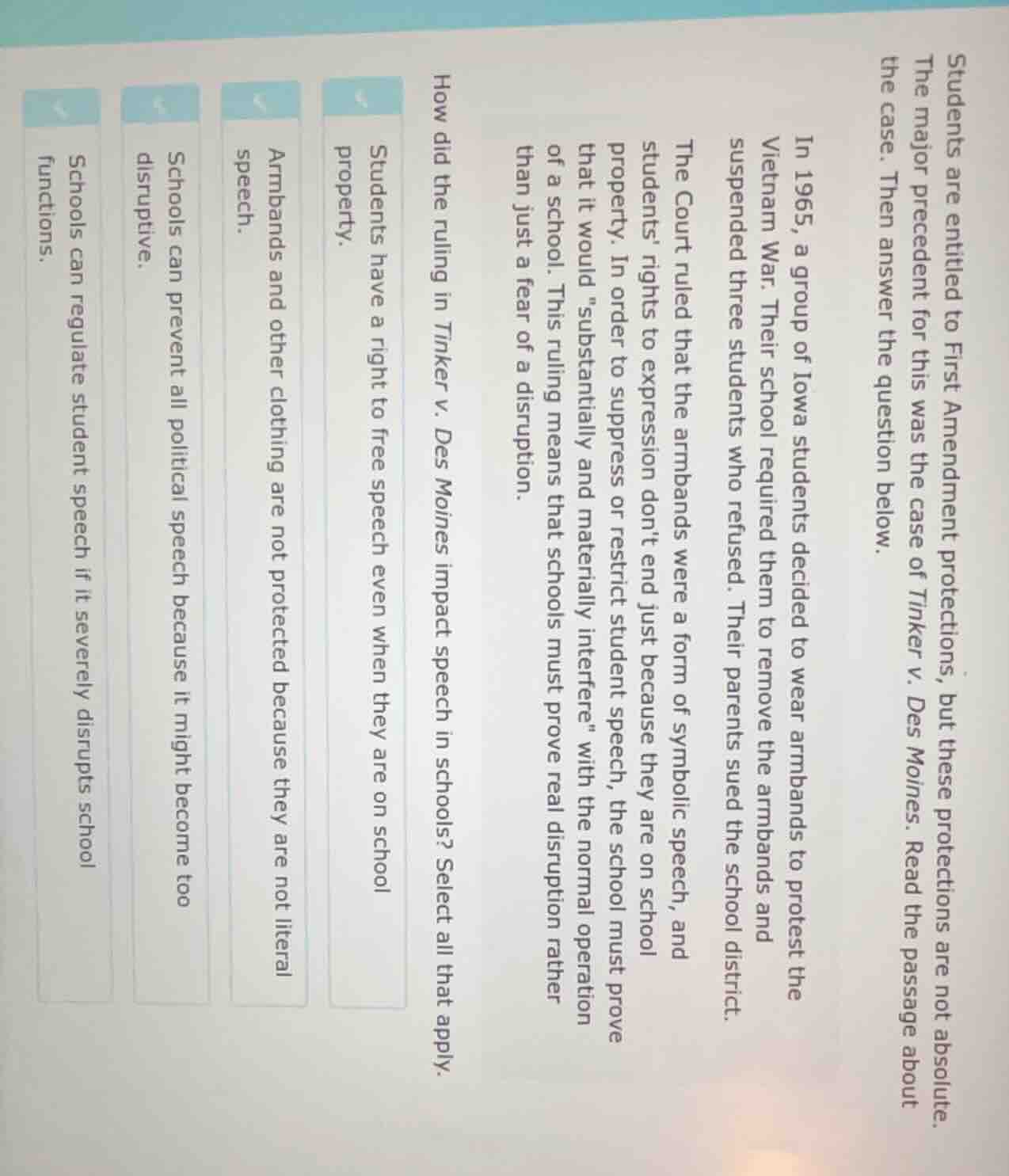
students are entitled to first amendment protections, but these protections are not absolute. the major precedent for this was the case of tinker v. des moines. read the passage about the case. then answer the question below. in 1965, a group of iowa students decided to wear armbands to protest the vietnam war. their school required them to remove the armbands and suspended three students who refused. their parents sued the school district. the court ruled that the armbands were a form of symbolic speech, and students rights to expression dont end just because they are on school property. in order to suppress or restrict student speech, the school must prove that it would \substantially and materially interfere\ with the normal operation of a school. this ruling means that schools must prove real disruption rather than just a fear of a disruption. how did the ruling in tinker v. des moines impact speech in schools? select all that apply. students have a right to free speech even when they are on school property. armbands and other clothing are not protected because they are not literal speech. schools can prevent all political speech because it might become too disruptive. schools can regulate student speech if it severely disrupts school functions.
- Analyze the first option: The Tinker ruling states students' free speech rights on school property are protected unless there's substantial disruption, so students do have free speech rights on school property (with the disruption condition), so this option is incorrect as it implies a right without considering the disruption condition? Wait, no—wait, the passage says "students' rights to expression don't end just because they are on school property"—so the first option "Students have a right to free speech even when they are on school property" aligns with that, but wait, no, the ruling says schools can restrict if it's substantially disruptive. Wait, no, the key is: the ruling says that students' rights don't end on school property, but schools can restrict if it's "substantially and materially interfere"—so the first option: "Students have a right to free speech even when they are on school property"—is that correct? Wait, the passage says "The Court ruled that the armbands were a form of symbolic speech, and students’ rights to expression don’t end just because they are on school property." So that means students do have free speech rights on school property (though schools can restrict if disruptive). So the first option is correct? Wait, no, the question is about the impact of the ruling. Wait, the options are about the impact. Let's re-examine the options:
Option 1: "Students have a right to free speech even when they are on school property." The ruling established that students' free speech rights don't end at school property, so this is a correct impact.
Option 2: "Armbands and other clothing are not protected because they are not literal speech." The ruling said armbands were symbolic speech (protected), so this is incorrect.
Option 3: "Schools can prevent all political speech because it might become too disruptive." The ruling says schools can only restrict if it's substantially disruptive, not "all" political speech. So this is incorrect.
Option 4: "Schools can regulate student speech if it severely disrupts school functions." The passage says "the school must prove that it would 'substantially and materially interfere' with the normal operation of a school"—so "severely disrupts" aligns with "substantially and materially interfere", so this option is correct.
Wait, but the first option: "Students have a right to free speech even when they are on school property"—the ruling's impact is that it established students have free speech rights on school property (with the disruption exception). So that's a correct impact. And the fourth option: "Schools can regulate student speech if it severely disrupts school functions"—since the ruling says schools can restrict if it's substantially disruptive, this is also correct? Wait, but let's check the passage again. The passage says: "In order to suppress or restrict student speech, the school must prove that it would 'substantially and materially interfere' with the normal operation of a school." So schools can regulate (restrict) speech if it severely disrupts (substantially and materially interfere) with school functions. So the fourth option is correct.
Wait, but the first option: "Students have a right to free speech even when they are on school property"—the ruling's impact is that it clarified students have free speech rights on school property (though schools can restrict if disruptive). So this is a correct impact. But wait, the options—let's check each:
- Students have a right to free speech even when they are on school property. The ruling said "students’ rights…

Snap & solve any problem in the app
Get step-by-step solutions on Sovi AI
Photo-based solutions with guided steps
Explore more problems and detailed explanations
- Students have a right to free speech even when they are on school property.
- Schools can regulate student speech if it severely disrupts school functions.