QUESTION IMAGE
Question
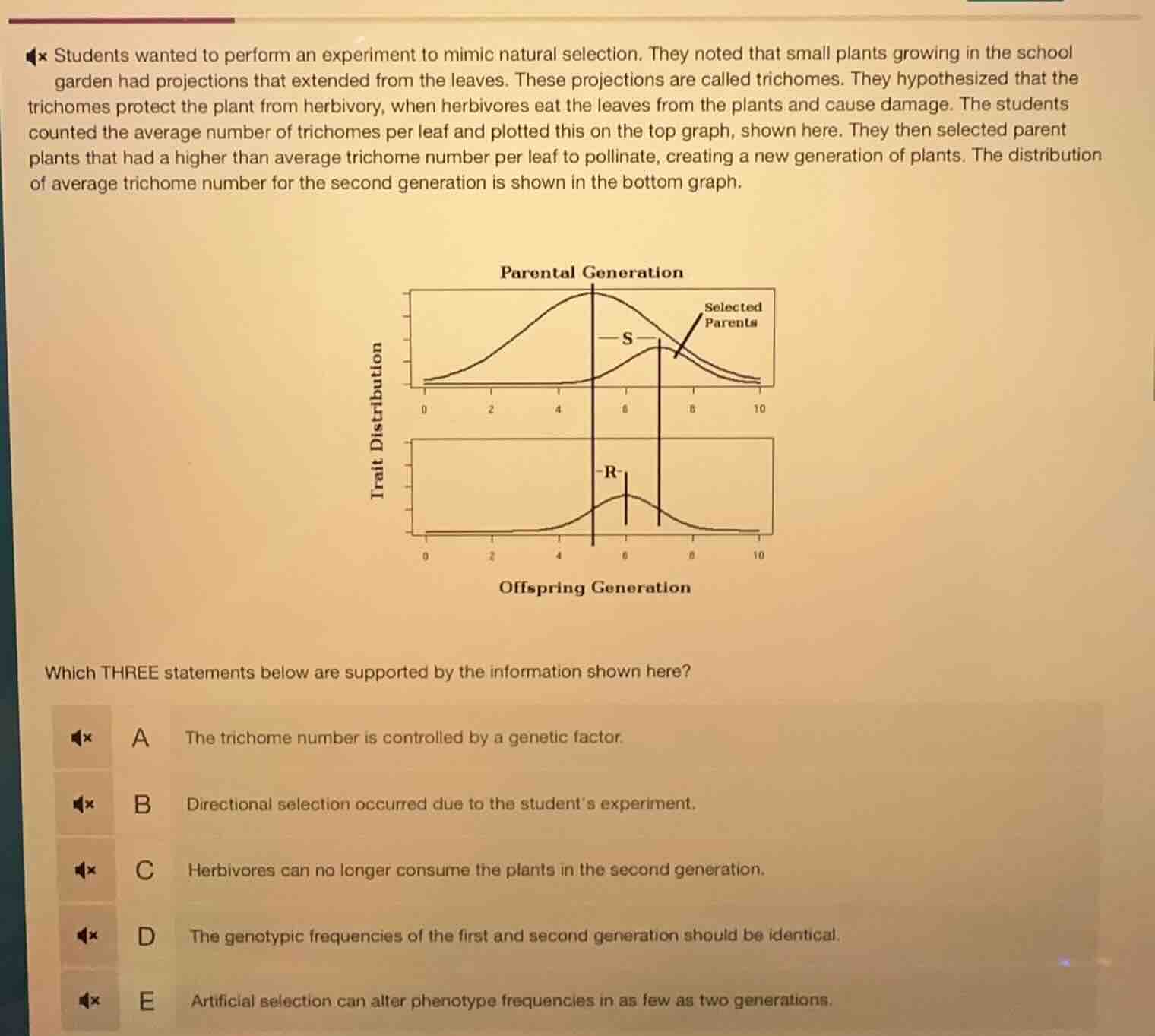
students wanted to perform an experiment to mimic natural selection. they noted that small plants growing in the school garden had projections that extended from the leaves. these projections are called trichomes. they hypothesized that the trichomes protect the plant from herbivory, when herbivores eat the leaves from the plants and cause damage. the students counted the average number of trichomes per leaf and plotted this on the top graph, shown here. they then selected parent plants that had a higher than average trichome number per leaf to pollinate, creating a new generation of plants. the distribution of average trichome number for the second generation is shown in the bottom graph. charts: parental generation and offspring generation trait distribution graphs which three statements below are supported by the information shown here? a the trichome number is controlled by a genetic factor. b directional selection occurred due to the student’s experiment. c herbivores can no longer consume the plants in the second generation. d the genotypic frequencies of the first and second generation should be identical. e artificial selection can alter phenotype frequencies in as few as two generations.
- Option A: Since the offspring of selected parents (with higher trichome numbers) have a shifted distribution, trichome number is heritable (genetic factor controls it).
- Option B: The selection of parents with higher trichome numbers led to a shift in the offspring's trait distribution towards higher trichome numbers, which is directional selection.
- Option C: The experiment shows trichomes may reduce herbivory, but it doesn't mean herbivores can't consume the second - generation plants at all. So this is incorrect.
- Option D: The selection process changed the trait distribution, so genotypic frequencies (related to trait inheritance) of the two generations won't be identical. This is incorrect.
- Option E: The students' artificial selection (selecting parents) led to a change in the phenotype (trichome number) distribution in just two generations (parental and offspring), so this is supported.

Snap & solve any problem in the app
Get step-by-step solutions on Sovi AI
Photo-based solutions with guided steps
Explore more problems and detailed explanations
A. The trichome number is controlled by a genetic factor, B. Directional selection occurred due to the student’s experiment, E. Artificial selection can alter phenotype frequencies in as few as two generations.